

Triacetin was chosen for convenience as the starting material, because it is less
viscous than glycerol and because the reaction is carried out in a water/acetic acid
mixture which would anyway lead to the formation of a mixture of mono-, di-, and
triacetoxyesters of glycerol. The main products of the reaction were butyric acid and
isobutyric acid followed by isopropyl iodide and isopropyl acetate (Scheme 6). HI
was found to be superior to methyl iodide as a cocatalyst. Additionally, the authors
examined the effect of an increasing CO pressure which resulted in an increase of
butyric acid while simultaneously the amount of isobutyric acid decreased.
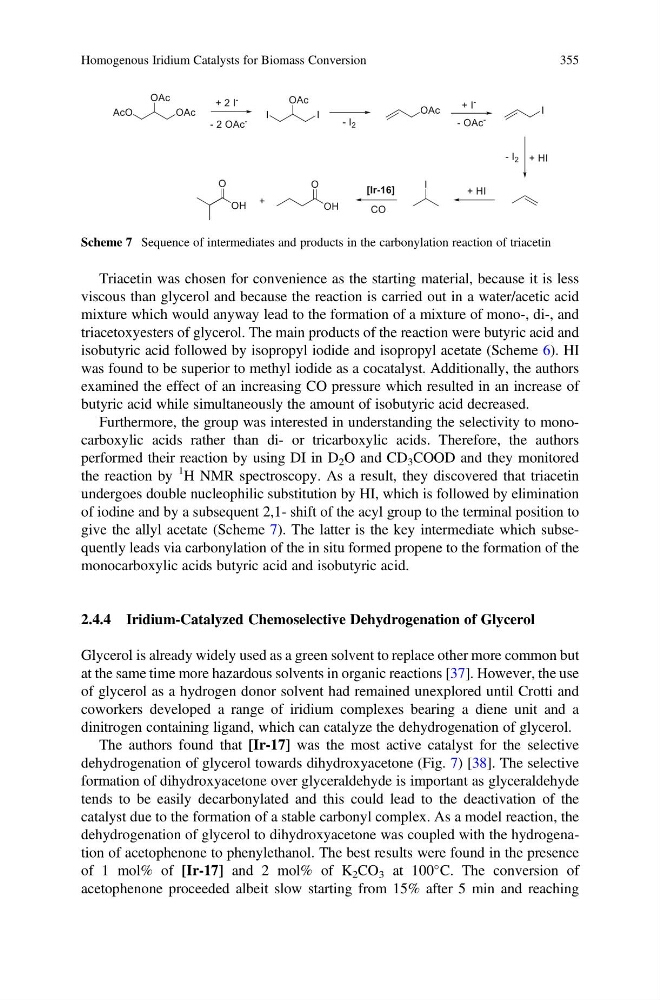
Furthermore, the group was interested in understanding the selectivity to monocarboxylic acids rather than di- or tricarboxylic acids. Therefore, the authors
performed their reaction by using DI in D 2 O and CD 3 COOD and they monitored
the reaction by
1 H NMR spectroscopy. As a result, they discovered that triacetin
undergoes double nucleophilic substitution by HI, which is followed by elimination
of iodine and by a subsequent 2,1- shift of the acyl group to the terminal position to
give the allyl acetate (Scheme 7). The latter is the key intermediate which subsequently leads via carbonylation of the in situ formed propene to the formation of the
monocarboxylic acids butyric acid and isobutyric acid.
2.4.4 Iridium-Catalyzed Chemoselective Dehydrogenation of Glycerol
Glycerol is already widely used as a green solvent to replace other more common but
at the same time more hazardous solvents in organic reactions [37]. However, the use
of glycerol as a hydrogen donor solvent had remained unexplored until Crotti and
coworkers developed a range of iridium complexes bearing a diene unit and a
dinitrogen containing ligand, which can catalyze the dehydrogenation of glycerol.
The authors found that [Ir-17] was the most active catalyst for the selective
dehydrogenation of glycerol towards dihydroxyacetone (Fig. 7) [38]. The selective
formation of dihydroxyacetone over glyceraldehyde is important as glyceraldehyde
tends to be easily decarbonylated and this could lead to the deactivation of the
catalyst due to the formation of a stable carbonyl complex. As a model reaction, the
dehydrogenation of glycerol to dihydroxyacetone was coupled with the hydrogenation of acetophenone to phenylethanol. The best results were found in the presence
of 1 mol% of [Ir-17] and 2 mol% of K 2 CO 3 at 100
C. The conversion of
acetophenone proceeded albeit slow starting from 15% after 5 min and reaching
Scheme 7 Sequence of intermediates and products in the carbonylation reaction of triacetin
Homogenous Iridium Catalysts for Biomass Conversion
355
viscous than glycerol and because the reaction is carried out in a water/acetic acid
mixture which would anyway lead to the formation of a mixture of mono-, di-, and
triacetoxyesters of glycerol. The main products of the reaction were butyric acid and
isobutyric acid followed by isopropyl iodide and isopropyl acetate (Scheme 6). HI
was found to be superior to methyl iodide as a cocatalyst. Additionally, the authors
examined the effect of an increasing CO pressure which resulted in an increase of
butyric acid while simultaneously the amount of isobutyric acid decreased.
Furthermore, the group was interested in understanding the selectivity to monocarboxylic acids rather than di- or tricarboxylic acids. Therefore, the authors
performed their reaction by using DI in D 2 O and CD 3 COOD and they monitored
the reaction by
1 H NMR spectroscopy. As a result, they discovered that triacetin
undergoes double nucleophilic substitution by HI, which is followed by elimination
of iodine and by a subsequent 2,1- shift of the acyl group to the terminal position to
give the allyl acetate (Scheme 7). The latter is the key intermediate which subsequently leads via carbonylation of the in situ formed propene to the formation of the
monocarboxylic acids butyric acid and isobutyric acid.
2.4.4 Iridium-Catalyzed Chemoselective Dehydrogenation of Glycerol
Glycerol is already widely used as a green solvent to replace other more common but
at the same time more hazardous solvents in organic reactions [37]. However, the use
of glycerol as a hydrogen donor solvent had remained unexplored until Crotti and
coworkers developed a range of iridium complexes bearing a diene unit and a
dinitrogen containing ligand, which can catalyze the dehydrogenation of glycerol.
The authors found that [Ir-17] was the most active catalyst for the selective
dehydrogenation of glycerol towards dihydroxyacetone (Fig. 7) [38]. The selective
formation of dihydroxyacetone over glyceraldehyde is important as glyceraldehyde
tends to be easily decarbonylated and this could lead to the deactivation of the
catalyst due to the formation of a stable carbonyl complex. As a model reaction, the
dehydrogenation of glycerol to dihydroxyacetone was coupled with the hydrogenation of acetophenone to phenylethanol. The best results were found in the presence
of 1 mol% of [Ir-17] and 2 mol% of K 2 CO 3 at 100
C. The conversion of
acetophenone proceeded albeit slow starting from 15% after 5 min and reaching
Scheme 7 Sequence of intermediates and products in the carbonylation reaction of triacetin
Homogenous Iridium Catalysts for Biomass Conversion
355