

sulfuric acid from 0.25% to 4% (w.r.t. glycerol), the conversion of glycerol increased
from 8 to 38% over 24 h at 200
C. However, the increase of the acid concentration
was also accompanied by a decrease in selectivity towards 1,3-PD in favor of
1-propanol (1-PO).
The iridium catalyst was also tested for the direct conversion of crude glycerol
generated as a by-product of the biodiesel manufacturing process. Since this material
is highly basic, the crude glycerol was acidified with 1 M sulfuric acid prior to
reaction. The resulting biphasic system was allowed to settle, the layer of impurities
was discarded, and the remaining mixture was used for the reaction. The recycled
waste glycerol was deoxygenated in 20% yield after 24 h at 200
C under 80 bar H 2
by using 0.125 mol% of [Ir-15] with a high selectivity towards 1-propanol (1-PO:
1,3-PD ¼ 9: 1). The observed selectivity was explained by the high acid concentration which remained after the purification of crude glycerol.
2.4.3 Iridium-Catalyzed Carbonylation of Glycerol
to Monocarboxylic Acids
A very common deoxygenation approach is the so-called hydro-deoxygenation
reaction, in which hydrogen is used as a co-reagent and water is formed as a
by-product. In a similar way, CO can be used as a co-reagent instead of hydrogen
in a reaction called carbodeoxygenation. Generally, carbonylation reactions are wellestablished in industry like the production of acetic acid from methanol. However,
notwithstanding the progress which has been made in the last decades, the carbonylation of higher alcohols like glycerol using iridium catalysts remains elusive. The
latter can be explained by the fact that iridium-based carbonylation catalysts rapidly
deactivate due to the formation of [IrI 4 (CO) 2 ]
À in the presence of HI as a cocatalyst.
As a consequence, a promoter is needed to reversibly bind the iodide and thus to
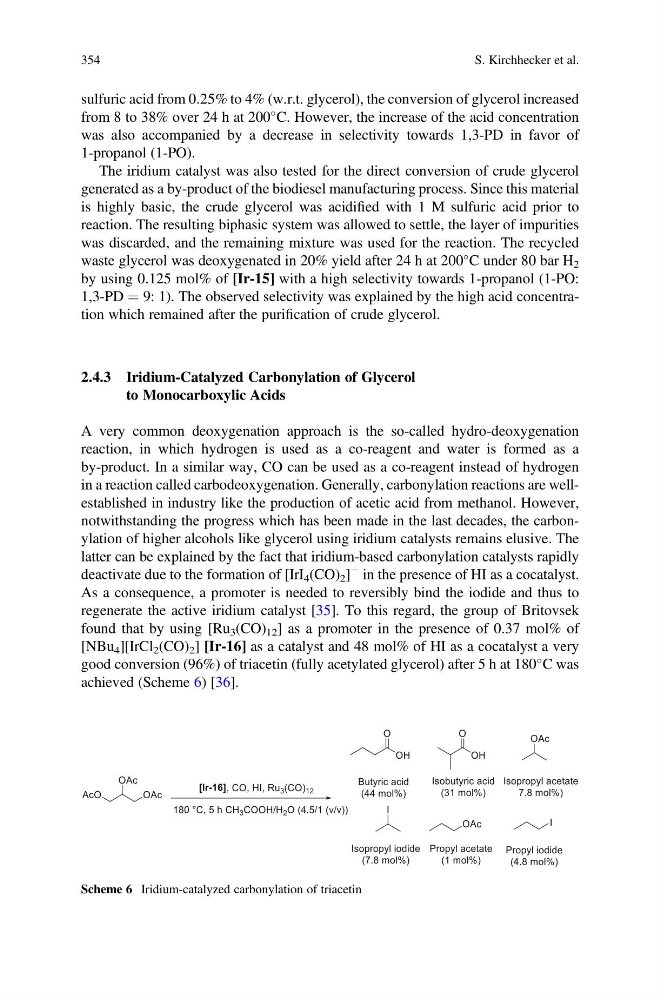
regenerate the active iridium catalyst [35]. To this regard, the group of Britovsek
found that by using [Ru 3 (CO) 12 ] as a promoter in the presence of 0.37 mol% of
[NBu 4 ][IrCl 2 (CO) 2 ] [Ir-16] as a catalyst and 48 mol% of HI as a cocatalyst a very
good conversion (96%) of triacetin (fully acetylated glycerol) after 5 h at 180
C was
achieved (Scheme 6) [36].
Scheme 6 Iridium-catalyzed carbonylation of triacetin
354
S. Kirchhecker et al.
from 8 to 38% over 24 h at 200
C. However, the increase of the acid concentration
was also accompanied by a decrease in selectivity towards 1,3-PD in favor of
1-propanol (1-PO).
The iridium catalyst was also tested for the direct conversion of crude glycerol
generated as a by-product of the biodiesel manufacturing process. Since this material
is highly basic, the crude glycerol was acidified with 1 M sulfuric acid prior to
reaction. The resulting biphasic system was allowed to settle, the layer of impurities
was discarded, and the remaining mixture was used for the reaction. The recycled
waste glycerol was deoxygenated in 20% yield after 24 h at 200
C under 80 bar H 2
by using 0.125 mol% of [Ir-15] with a high selectivity towards 1-propanol (1-PO:
1,3-PD ¼ 9: 1). The observed selectivity was explained by the high acid concentration which remained after the purification of crude glycerol.
2.4.3 Iridium-Catalyzed Carbonylation of Glycerol
to Monocarboxylic Acids
A very common deoxygenation approach is the so-called hydro-deoxygenation
reaction, in which hydrogen is used as a co-reagent and water is formed as a
by-product. In a similar way, CO can be used as a co-reagent instead of hydrogen
in a reaction called carbodeoxygenation. Generally, carbonylation reactions are wellestablished in industry like the production of acetic acid from methanol. However,
notwithstanding the progress which has been made in the last decades, the carbonylation of higher alcohols like glycerol using iridium catalysts remains elusive. The
latter can be explained by the fact that iridium-based carbonylation catalysts rapidly
deactivate due to the formation of [IrI 4 (CO) 2 ]
À in the presence of HI as a cocatalyst.
As a consequence, a promoter is needed to reversibly bind the iodide and thus to
regenerate the active iridium catalyst [35]. To this regard, the group of Britovsek
found that by using [Ru 3 (CO) 12 ] as a promoter in the presence of 0.37 mol% of
[NBu 4 ][IrCl 2 (CO) 2 ] [Ir-16] as a catalyst and 48 mol% of HI as a cocatalyst a very
good conversion (96%) of triacetin (fully acetylated glycerol) after 5 h at 180
C was
achieved (Scheme 6) [36].
Scheme 6 Iridium-catalyzed carbonylation of triacetin
354
S. Kirchhecker et al.