

2.4.2 Iridium-Catalyzed Deoxygenation of Glycerol
Glycerol is like many other bio-derived chemicals, an oxygen-rich molecule and for
this reason deoxygenation/dehydration reactions need to be performed to obtain
molecules with low oxygen content. A glycerol derivative of potential interest is, for
example, 1,3-propanediol (1,3-PD), a diol commonly used for the synthesis of
polymers. The conversion of glycerol to 1,3-PD can be described as a tandem
reaction consisting of an initial acid-catalyzed dehydration step followed by a
metal catalyzed hydrogenation reaction. For the selective deoxygenation of glycerol
mainly heterogenous catalysts are known, also because aqueous acidic conditions
and high temperatures are very challenging conditions for many catalytic systems
based on well-defined metal complexes. Nevertheless, the groups of Heinekey and
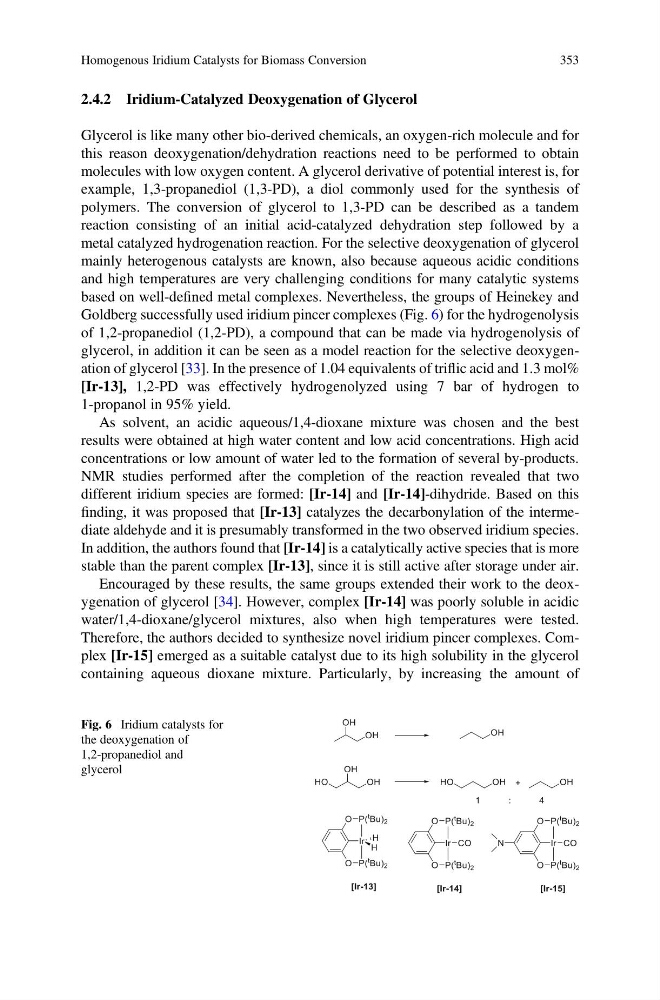
Goldberg successfully used iridium pincer complexes (Fig. 6) for the hydrogenolysis
of 1,2-propanediol (1,2-PD), a compound that can be made via hydrogenolysis of
glycerol, in addition it can be seen as a model reaction for the selective deoxygenation of glycerol [33]. In the presence of 1.04 equivalents of triflic acid and 1.3 mol%
[Ir-13], 1,2-PD was effectively hydrogenolyzed using 7 bar of hydrogen to
1-propanol in 95% yield.
As solvent, an acidic aqueous/1,4-dioxane mixture was chosen and the best
results were obtained at high water content and low acid concentrations. High acid
concentrations or low amount of water led to the formation of several by-products.
NMR studies performed after the completion of the reaction revealed that two
different iridium species are formed: [Ir-14] and [Ir-14]-dihydride. Based on this
finding, it was proposed that [Ir-13] catalyzes the decarbonylation of the intermediate aldehyde and it is presumably transformed in the two observed iridium species.
In addition, the authors found that [Ir-14] is a catalytically active species that is more
stable than the parent complex [Ir-13], since it is still active after storage under air.
Encouraged by these results, the same groups extended their work to the deoxygenation of glycerol [34]. However, complex [Ir-14] was poorly soluble in acidic
water/1,4-dioxane/glycerol mixtures, also when high temperatures were tested.
Therefore, the authors decided to synthesize novel iridium pincer complexes. Complex [Ir-15] emerged as a suitable catalyst due to its high solubility in the glycerol
containing aqueous dioxane mixture. Particularly, by increasing the amount of
Fig. 6 Iridium catalysts for
the deoxygenation of
1,2-propanediol and
glycerol
Homogenous Iridium Catalysts for Biomass Conversion
353
Glycerol is like many other bio-derived chemicals, an oxygen-rich molecule and for
this reason deoxygenation/dehydration reactions need to be performed to obtain
molecules with low oxygen content. A glycerol derivative of potential interest is, for
example, 1,3-propanediol (1,3-PD), a diol commonly used for the synthesis of
polymers. The conversion of glycerol to 1,3-PD can be described as a tandem
reaction consisting of an initial acid-catalyzed dehydration step followed by a
metal catalyzed hydrogenation reaction. For the selective deoxygenation of glycerol
mainly heterogenous catalysts are known, also because aqueous acidic conditions
and high temperatures are very challenging conditions for many catalytic systems
based on well-defined metal complexes. Nevertheless, the groups of Heinekey and
Goldberg successfully used iridium pincer complexes (Fig. 6) for the hydrogenolysis
of 1,2-propanediol (1,2-PD), a compound that can be made via hydrogenolysis of
glycerol, in addition it can be seen as a model reaction for the selective deoxygenation of glycerol [33]. In the presence of 1.04 equivalents of triflic acid and 1.3 mol%
[Ir-13], 1,2-PD was effectively hydrogenolyzed using 7 bar of hydrogen to
1-propanol in 95% yield.
As solvent, an acidic aqueous/1,4-dioxane mixture was chosen and the best
results were obtained at high water content and low acid concentrations. High acid
concentrations or low amount of water led to the formation of several by-products.
NMR studies performed after the completion of the reaction revealed that two
different iridium species are formed: [Ir-14] and [Ir-14]-dihydride. Based on this
finding, it was proposed that [Ir-13] catalyzes the decarbonylation of the intermediate aldehyde and it is presumably transformed in the two observed iridium species.
In addition, the authors found that [Ir-14] is a catalytically active species that is more
stable than the parent complex [Ir-13], since it is still active after storage under air.
Encouraged by these results, the same groups extended their work to the deoxygenation of glycerol [34]. However, complex [Ir-14] was poorly soluble in acidic
water/1,4-dioxane/glycerol mixtures, also when high temperatures were tested.
Therefore, the authors decided to synthesize novel iridium pincer complexes. Complex [Ir-15] emerged as a suitable catalyst due to its high solubility in the glycerol
containing aqueous dioxane mixture. Particularly, by increasing the amount of
Fig. 6 Iridium catalysts for
the deoxygenation of
1,2-propanediol and
glycerol
Homogenous Iridium Catalysts for Biomass Conversion
353