

conditions. Tu and coworkers developed a polymeric iridium catalyst ([Ir-8], Fig. 4)
which allowed the catalyst’s recyclability [30]. A maximum turnover number of
124,000 was measured with this catalyst. The extraordinary performance of [Ir-9]
was explained by the authors as a result of the high stability provided by the
bidentate (pyridyl)carbene ligand [29]. In essence, the bidentate coordination
mode reduces the probability of ligand scrambling processes which are the major
cause of loss of catalytic activity [27]. Subsequently, the group of VoutchkovaKostal reported other Ir(I)/Ir(III) complexes bearing NHC ligands with attached
sulfonate groups [31]. The most active catalyst [Ir-10] reached a TOF of
45,592 h
À1 under microwave irradiation at 150
C and of 3,477 h
À1 when the
reaction was conventionally heated at 150
C.
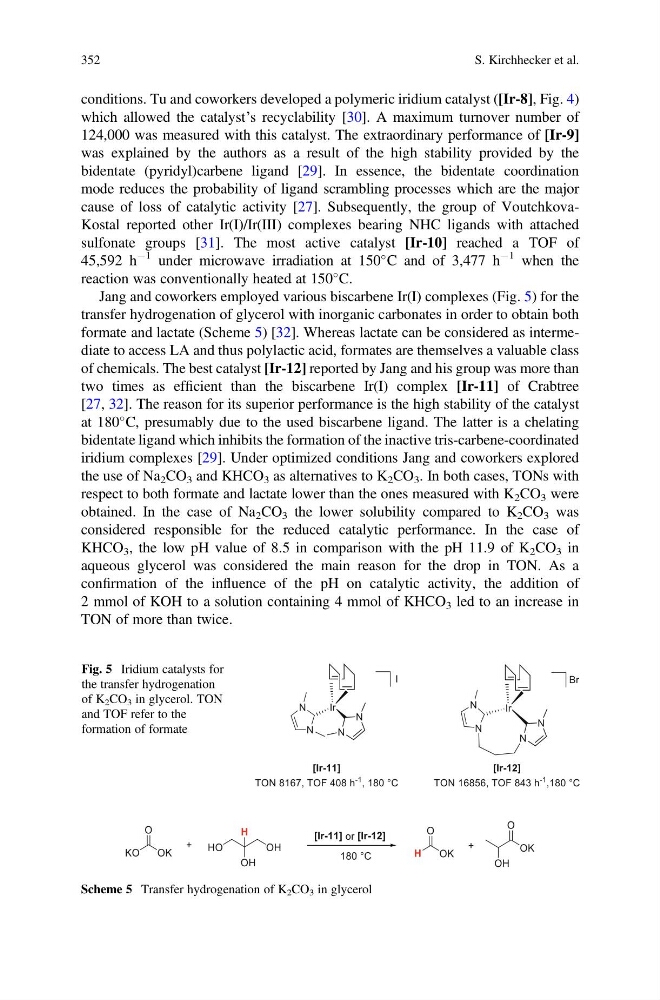
Jang and coworkers employed various biscarbene Ir(I) complexes (Fig. 5) for the
transfer hydrogenation of glycerol with inorganic carbonates in order to obtain both
formate and lactate (Scheme 5) [32]. Whereas lactate can be considered as intermediate to access LA and thus polylactic acid, formates are themselves a valuable class
of chemicals. The best catalyst [Ir-12] reported by Jang and his group was more than
two times as efficient than the biscarbene Ir(I) complex [Ir-11] of Crabtree
[27, 32]. The reason for its superior performance is the high stability of the catalyst
at 180
C, presumably due to the used biscarbene ligand. The latter is a chelating
bidentate ligand which inhibits the formation of the inactive tris-carbene-coordinated
iridium complexes [29]. Under optimized conditions Jang and coworkers explored
the use of Na 2 CO 3 and KHCO 3 as alternatives to K 2 CO 3 . In both cases, TONs with
respect to both formate and lactate lower than the ones measured with K 2 CO 3 were
obtained. In the case of Na 2 CO 3 the lower solubility compared to K 2 CO 3 was
considered responsible for the reduced catalytic performance. In the case of
KHCO 3 , the low pH value of 8.5 in comparison with the pH 11.9 of K 2 CO 3 in
aqueous glycerol was considered the main reason for the drop in TON. As a
confirmation of the influence of the pH on catalytic activity, the addition of
2 mmol of KOH to a solution containing 4 mmol of KHCO 3 led to an increase in
TON of more than twice.
Fig. 5 Iridium catalysts for
the transfer hydrogenation
of K 2 CO 3 in glycerol. TON
and TOF refer to the
formation of formate
Scheme 5 Transfer hydrogenation of K 2 CO 3 in glycerol
352
S. Kirchhecker et al.
which allowed the catalyst’s recyclability [30]. A maximum turnover number of
124,000 was measured with this catalyst. The extraordinary performance of [Ir-9]
was explained by the authors as a result of the high stability provided by the
bidentate (pyridyl)carbene ligand [29]. In essence, the bidentate coordination
mode reduces the probability of ligand scrambling processes which are the major
cause of loss of catalytic activity [27]. Subsequently, the group of VoutchkovaKostal reported other Ir(I)/Ir(III) complexes bearing NHC ligands with attached
sulfonate groups [31]. The most active catalyst [Ir-10] reached a TOF of
45,592 h
À1 under microwave irradiation at 150
C and of 3,477 h
À1 when the
reaction was conventionally heated at 150
C.
Jang and coworkers employed various biscarbene Ir(I) complexes (Fig. 5) for the
transfer hydrogenation of glycerol with inorganic carbonates in order to obtain both
formate and lactate (Scheme 5) [32]. Whereas lactate can be considered as intermediate to access LA and thus polylactic acid, formates are themselves a valuable class
of chemicals. The best catalyst [Ir-12] reported by Jang and his group was more than
two times as efficient than the biscarbene Ir(I) complex [Ir-11] of Crabtree
[27, 32]. The reason for its superior performance is the high stability of the catalyst
at 180
C, presumably due to the used biscarbene ligand. The latter is a chelating
bidentate ligand which inhibits the formation of the inactive tris-carbene-coordinated
iridium complexes [29]. Under optimized conditions Jang and coworkers explored
the use of Na 2 CO 3 and KHCO 3 as alternatives to K 2 CO 3 . In both cases, TONs with
respect to both formate and lactate lower than the ones measured with K 2 CO 3 were
obtained. In the case of Na 2 CO 3 the lower solubility compared to K 2 CO 3 was
considered responsible for the reduced catalytic performance. In the case of
KHCO 3 , the low pH value of 8.5 in comparison with the pH 11.9 of K 2 CO 3 in
aqueous glycerol was considered the main reason for the drop in TON. As a
confirmation of the influence of the pH on catalytic activity, the addition of
2 mmol of KOH to a solution containing 4 mmol of KHCO 3 led to an increase in
TON of more than twice.
Fig. 5 Iridium catalysts for
the transfer hydrogenation
of K 2 CO 3 in glycerol. TON
and TOF refer to the
formation of formate
Scheme 5 Transfer hydrogenation of K 2 CO 3 in glycerol
352
S. Kirchhecker et al.