

2.4 Iridium-Catalyzed Conversion of Glycerol
2.4.1 Iridium-Catalyzed Oxidative Conversion of Glycerol
The by-product of the production of biodiesel from fats is glycerol. Thus, glycerol is
readily available from biomass, and its use has received a lot of attention, not only
with the aim of improving the entire value-chain of biomass transformation, but also
as a consequence of the variety of reactions which can be done with this polyol. As
mentioned before in Sect. 2.1.1, LA and its derivatives have numerous applications
and the demand for polylactide materials is increasing steadily. Currently, lactic acid
(LA) is produced via fermentation on a scale of 450,000 tons/year [26]. Nevertheless,
the use of a low-value waste product like glycerol as a feedstock material could offer,
when catalytically and economically feasible, another scalable and valuable alternative for the synthesis of lactic acid/lactate.
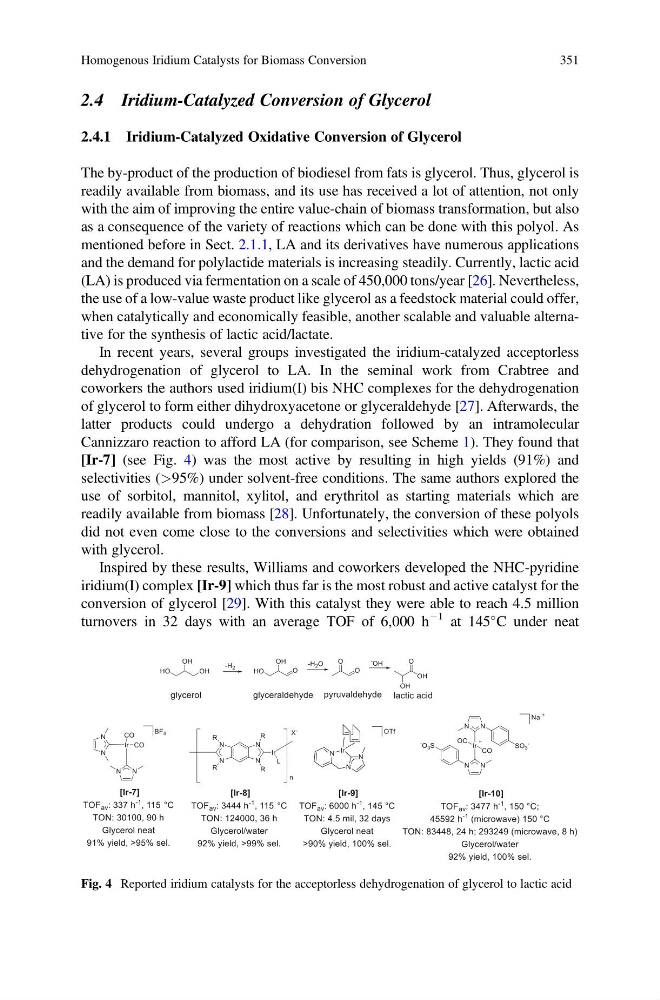
In recent years, several groups investigated the iridium-catalyzed acceptorless
dehydrogenation of glycerol to LA. In the seminal work from Crabtree and
coworkers the authors used iridium(I) bis NHC complexes for the dehydrogenation
of glycerol to form either dihydroxyacetone or glyceraldehyde [27]. Afterwards, the
latter products could undergo a dehydration followed by an intramolecular
Cannizzaro reaction to afford LA (for comparison, see Scheme 1). They found that
[Ir-7] (see Fig. 4) was the most active by resulting in high yields (91%) and
selectivities (>95%) under solvent-free conditions. The same authors explored the
use of sorbitol, mannitol, xylitol, and erythritol as starting materials which are
readily available from biomass [28]. Unfortunately, the conversion of these polyols
did not even come close to the conversions and selectivities which were obtained
with glycerol.
Inspired by these results, Williams and coworkers developed the NHC-pyridine
iridium(I) complex [Ir-9] which thus far is the most robust and active catalyst for the
conversion of glycerol [29]. With this catalyst they were able to reach 4.5 million
turnovers in 32 days with an average TOF of 6,000 h
À1 at 145
C under neat
Fig. 4 Reported iridium catalysts for the acceptorless dehydrogenation of glycerol to lactic acid
Homogenous Iridium Catalysts for Biomass Conversion
351
2.4.1 Iridium-Catalyzed Oxidative Conversion of Glycerol
The by-product of the production of biodiesel from fats is glycerol. Thus, glycerol is
readily available from biomass, and its use has received a lot of attention, not only
with the aim of improving the entire value-chain of biomass transformation, but also
as a consequence of the variety of reactions which can be done with this polyol. As
mentioned before in Sect. 2.1.1, LA and its derivatives have numerous applications
and the demand for polylactide materials is increasing steadily. Currently, lactic acid
(LA) is produced via fermentation on a scale of 450,000 tons/year [26]. Nevertheless,
the use of a low-value waste product like glycerol as a feedstock material could offer,
when catalytically and economically feasible, another scalable and valuable alternative for the synthesis of lactic acid/lactate.
In recent years, several groups investigated the iridium-catalyzed acceptorless
dehydrogenation of glycerol to LA. In the seminal work from Crabtree and
coworkers the authors used iridium(I) bis NHC complexes for the dehydrogenation
of glycerol to form either dihydroxyacetone or glyceraldehyde [27]. Afterwards, the
latter products could undergo a dehydration followed by an intramolecular
Cannizzaro reaction to afford LA (for comparison, see Scheme 1). They found that
[Ir-7] (see Fig. 4) was the most active by resulting in high yields (91%) and
selectivities (>95%) under solvent-free conditions. The same authors explored the
use of sorbitol, mannitol, xylitol, and erythritol as starting materials which are
readily available from biomass [28]. Unfortunately, the conversion of these polyols
did not even come close to the conversions and selectivities which were obtained
with glycerol.
Inspired by these results, Williams and coworkers developed the NHC-pyridine
iridium(I) complex [Ir-9] which thus far is the most robust and active catalyst for the
conversion of glycerol [29]. With this catalyst they were able to reach 4.5 million
turnovers in 32 days with an average TOF of 6,000 h
À1 at 145
C under neat
Fig. 4 Reported iridium catalysts for the acceptorless dehydrogenation of glycerol to lactic acid
Homogenous Iridium Catalysts for Biomass Conversion
351