

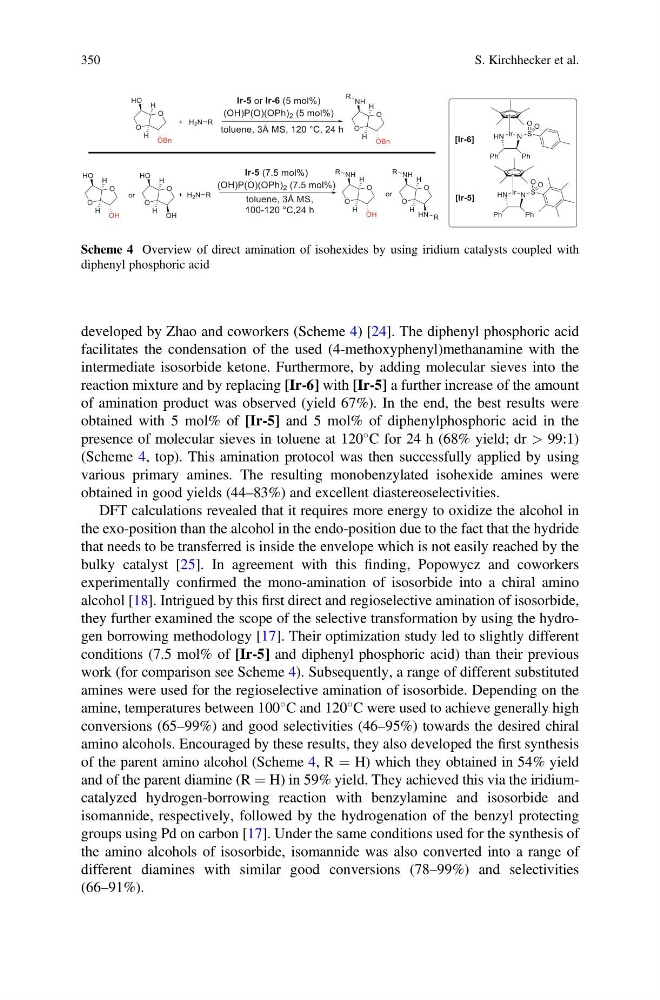
developed by Zhao and coworkers (Scheme 4) [24]. The diphenyl phosphoric acid
facilitates the condensation of the used (4-methoxyphenyl)methanamine with the
intermediate isosorbide ketone. Furthermore, by adding molecular sieves into the
reaction mixture and by replacing [Ir-6] with [Ir-5] a further increase of the amount
of amination product was observed (yield 67%). In the end, the best results were
obtained with 5 mol% of [Ir-5] and 5 mol% of diphenylphosphoric acid in the
presence of molecular sieves in toluene at 120
C for 24 h (68% yield; dr > 99:1)
(Scheme 4, top). This amination protocol was then successfully applied by using
various primary amines. The resulting monobenzylated isohexide amines were
obtained in good yields (44–83%) and excellent diastereoselectivities.
DFT calculations revealed that it requires more energy to oxidize the alcohol in
the exo-position than the alcohol in the endo-position due to the fact that the hydride
that needs to be transferred is inside the envelope which is not easily reached by the
bulky catalyst [25]. In agreement with this finding, Popowycz and coworkers
experimentally confirmed the mono-amination of isosorbide into a chiral amino
alcohol [18]. Intrigued by this first direct and regioselective amination of isosorbide,
they further examined the scope of the selective transformation by using the hydrogen borrowing methodology [17]. Their optimization study led to slightly different
conditions (7.5 mol% of [Ir-5] and diphenyl phosphoric acid) than their previous
work (for comparison see Scheme 4). Subsequently, a range of different substituted
amines were used for the regioselective amination of isosorbide. Depending on the
amine, temperatures between 100
C and 120
C were used to achieve generally high
conversions (65–99%) and good selectivities (46–95%) towards the desired chiral
amino alcohols. Encouraged by these results, they also developed the first synthesis
of the parent amino alcohol (Scheme 4, R ¼ H) which they obtained in 54% yield
and of the parent diamine (R ¼ H) in 59% yield. They achieved this via the iridiumcatalyzed hydrogen-borrowing reaction with benzylamine and isosorbide and
isomannide, respectively, followed by the hydrogenation of the benzyl protecting
groups using Pd on carbon [17]. Under the same conditions used for the synthesis of
the amino alcohols of isosorbide, isomannide was also converted into a range of
different diamines with similar good conversions (78–99%) and selectivities
(66–91%).
Scheme 4 Overview of direct amination of isohexides by using iridium catalysts coupled with
diphenyl phosphoric acid
350
S. Kirchhecker et al.
facilitates the condensation of the used (4-methoxyphenyl)methanamine with the
intermediate isosorbide ketone. Furthermore, by adding molecular sieves into the
reaction mixture and by replacing [Ir-6] with [Ir-5] a further increase of the amount
of amination product was observed (yield 67%). In the end, the best results were
obtained with 5 mol% of [Ir-5] and 5 mol% of diphenylphosphoric acid in the
presence of molecular sieves in toluene at 120
C for 24 h (68% yield; dr > 99:1)
(Scheme 4, top). This amination protocol was then successfully applied by using
various primary amines. The resulting monobenzylated isohexide amines were
obtained in good yields (44–83%) and excellent diastereoselectivities.
DFT calculations revealed that it requires more energy to oxidize the alcohol in
the exo-position than the alcohol in the endo-position due to the fact that the hydride
that needs to be transferred is inside the envelope which is not easily reached by the
bulky catalyst [25]. In agreement with this finding, Popowycz and coworkers
experimentally confirmed the mono-amination of isosorbide into a chiral amino
alcohol [18]. Intrigued by this first direct and regioselective amination of isosorbide,
they further examined the scope of the selective transformation by using the hydrogen borrowing methodology [17]. Their optimization study led to slightly different
conditions (7.5 mol% of [Ir-5] and diphenyl phosphoric acid) than their previous
work (for comparison see Scheme 4). Subsequently, a range of different substituted
amines were used for the regioselective amination of isosorbide. Depending on the
amine, temperatures between 100
C and 120
C were used to achieve generally high
conversions (65–99%) and good selectivities (46–95%) towards the desired chiral
amino alcohols. Encouraged by these results, they also developed the first synthesis
of the parent amino alcohol (Scheme 4, R ¼ H) which they obtained in 54% yield
and of the parent diamine (R ¼ H) in 59% yield. They achieved this via the iridiumcatalyzed hydrogen-borrowing reaction with benzylamine and isosorbide and
isomannide, respectively, followed by the hydrogenation of the benzyl protecting
groups using Pd on carbon [17]. Under the same conditions used for the synthesis of
the amino alcohols of isosorbide, isomannide was also converted into a range of
different diamines with similar good conversions (78–99%) and selectivities
(66–91%).
Scheme 4 Overview of direct amination of isohexides by using iridium catalysts coupled with
diphenyl phosphoric acid
350
S. Kirchhecker et al.