

[15]. Intrigued by these promising results, they extended their investigations by
using basic ionic liquids gel [16]. In this work, they used mixtures of [P 6,6,6,14 ]
[OH] and [C 4 mmim][NTf 2 ] (Fig. 2) and added tetraethoxysilane which over time
cured to form a gel. By using [Ir-4] in these gels, high conversions (80–99%) and
good yields towards propanal (82–90%) were obtained. A 1:3 ratio of [C 4 mmim]
[NTf 2 ]: [P 6,6,6,14 ][OH] was found to be the best mixture which allowed the optimal
balance between basicity, stability, and activity with regard to the formation of
propanal.
2.3 Iridium-Catalyzed Direct Amination of Isohexides
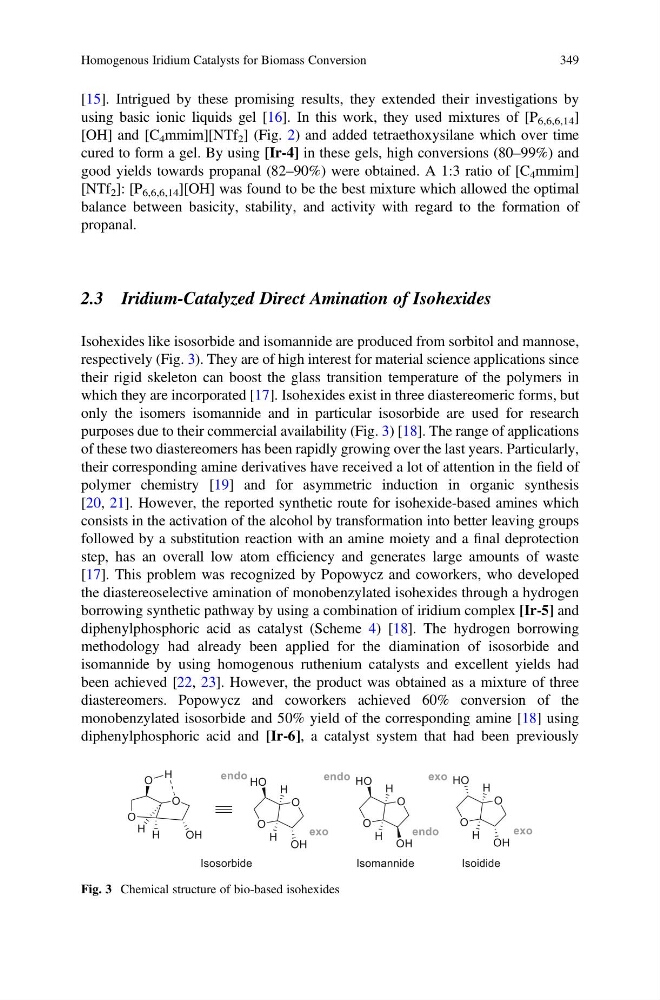
Isohexides like isosorbide and isomannide are produced from sorbitol and mannose,
respectively (Fig. 3). They are of high interest for material science applications since
their rigid skeleton can boost the glass transition temperature of the polymers in
which they are incorporated [17]. Isohexides exist in three diastereomeric forms, but
only the isomers isomannide and in particular isosorbide are used for research
purposes due to their commercial availability (Fig. 3) [18]. The range of applications
of these two diastereomers has been rapidly growing over the last years. Particularly,
their corresponding amine derivatives have received a lot of attention in the field of
polymer chemistry [19] and for asymmetric induction in organic synthesis
[20, 21]. However, the reported synthetic route for isohexide-based amines which
consists in the activation of the alcohol by transformation into better leaving groups
followed by a substitution reaction with an amine moiety and a final deprotection
step, has an overall low atom efficiency and generates large amounts of waste
[17]. This problem was recognized by Popowycz and coworkers, who developed
the diastereoselective amination of monobenzylated isohexides through a hydrogen
borrowing synthetic pathway by using a combination of iridium complex [Ir-5] and
diphenylphosphoric acid as catalyst (Scheme 4) [18]. The hydrogen borrowing
methodology had already been applied for the diamination of isosorbide and
isomannide by using homogenous ruthenium catalysts and excellent yields had
been achieved [22, 23]. However, the product was obtained as a mixture of three
diastereomers. Popowycz and coworkers achieved 60% conversion of the
monobenzylated isosorbide and 50% yield of the corresponding amine [18] using
diphenylphosphoric acid and [Ir-6], a catalyst system that had been previously
Fig. 3 Chemical structure of bio-based isohexides
Homogenous Iridium Catalysts for Biomass Conversion
349
using basic ionic liquids gel [16]. In this work, they used mixtures of [P 6,6,6,14 ]
[OH] and [C 4 mmim][NTf 2 ] (Fig. 2) and added tetraethoxysilane which over time
cured to form a gel. By using [Ir-4] in these gels, high conversions (80–99%) and
good yields towards propanal (82–90%) were obtained. A 1:3 ratio of [C 4 mmim]
[NTf 2 ]: [P 6,6,6,14 ][OH] was found to be the best mixture which allowed the optimal
balance between basicity, stability, and activity with regard to the formation of
propanal.
2.3 Iridium-Catalyzed Direct Amination of Isohexides
Isohexides like isosorbide and isomannide are produced from sorbitol and mannose,
respectively (Fig. 3). They are of high interest for material science applications since
their rigid skeleton can boost the glass transition temperature of the polymers in
which they are incorporated [17]. Isohexides exist in three diastereomeric forms, but
only the isomers isomannide and in particular isosorbide are used for research
purposes due to their commercial availability (Fig. 3) [18]. The range of applications
of these two diastereomers has been rapidly growing over the last years. Particularly,
their corresponding amine derivatives have received a lot of attention in the field of
polymer chemistry [19] and for asymmetric induction in organic synthesis
[20, 21]. However, the reported synthetic route for isohexide-based amines which
consists in the activation of the alcohol by transformation into better leaving groups
followed by a substitution reaction with an amine moiety and a final deprotection
step, has an overall low atom efficiency and generates large amounts of waste
[17]. This problem was recognized by Popowycz and coworkers, who developed
the diastereoselective amination of monobenzylated isohexides through a hydrogen
borrowing synthetic pathway by using a combination of iridium complex [Ir-5] and
diphenylphosphoric acid as catalyst (Scheme 4) [18]. The hydrogen borrowing
methodology had already been applied for the diamination of isosorbide and
isomannide by using homogenous ruthenium catalysts and excellent yields had
been achieved [22, 23]. However, the product was obtained as a mixture of three
diastereomers. Popowycz and coworkers achieved 60% conversion of the
monobenzylated isosorbide and 50% yield of the corresponding amine [18] using
diphenylphosphoric acid and [Ir-6], a catalyst system that had been previously
Fig. 3 Chemical structure of bio-based isohexides
Homogenous Iridium Catalysts for Biomass Conversion
349