

although its concentration strongly affected the yield of the reaction. Specifically, it
was noted that the higher the base concentration was, the lower the yield of 2. The
recyclability of [Ir-3] was proven in EmmimNTf 2 , by reusing it for ten cycles in the
presence of K 2 CO 3 at 150
C and 0.35 bar [13]. The conversion of 1,3-PDO
(75–99%) and the selectivity towards propionaldehyde (65–72%) remained high
over all the runs. Both the used ionic liquid and the catalyst [Ir-3] exhibited excellent
stability towards water, air, and temperature throughout the 10 runs albeit K 2 CO 3
needed to be replenished.
Subsequent work of Marr and coworkers revealed that the use of the fluorinated
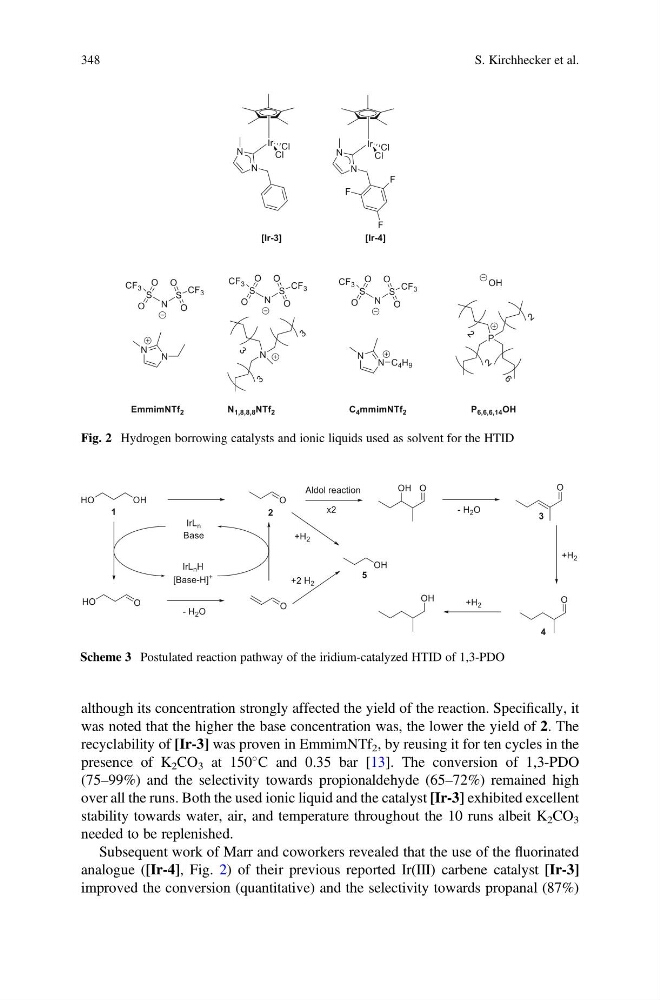
analogue ([Ir-4], Fig. 2) of their previous reported Ir(III) carbene catalyst [Ir-3]
improved the conversion (quantitative) and the selectivity towards propanal (87%)
Scheme 3 Postulated reaction pathway of the iridium-catalyzed HTID of 1,3-PDO
Fig. 2 Hydrogen borrowing catalysts and ionic liquids used as solvent for the HTID
348
S. Kirchhecker et al.
was noted that the higher the base concentration was, the lower the yield of 2. The
recyclability of [Ir-3] was proven in EmmimNTf 2 , by reusing it for ten cycles in the
presence of K 2 CO 3 at 150
C and 0.35 bar [13]. The conversion of 1,3-PDO
(75–99%) and the selectivity towards propionaldehyde (65–72%) remained high
over all the runs. Both the used ionic liquid and the catalyst [Ir-3] exhibited excellent
stability towards water, air, and temperature throughout the 10 runs albeit K 2 CO 3
needed to be replenished.
Subsequent work of Marr and coworkers revealed that the use of the fluorinated
analogue ([Ir-4], Fig. 2) of their previous reported Ir(III) carbene catalyst [Ir-3]
improved the conversion (quantitative) and the selectivity towards propanal (87%)
Scheme 3 Postulated reaction pathway of the iridium-catalyzed HTID of 1,3-PDO
Fig. 2 Hydrogen borrowing catalysts and ionic liquids used as solvent for the HTID
348
S. Kirchhecker et al.