

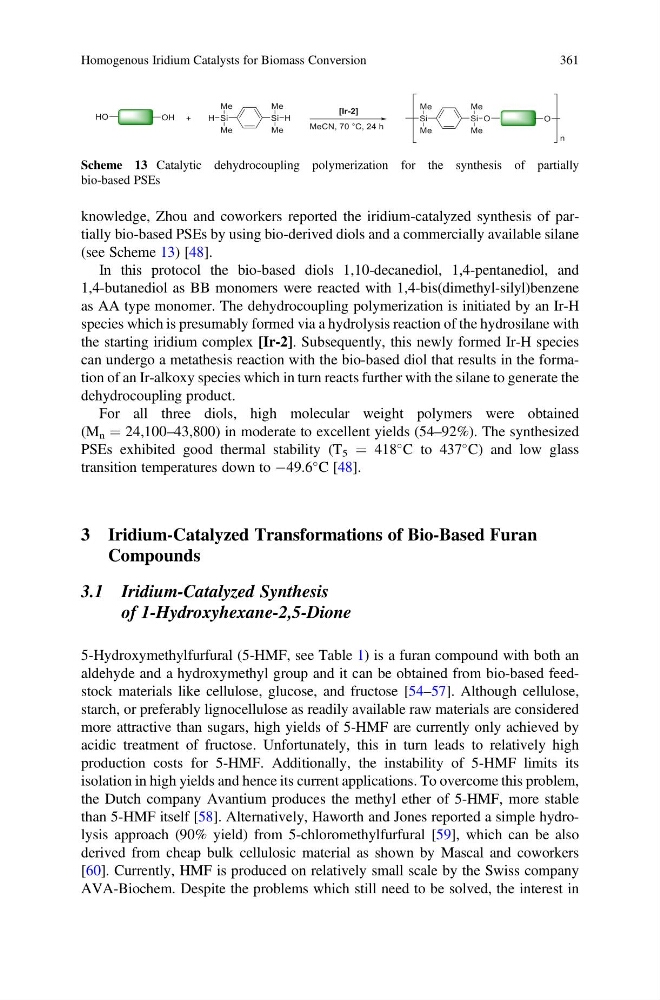
knowledge, Zhou and coworkers reported the iridium-catalyzed synthesis of partially bio-based PSEs by using bio-derived diols and a commercially available silane
(see Scheme 13) [48].
In this protocol the bio-based diols 1,10-decanediol, 1,4-pentanediol, and
1,4-butanediol as BB monomers were reacted with 1,4-bis(dimethyl-silyl)benzene
as AA type monomer. The dehydrocoupling polymerization is initiated by an Ir-H
species which is presumably formed via a hydrolysis reaction of the hydrosilane with
the starting iridium complex [Ir-2]. Subsequently, this newly formed Ir-H species
can undergo a metathesis reaction with the bio-based diol that results in the formation of an Ir-alkoxy species which in turn reacts further with the silane to generate the
dehydrocoupling product.
For all three diols, high molecular weight polymers were obtained
(M n ¼ 24,100–43,800) in moderate to excellent yields (54–92%). The synthesized
PSEs exhibited good thermal stability (T 5 ¼ 418
C to 437
C) and low glass
transition temperatures down to À49.6
C [48].
3 Iridium-Catalyzed Transformations of Bio-Based Furan
Compounds
3.1 Iridium-Catalyzed Synthesis
of 1-Hydroxyhexane-2,5-Dione
5-Hydroxymethylfurfural (5-HMF, see Table 1) is a furan compound with both an
aldehyde and a hydroxymethyl group and it can be obtained from bio-based feedstock materials like cellulose, glucose, and fructose [54–57]. Although cellulose,
starch, or preferably lignocellulose as readily available raw materials are considered
more attractive than sugars, high yields of 5-HMF are currently only achieved by
acidic treatment of fructose. Unfortunately, this in turn leads to relatively high
production costs for 5-HMF. Additionally, the instability of 5-HMF limits its
isolation in high yields and hence its current applications. To overcome this problem,
the Dutch company Avantium produces the methyl ether of 5-HMF, more stable
than 5-HMF itself [58]. Alternatively, Haworth and Jones reported a simple hydrolysis approach (90% yield) from 5-chloromethylfurfural [59], which can be also
derived from cheap bulk cellulosic material as shown by Mascal and coworkers
[60]. Currently, HMF is produced on relatively small scale by the Swiss company
AVA-Biochem. Despite the problems which still need to be solved, the interest in
Scheme 13 Catalytic dehydrocoupling polymerization for the synthesis of partially
bio-based PSEs
Homogenous Iridium Catalysts for Biomass Conversion
361
(see Scheme 13) [48].
In this protocol the bio-based diols 1,10-decanediol, 1,4-pentanediol, and
1,4-butanediol as BB monomers were reacted with 1,4-bis(dimethyl-silyl)benzene
as AA type monomer. The dehydrocoupling polymerization is initiated by an Ir-H
species which is presumably formed via a hydrolysis reaction of the hydrosilane with
the starting iridium complex [Ir-2]. Subsequently, this newly formed Ir-H species
can undergo a metathesis reaction with the bio-based diol that results in the formation of an Ir-alkoxy species which in turn reacts further with the silane to generate the
dehydrocoupling product.
For all three diols, high molecular weight polymers were obtained
(M n ¼ 24,100–43,800) in moderate to excellent yields (54–92%). The synthesized
PSEs exhibited good thermal stability (T 5 ¼ 418
C to 437
C) and low glass
transition temperatures down to À49.6
C [48].
3 Iridium-Catalyzed Transformations of Bio-Based Furan
Compounds
3.1 Iridium-Catalyzed Synthesis
of 1-Hydroxyhexane-2,5-Dione
5-Hydroxymethylfurfural (5-HMF, see Table 1) is a furan compound with both an
aldehyde and a hydroxymethyl group and it can be obtained from bio-based feedstock materials like cellulose, glucose, and fructose [54–57]. Although cellulose,
starch, or preferably lignocellulose as readily available raw materials are considered
more attractive than sugars, high yields of 5-HMF are currently only achieved by
acidic treatment of fructose. Unfortunately, this in turn leads to relatively high
production costs for 5-HMF. Additionally, the instability of 5-HMF limits its
isolation in high yields and hence its current applications. To overcome this problem,
the Dutch company Avantium produces the methyl ether of 5-HMF, more stable
than 5-HMF itself [58]. Alternatively, Haworth and Jones reported a simple hydrolysis approach (90% yield) from 5-chloromethylfurfural [59], which can be also
derived from cheap bulk cellulosic material as shown by Mascal and coworkers
[60]. Currently, HMF is produced on relatively small scale by the Swiss company
AVA-Biochem. Despite the problems which still need to be solved, the interest in
Scheme 13 Catalytic dehydrocoupling polymerization for the synthesis of partially
bio-based PSEs
Homogenous Iridium Catalysts for Biomass Conversion
361