

In general, since the reduction of CO 2 and H
+ on the cathode competes during the
electroreduction of CO 2 , the suppression of H 2 generation is necessary to improve
the selectivity. On the other hand, from the viewpoint of synthesis gas production,
H 2 generation is not a disadvantage; if the H 2 /CO ratios can be controlled with a
catalyst, not only CO but also synthesis gas can be produced directly. However, the
reduction of CO 2 to CO requires a large amount of energy, and even in the presence
of strong reducing agents, overcoming the O¼CO bond enthalpy of 532 kJ mol
À1
often presents kinetic difficulties.
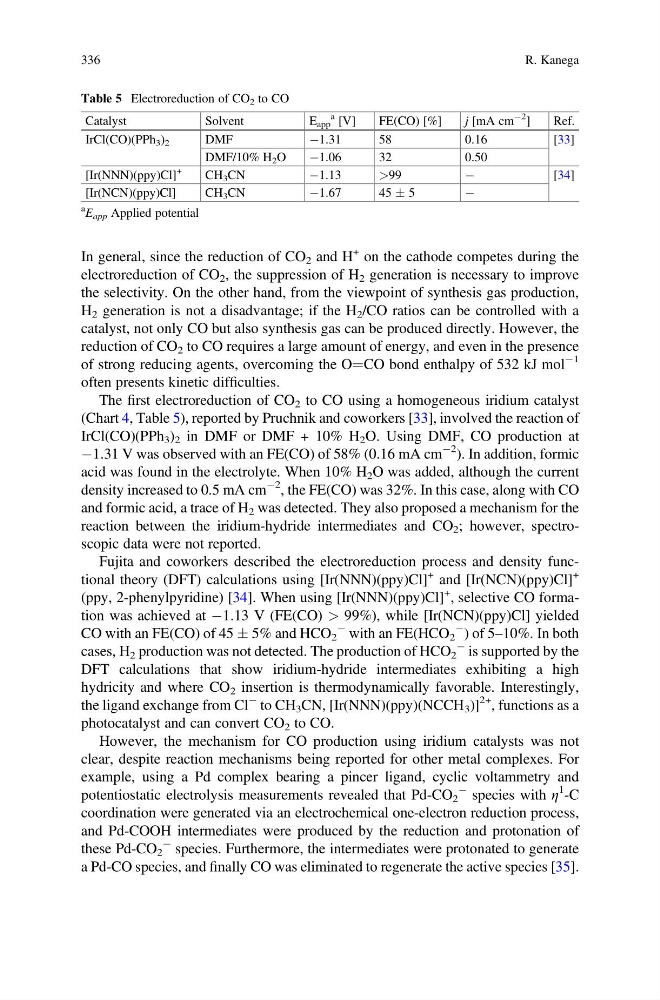
The first electroreduction of CO 2 to CO using a homogeneous iridium catalyst
(Chart 4, Table 5), reported by Pruchnik and coworkers [33], involved the reaction of
IrCl(CO)(PPh 3 ) 2 in DMF or DMF + 10% H 2 O. Using DMF, CO production at
À1.31 V was observed with an FE(CO) of 58% (0.16 mA cm
À2 ). In addition, formic
acid was found in the electrolyte. When 10% H 2 O was added, although the current
density increased to 0.5 mA cm
À2 , the FE(CO) was 32%. In this case, along with CO
and formic acid, a trace of H 2 was detected. They also proposed a mechanism for the
reaction between the iridium-hydride intermediates and CO 2 ; however, spectroscopic data were not reported.
Fujita and coworkers described the electroreduction process and density functional theory (DFT) calculations using [Ir(NNN)(ppy)Cl]
+ and [Ir(NCN)(ppy)Cl]
+
(ppy, 2-phenylpyridine) [34]. When using [Ir(NNN)(ppy)Cl]
+
, selective CO formation was achieved at À1.13 V (FE(CO) > 99%), while [Ir(NCN)(ppy)Cl] yielded
CO with an FE(CO) of 45 Æ 5% and HCO 2
À with an FE(HCO 2
À ) of 5–10%. In both
cases, H 2 production was not detected. The production of HCO 2
À is supported by the
DFT calculations that show iridium-hydride intermediates exhibiting a high
hydricity and where CO 2 insertion is thermodynamically favorable. Interestingly,
the ligand exchange from Cl
À to CH 3 CN, [Ir(NNN)(ppy)(NCCH 3 )]
2+ , functions as a
photocatalyst and can convert CO 2 to CO.
However, the mechanism for CO production using iridium catalysts was not
clear, despite reaction mechanisms being reported for other metal complexes. For
example, using a Pd complex bearing a pincer ligand, cyclic voltammetry and
potentiostatic electrolysis measurements revealed that Pd-CO 2
À species with η
1 -C
coordination were generated via an electrochemical one-electron reduction process,
and Pd-COOH intermediates were produced by the reduction and protonation of
these Pd-CO 2
À species. Furthermore, the intermediates were protonated to generate
a Pd-CO species, and finally CO was eliminated to regenerate the active species [35].
Table 5 Electroreduction of CO 2 to CO
Catalyst
Solvent
E app
a [V]
FE(CO) [%]
j [mA cm
À2
]
Ref.
IrCl(CO)(PPh 3 ) 2
DMF
À1.31
58
0.16
[33]
DMF/10% H 2 O
À1.06
32
0.50
[Ir(NNN)(ppy)Cl]
+
CH 3 CN
À1.13
>99
À
[34]
[Ir(NCN)(ppy)Cl]
CH 3 CN
À1.67
45 Æ 5
À
a E app Applied potential
336
R. Kanega
+ on the cathode competes during the
electroreduction of CO 2 , the suppression of H 2 generation is necessary to improve
the selectivity. On the other hand, from the viewpoint of synthesis gas production,
H 2 generation is not a disadvantage; if the H 2 /CO ratios can be controlled with a
catalyst, not only CO but also synthesis gas can be produced directly. However, the
reduction of CO 2 to CO requires a large amount of energy, and even in the presence
of strong reducing agents, overcoming the O¼CO bond enthalpy of 532 kJ mol
À1
often presents kinetic difficulties.
The first electroreduction of CO 2 to CO using a homogeneous iridium catalyst
(Chart 4, Table 5), reported by Pruchnik and coworkers [33], involved the reaction of
IrCl(CO)(PPh 3 ) 2 in DMF or DMF + 10% H 2 O. Using DMF, CO production at
À1.31 V was observed with an FE(CO) of 58% (0.16 mA cm
À2 ). In addition, formic
acid was found in the electrolyte. When 10% H 2 O was added, although the current
density increased to 0.5 mA cm
À2 , the FE(CO) was 32%. In this case, along with CO
and formic acid, a trace of H 2 was detected. They also proposed a mechanism for the
reaction between the iridium-hydride intermediates and CO 2 ; however, spectroscopic data were not reported.
Fujita and coworkers described the electroreduction process and density functional theory (DFT) calculations using [Ir(NNN)(ppy)Cl]
+ and [Ir(NCN)(ppy)Cl]
+
(ppy, 2-phenylpyridine) [34]. When using [Ir(NNN)(ppy)Cl]
+
, selective CO formation was achieved at À1.13 V (FE(CO) > 99%), while [Ir(NCN)(ppy)Cl] yielded
CO with an FE(CO) of 45 Æ 5% and HCO 2
À with an FE(HCO 2
À ) of 5–10%. In both
cases, H 2 production was not detected. The production of HCO 2
À is supported by the
DFT calculations that show iridium-hydride intermediates exhibiting a high
hydricity and where CO 2 insertion is thermodynamically favorable. Interestingly,
the ligand exchange from Cl
À to CH 3 CN, [Ir(NNN)(ppy)(NCCH 3 )]
2+ , functions as a
photocatalyst and can convert CO 2 to CO.
However, the mechanism for CO production using iridium catalysts was not
clear, despite reaction mechanisms being reported for other metal complexes. For
example, using a Pd complex bearing a pincer ligand, cyclic voltammetry and
potentiostatic electrolysis measurements revealed that Pd-CO 2
À species with η
1 -C
coordination were generated via an electrochemical one-electron reduction process,
and Pd-COOH intermediates were produced by the reduction and protonation of
these Pd-CO 2
À species. Furthermore, the intermediates were protonated to generate
a Pd-CO species, and finally CO was eliminated to regenerate the active species [35].
Table 5 Electroreduction of CO 2 to CO
Catalyst
Solvent
E app
a [V]
FE(CO) [%]
j [mA cm
À2
]
Ref.
IrCl(CO)(PPh 3 ) 2
DMF
À1.31
58
0.16
[33]
DMF/10% H 2 O
À1.06
32
0.50
[Ir(NNN)(ppy)Cl]
+
CH 3 CN
À1.13
>99
À
[34]
[Ir(NCN)(ppy)Cl]
CH 3 CN
À1.67
45 Æ 5
À
a E app Applied potential
336
R. Kanega