

4 Electroreduction of Carbon Dioxide to Oxalate
C-C bond formation is an important reaction in chemical synthesis that is commonly
carried out through coupling reactions with organometallic reagents. In this context,
the use of C 2 O 4
2À as a C2 compound is interesting from the viewpoint of electrochemical C-C bond formation. In addition, C 2 O 4
2À are useful chemicals; for example, dimethyl C 2 O 4
2À is a precursor for the production of ethylene glycol and methyl
glycolate [36].
When the electroreduction of CO 2 was conducted in CH 3 CN at À1.40 V,
trinuclear iridium complex [(Cp*Ir) 3 (μ 3 -S) 2 ]
2+ gave C 2 O 4
2À (FE(C 2 O 4
2À ) 64%)
and
[(Cp*Ir) 2 (Ir(η
4 -C 5 (CH 3 ) 5 )CH 2 CN)(μ 3 -S) 2 ]
+
([(Cp*Ir) 3 CH 2 CN(μ 3 -S) 2 ]
+
)
[37]. The crystal structure of [(Cp*Ir) 3 CH 2 CN(μ 3 -S) 2 ]
+ was determined by X-ray
diffraction, and it was found that a linear CH 2 CN group was linked at the
exo-position of a Cp* ligand, and the C 5 (CH 3 ) 5 CH 2 CN ligand was coordinated to
an iridium atom in the η
4
-mode. In addition, the cyclic voltammogram of
[(Cp*Ir) 3 CH 2 CN(μ 3 -S) 2 ]
+ recorded in CH 3 CN in the presence of CO 2 exhibited a
strong catalytic current due to the reduction of CO 2 , although this was not observed
for [(Cp*Ir) 3 (μ 3 -S) 2 ]
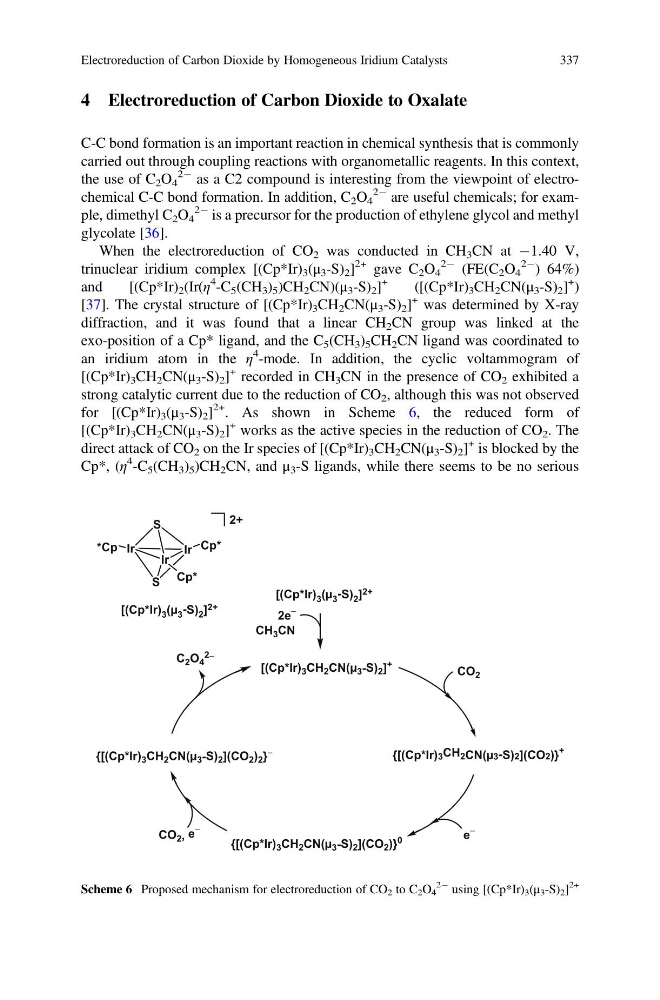
2+ . As shown in Scheme 6, the reduced form of
[(Cp*Ir) 3 CH 2 CN(μ 3 -S) 2 ]
+ works as the active species in the reduction of CO 2 . The
direct attack of CO 2 on the Ir species of [(Cp*Ir) 3 CH 2 CN(μ 3 -S) 2 ]
+ is blocked by the
Cp*, (η
4 -C 5 (CH 3 ) 5 )CH 2 CN, and μ 3 -S ligands, while there seems to be no serious
CO 2
e
−
C 2 O 4
2−
2e
−
Ir
S
2+
Ir
Ir
S
*Cp
Cp*
Cp*
[(Cp*Ir) 3 (µ 3 -S) 2 ] 2+
[(Cp*Ir) 3 (µ 3 -S) 2 ] 2+
CH 3 CN
{[(Cp*Ir)3 CH 2CN(µ3-S)2](CO2)}
+
[(Cp*Ir) 3 CH 2 CN(µ 3 -S) 2 ] +
{[(Cp*Ir) 3 CH 2 CN(µ 3 -S) 2 ](CO 2 )}
0
{[(Cp*Ir) 3 CH 2 CN(µ 3 -S) 2 ](CO 2 ) 2 }
−
CO 2 , e
−
Scheme 6 Proposed mechanism for electroreduction of CO 2 to C 2 O 4
2À using [(Cp*Ir) 3 (μ 3 -S) 2 ]
2+
Electroreduction of Carbon Dioxide by Homogeneous Iridium Catalysts
337
C-C bond formation is an important reaction in chemical synthesis that is commonly
carried out through coupling reactions with organometallic reagents. In this context,
the use of C 2 O 4
2À as a C2 compound is interesting from the viewpoint of electrochemical C-C bond formation. In addition, C 2 O 4
2À are useful chemicals; for example, dimethyl C 2 O 4
2À is a precursor for the production of ethylene glycol and methyl
glycolate [36].
When the electroreduction of CO 2 was conducted in CH 3 CN at À1.40 V,
trinuclear iridium complex [(Cp*Ir) 3 (μ 3 -S) 2 ]
2+ gave C 2 O 4
2À (FE(C 2 O 4
2À ) 64%)
and
[(Cp*Ir) 2 (Ir(η
4 -C 5 (CH 3 ) 5 )CH 2 CN)(μ 3 -S) 2 ]
+
([(Cp*Ir) 3 CH 2 CN(μ 3 -S) 2 ]
+
)
[37]. The crystal structure of [(Cp*Ir) 3 CH 2 CN(μ 3 -S) 2 ]
+ was determined by X-ray
diffraction, and it was found that a linear CH 2 CN group was linked at the
exo-position of a Cp* ligand, and the C 5 (CH 3 ) 5 CH 2 CN ligand was coordinated to
an iridium atom in the η
4
-mode. In addition, the cyclic voltammogram of
[(Cp*Ir) 3 CH 2 CN(μ 3 -S) 2 ]
+ recorded in CH 3 CN in the presence of CO 2 exhibited a
strong catalytic current due to the reduction of CO 2 , although this was not observed
for [(Cp*Ir) 3 (μ 3 -S) 2 ]
2+ . As shown in Scheme 6, the reduced form of
[(Cp*Ir) 3 CH 2 CN(μ 3 -S) 2 ]
+ works as the active species in the reduction of CO 2 . The
direct attack of CO 2 on the Ir species of [(Cp*Ir) 3 CH 2 CN(μ 3 -S) 2 ]
+ is blocked by the
Cp*, (η
4 -C 5 (CH 3 ) 5 )CH 2 CN, and μ 3 -S ligands, while there seems to be no serious
CO 2
e
−
C 2 O 4
2−
2e
−
Ir
S
2+
Ir
Ir
S
*Cp
Cp*
Cp*
[(Cp*Ir) 3 (µ 3 -S) 2 ] 2+
[(Cp*Ir) 3 (µ 3 -S) 2 ] 2+
CH 3 CN
{[(Cp*Ir)3 CH 2CN(µ3-S)2](CO2)}
+
[(Cp*Ir) 3 CH 2 CN(µ 3 -S) 2 ] +
{[(Cp*Ir) 3 CH 2 CN(µ 3 -S) 2 ](CO 2 )}
0
{[(Cp*Ir) 3 CH 2 CN(µ 3 -S) 2 ](CO 2 ) 2 }
−
CO 2 , e
−
Scheme 6 Proposed mechanism for electroreduction of CO 2 to C 2 O 4
2À using [(Cp*Ir) 3 (μ 3 -S) 2 ]
2+
Electroreduction of Carbon Dioxide by Homogeneous Iridium Catalysts
337