

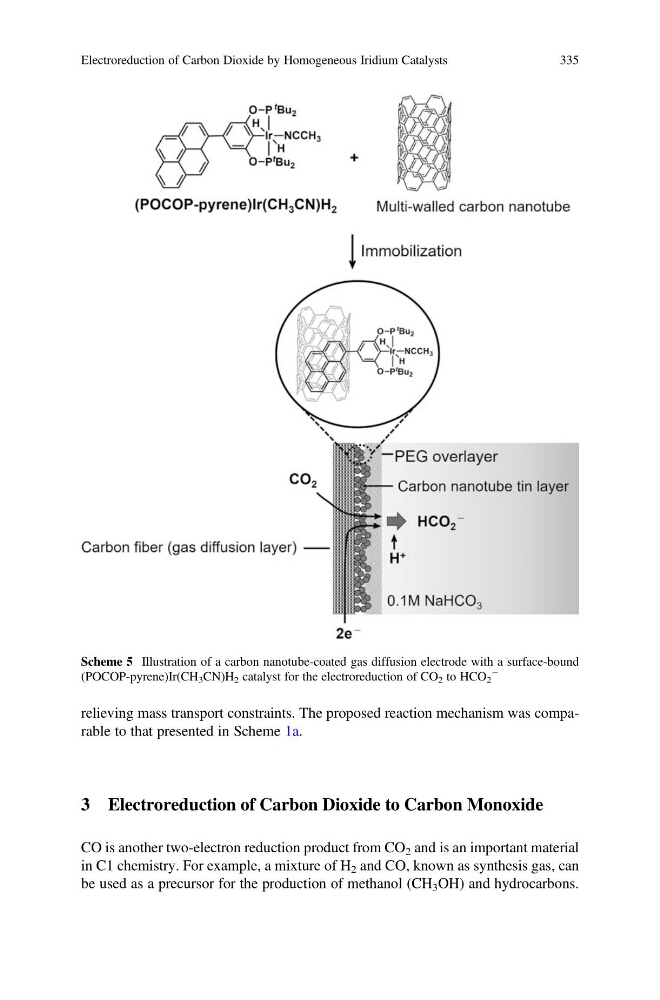
relieving mass transport constraints. The proposed reaction mechanism was comparable to that presented in Scheme 1a.
3 Electroreduction of Carbon Dioxide to Carbon Monoxide
CO is another two-electron reduction product from CO 2 and is an important material
in C1 chemistry. For example, a mixture of H 2 and CO, known as synthesis gas, can
be used as a precursor for the production of methanol (CH 3 OH) and hydrocarbons.
Scheme 5 Illustration of a carbon nanotube-coated gas diffusion electrode with a surface-bound
(POCOP-pyrene)Ir(CH 3 CN)H 2 catalyst for the electroreduction of CO 2 to HCO 2
À
Electroreduction of Carbon Dioxide by Homogeneous Iridium Catalysts
335
3 Electroreduction of Carbon Dioxide to Carbon Monoxide
CO is another two-electron reduction product from CO 2 and is an important material
in C1 chemistry. For example, a mixture of H 2 and CO, known as synthesis gas, can
be used as a precursor for the production of methanol (CH 3 OH) and hydrocarbons.
Scheme 5 Illustration of a carbon nanotube-coated gas diffusion electrode with a surface-bound
(POCOP-pyrene)Ir(CH 3 CN)H 2 catalyst for the electroreduction of CO 2 to HCO 2
À
Electroreduction of Carbon Dioxide by Homogeneous Iridium Catalysts
335