

generated by the two-electron reduction of [Cp*Ir
III (N4)(OH 2 )]
+ (Eq. 5). Subsequently, [Cp*Ir
III H(N4)]
+ produced by the reaction of [Cp*Ir
I
(N4)]
À with H 2 O
(Eq. 6) reduced CO 2 to HCO 2
À (Eq. 7). The cathodic current observed under CO 2
was derived so that [Cp*Ir
III (N4)]
+ was regenerated by the reaction of [Cp*Ir
III
H
(N4)]
+ with CO 2 .
Cp à Ir
III N4
ð Þ OH 2
ð
Þ
Â
à þ þ 2e
À
! Cp à Ir
I N4
ð Þ
Â
à À þ H 2 O
ð5Þ
Cp à Ir
I N4
ð Þ
Â
à À þ H 2 O ! Cp à Ir
III H N4
ð Þ
Â
à À þ OH
À
ð6Þ
Cp à Ir
III H N4
ð Þ
Â
à À þ CO 2 þ H 2 O ! Cp à Ir
III N4
ð Þ OH 2
ð
Þ
Â
à þ þ HCO 2
À
ð7Þ
Although the [Fe 4 N(CO) 12 ]
À catalyst has been reported to exhibit activity in
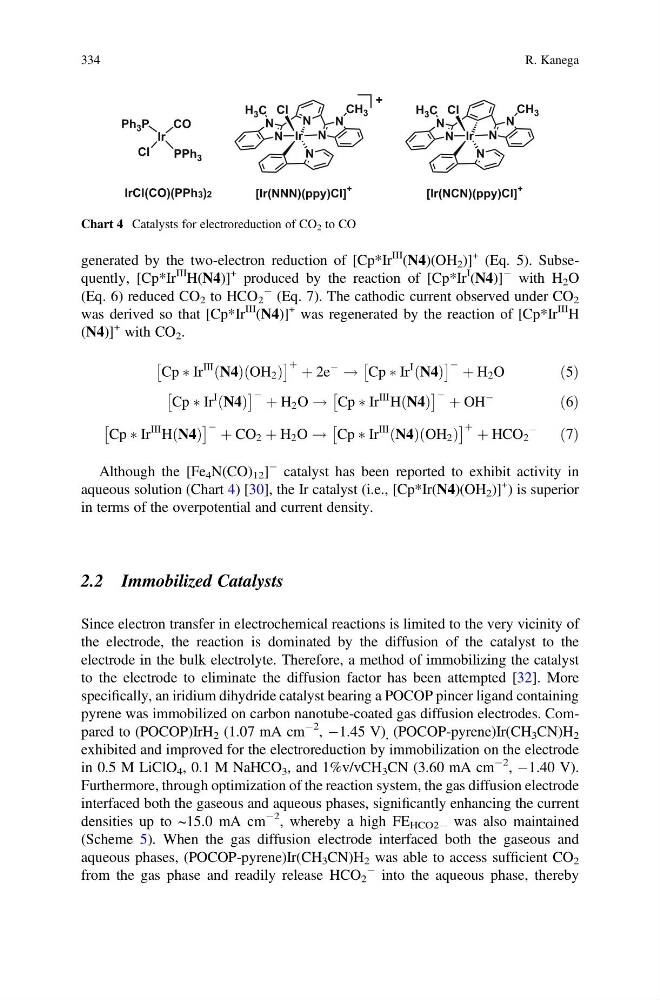
aqueous solution (Chart 4) [30], the Ir catalyst (i.e., [Cp*Ir(N4)(OH 2 )]
+
) is superior
in terms of the overpotential and current density.
2.2 Immobilized Catalysts
Since electron transfer in electrochemical reactions is limited to the very vicinity of
the electrode, the reaction is dominated by the diffusion of the catalyst to the
electrode in the bulk electrolyte. Therefore, a method of immobilizing the catalyst
to the electrode to eliminate the diffusion factor has been attempted [32]. More
specifically, an iridium dihydride catalyst bearing a POCOP pincer ligand containing
pyrene was immobilized on carbon nanotube-coated gas diffusion electrodes. Compared to (POCOP)IrH 2 (1.07 mA cm
À2 , À1.45 V) , (POCOP-pyrene)Ir(CH 3 CN)H 2
exhibited and improved for the electroreduction by immobilization on the electrode
in 0.5 M LiClO 4 , 0.1 M NaHCO 3 , and 1%v/vCH 3 CN (3.60 mA cm
À2 , À1.40 V).
Furthermore, through optimization of the reaction system, the gas diffusion electrode
interfaced both the gaseous and aqueous phases, significantly enhancing the current
densities up to ~15.0 mA cm
À2 , whereby a high FE HCO2À was also maintained
(Scheme 5). When the gas diffusion electrode interfaced both the gaseous and
aqueous phases, (POCOP-pyrene)Ir(CH 3 CN)H 2 was able to access sufficient CO 2
from the gas phase and readily release HCO 2
À into the aqueous phase, thereby
CO
PPh 3
Ir
Cl
Ph 3 P
N
N
Ir
N
N
N
N
H 3 C
CH 3
Cl
IrCl(CO)(PPh3)2
[Ir(NNN)(ppy)Cl]
+
+
N
N
Ir
N
N
N
H 3 C
CH 3
Cl
[Ir(NCN)(ppy)Cl]
+
Chart 4 Catalysts for electroreduction of CO 2 to CO
334
R. Kanega
III (N4)(OH 2 )]
+ (Eq. 5). Subsequently, [Cp*Ir
III H(N4)]
+ produced by the reaction of [Cp*Ir
I
(N4)]
À with H 2 O
(Eq. 6) reduced CO 2 to HCO 2
À (Eq. 7). The cathodic current observed under CO 2
was derived so that [Cp*Ir
III (N4)]
+ was regenerated by the reaction of [Cp*Ir
III
H
(N4)]
+ with CO 2 .
Cp à Ir
III N4
ð Þ OH 2
ð
Þ
Â
à þ þ 2e
À
! Cp à Ir
I N4
ð Þ
Â
à À þ H 2 O
ð5Þ
Cp à Ir
I N4
ð Þ
Â
à À þ H 2 O ! Cp à Ir
III H N4
ð Þ
Â
à À þ OH
À
ð6Þ
Cp à Ir
III H N4
ð Þ
Â
à À þ CO 2 þ H 2 O ! Cp à Ir
III N4
ð Þ OH 2
ð
Þ
Â
à þ þ HCO 2
À
ð7Þ
Although the [Fe 4 N(CO) 12 ]
À catalyst has been reported to exhibit activity in
aqueous solution (Chart 4) [30], the Ir catalyst (i.e., [Cp*Ir(N4)(OH 2 )]
+
) is superior
in terms of the overpotential and current density.
2.2 Immobilized Catalysts
Since electron transfer in electrochemical reactions is limited to the very vicinity of
the electrode, the reaction is dominated by the diffusion of the catalyst to the
electrode in the bulk electrolyte. Therefore, a method of immobilizing the catalyst
to the electrode to eliminate the diffusion factor has been attempted [32]. More
specifically, an iridium dihydride catalyst bearing a POCOP pincer ligand containing
pyrene was immobilized on carbon nanotube-coated gas diffusion electrodes. Compared to (POCOP)IrH 2 (1.07 mA cm
À2 , À1.45 V) , (POCOP-pyrene)Ir(CH 3 CN)H 2
exhibited and improved for the electroreduction by immobilization on the electrode
in 0.5 M LiClO 4 , 0.1 M NaHCO 3 , and 1%v/vCH 3 CN (3.60 mA cm
À2 , À1.40 V).
Furthermore, through optimization of the reaction system, the gas diffusion electrode
interfaced both the gaseous and aqueous phases, significantly enhancing the current
densities up to ~15.0 mA cm
À2 , whereby a high FE HCO2À was also maintained
(Scheme 5). When the gas diffusion electrode interfaced both the gaseous and
aqueous phases, (POCOP-pyrene)Ir(CH 3 CN)H 2 was able to access sufficient CO 2
from the gas phase and readily release HCO 2
À into the aqueous phase, thereby
CO
PPh 3
Ir
Cl
Ph 3 P
N
N
Ir
N
N
N
N
H 3 C
CH 3
Cl
IrCl(CO)(PPh3)2
[Ir(NNN)(ppy)Cl]
+
+
N
N
Ir
N
N
N
H 3 C
CH 3
Cl
[Ir(NCN)(ppy)Cl]
+
Chart 4 Catalysts for electroreduction of CO 2 to CO
334
R. Kanega