

was further enhanced. When the catalytic performances of [Cp*Ir(4DHBP)(OH 2 )]
2+ ,
[Cp*Ir(6DHBP)(OH 2 )]
2+ , [(Cp*IrCl) 2 (THBPM)]
2+ , [Cp*Ir(N3)(OH 2 )]
2+ , and
[Cp*Ir(N4)(OH 2 )]
+ were compared, the results were consistent with the order of
activity for the hydrogenation of CO 2 [31], thereby indicating that common active
species are involved in the electroreduction and hydrogenation of CO 2 . Interestingly,
combination of the iridium catalyst with different electrode materials indicated that
electrodes exhibiting lower hydrogen overpotentials (i.e., a Pt black electrode) led to
a remarkable decrease in the applied potential. As a result, the combination of [Cp*Ir
(N4)(OH 2 )]
+ and a Pt black working electrode gave a high current density
(7.20 mA cm
À2 ) and a high FE(HCO 2
À ) (95.0%). In addition, electrochemical
measurements, electrokinetic analyses, and reaction mechanism studies revealed
that the iridium-hydride species detected by
1 H NMR were generated via a
two-electron reduction process. The above values represent the lowest overpotential
and the highest current density among the previous reports using homogeneous
catalysts for the electroreduction of CO 2 to HCO 2
À , and the overpotential was
lower than that of the heterogeneous catalyst, thereby indicating that iridium-hydride
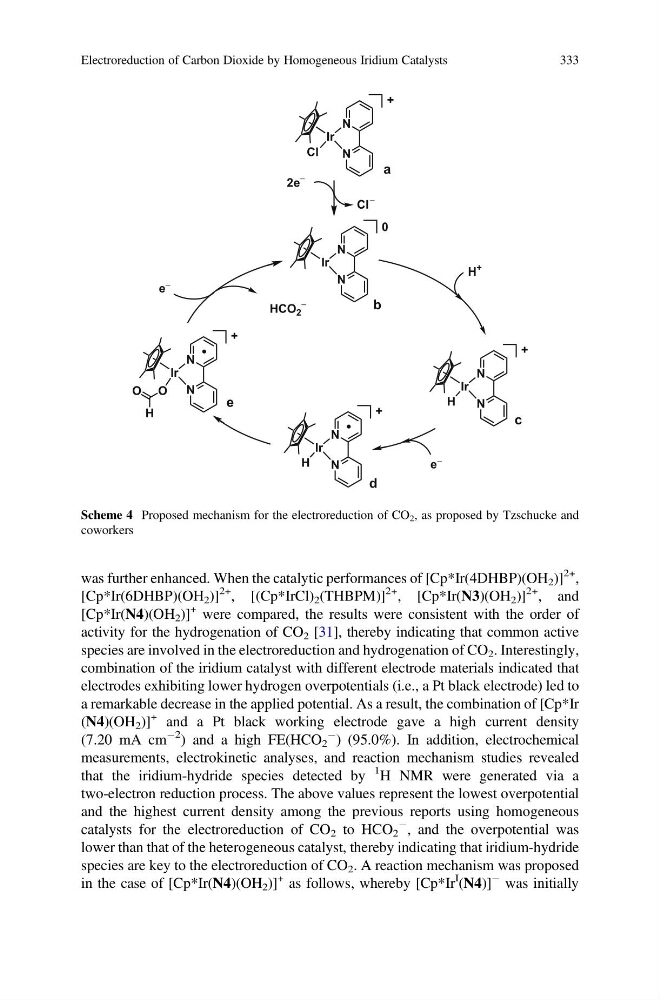
species are key to the electroreduction of CO 2 . A reaction mechanism was proposed
in the case of [Cp*Ir(N4)(OH 2 )]
+ as follows, whereby [Cp*Ir
I (N4)]
À was initially
H
+
e −
HCO 2
−
e −
N
N
Ir
Cl
+
N
N
Ir
0
2e
−
Cl
−
N
N
Ir
H
+
N
N
Ir
H
+
N
N
Ir
+
O
H
O
a
b
c
d
e
Scheme 4 Proposed mechanism for the electroreduction of CO 2 , as proposed by Tzschucke and
coworkers
Electroreduction of Carbon Dioxide by Homogeneous Iridium Catalysts
333
2+ ,
[Cp*Ir(6DHBP)(OH 2 )]
2+ , [(Cp*IrCl) 2 (THBPM)]
2+ , [Cp*Ir(N3)(OH 2 )]
2+ , and
[Cp*Ir(N4)(OH 2 )]
+ were compared, the results were consistent with the order of
activity for the hydrogenation of CO 2 [31], thereby indicating that common active
species are involved in the electroreduction and hydrogenation of CO 2 . Interestingly,
combination of the iridium catalyst with different electrode materials indicated that
electrodes exhibiting lower hydrogen overpotentials (i.e., a Pt black electrode) led to
a remarkable decrease in the applied potential. As a result, the combination of [Cp*Ir
(N4)(OH 2 )]
+ and a Pt black working electrode gave a high current density
(7.20 mA cm
À2 ) and a high FE(HCO 2
À ) (95.0%). In addition, electrochemical
measurements, electrokinetic analyses, and reaction mechanism studies revealed
that the iridium-hydride species detected by
1 H NMR were generated via a
two-electron reduction process. The above values represent the lowest overpotential
and the highest current density among the previous reports using homogeneous
catalysts for the electroreduction of CO 2 to HCO 2
À , and the overpotential was
lower than that of the heterogeneous catalyst, thereby indicating that iridium-hydride
species are key to the electroreduction of CO 2 . A reaction mechanism was proposed
in the case of [Cp*Ir(N4)(OH 2 )]
+ as follows, whereby [Cp*Ir
I (N4)]
À was initially
H
+
e −
HCO 2
−
e −
N
N
Ir
Cl
+
N
N
Ir
0
2e
−
Cl
−
N
N
Ir
H
+
N
N
Ir
H
+
N
N
Ir
+
O
H
O
a
b
c
d
e
Scheme 4 Proposed mechanism for the electroreduction of CO 2 , as proposed by Tzschucke and
coworkers
Electroreduction of Carbon Dioxide by Homogeneous Iridium Catalysts
333