

substituent effects on the 2, 4, and 4
0 positions of the bipyridine ligand was examined,
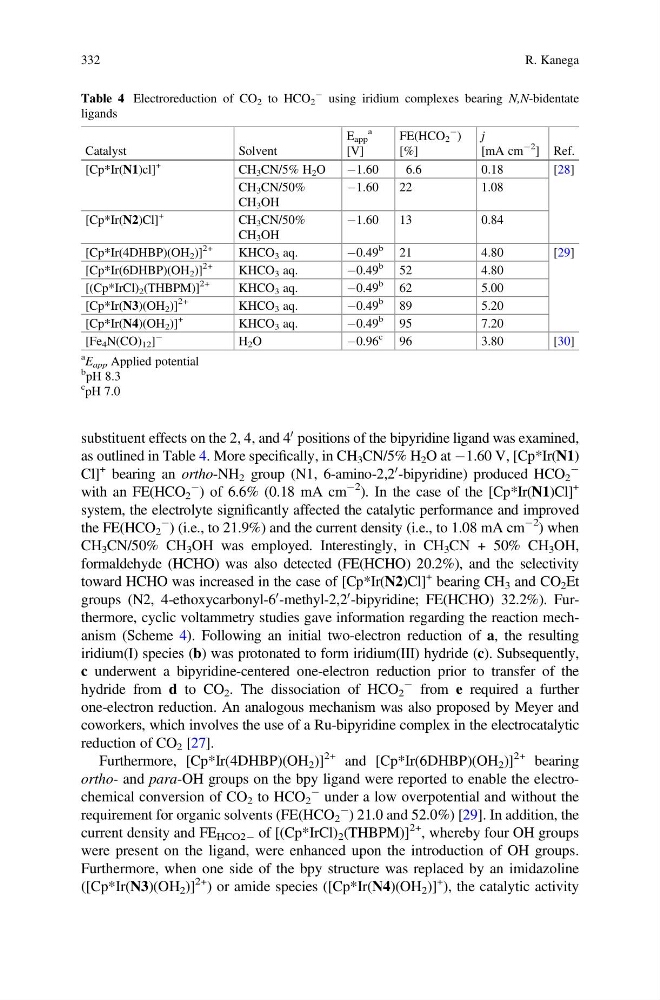
as outlined in Table 4. More specifically, in CH 3 CN/5% H 2 O at À1.60 V, [Cp*Ir(N1)
Cl]
+ bearing an ortho-NH 2 group (N1, 6-amino-2,2
0 -bipyridine) produced HCO 2
À
with an FE(HCO 2
À ) of 6.6% (0.18 mA cm
À2
). In the case of the [Cp*Ir(N1)Cl]
+
system, the electrolyte significantly affected the catalytic performance and improved
the FE(HCO 2
À
) (i.e., to 21.9%) and the current density (i.e., to 1.08 mA cm
À2
) when
CH 3 CN/50% CH 3 OH was employed. Interestingly, in CH 3 CN + 50% CH 3 OH,
formaldehyde (HCHO) was also detected (FE(HCHO) 20.2%), and the selectivity
toward HCHO was increased in the case of [Cp*Ir(N2)Cl]
+ bearing CH 3 and CO 2 Et
groups (N2, 4-ethoxycarbonyl-6
0 -methyl-2,2
0 -bipyridine; FE(HCHO) 32.2%). Furthermore, cyclic voltammetry studies gave information regarding the reaction mechanism (Scheme 4). Following an initial two-electron reduction of a, the resulting
iridium(I) species (b) was protonated to form iridium(III) hydride (c). Subsequently,
c underwent a bipyridine-centered one-electron reduction prior to transfer of the
hydride from d to CO 2 . The dissociation of HCO 2
À from e required a further
one-electron reduction. An analogous mechanism was also proposed by Meyer and
coworkers, which involves the use of a Ru-bipyridine complex in the electrocatalytic
reduction of CO 2 [27].
Furthermore, [Cp*Ir(4DHBP)(OH 2 )]
2+ and [Cp*Ir(6DHBP)(OH 2 )]
2+ bearing
ortho- and para-OH groups on the bpy ligand were reported to enable the electrochemical conversion of CO 2 to HCO 2
À under a low overpotential and without the
requirement for organic solvents (FE(HCO 2
À ) 21.0 and 52.0%) [29]. In addition, the
current density and FE HCO2À of [(Cp*IrCl) 2 (THBPM)]
2+ , whereby four OH groups
were present on the ligand, were enhanced upon the introduction of OH groups.
Furthermore, when one side of the bpy structure was replaced by an imidazoline
([Cp*Ir(N3)(OH 2 )]
2+ ) or amide species ([Cp*Ir(N4)(OH 2 )]
+
), the catalytic activity
Table 4 Electroreduction of CO 2 to HCO 2
À using iridium complexes bearing N,N-bidentate
ligands
Catalyst
Solvent
E app
a
[V]
FE(HCO 2
À
)
[%]
j
[mA cm
À2
] Ref.
[Cp*Ir(N1)cl]
+
CH 3 CN/5% H 2 O
À1.60
6.6
0.18
[28]
CH 3 CN/50%
CH 3 OH
À1.60
22
1.08
[Cp*Ir(N2)Cl]
+
CH 3 CN/50%
CH 3 OH
À1.60
13
0.84
[Cp*Ir(4DHBP)(OH 2 )]
2+
KHCO 3 aq.
À0.49
b
21
4.80
[29]
[Cp*Ir(6DHBP)(OH 2 )]
2+
KHCO 3 aq.
À0.49
b
52
4.80
[(Cp*IrCl) 2 (THBPM)]
2+
KHCO 3 aq.
À0.49
b
62
5.00
[Cp*Ir(N3)(OH 2 )]
2+
KHCO 3 aq.
À0.49
b
89
5.20
[Cp*Ir(N4)(OH 2 )]
+
KHCO 3 aq.
À0.49
b
95
7.20
[Fe 4 N(CO) 12 ]
À
H 2 O
À0.96
c
96
3.80
[30]
a E app Applied potential
b
pH 8.3
c pH 7.0
332
R. Kanega
0 positions of the bipyridine ligand was examined,
as outlined in Table 4. More specifically, in CH 3 CN/5% H 2 O at À1.60 V, [Cp*Ir(N1)
Cl]
+ bearing an ortho-NH 2 group (N1, 6-amino-2,2
0 -bipyridine) produced HCO 2
À
with an FE(HCO 2
À ) of 6.6% (0.18 mA cm
À2
). In the case of the [Cp*Ir(N1)Cl]
+
system, the electrolyte significantly affected the catalytic performance and improved
the FE(HCO 2
À
) (i.e., to 21.9%) and the current density (i.e., to 1.08 mA cm
À2
) when
CH 3 CN/50% CH 3 OH was employed. Interestingly, in CH 3 CN + 50% CH 3 OH,
formaldehyde (HCHO) was also detected (FE(HCHO) 20.2%), and the selectivity
toward HCHO was increased in the case of [Cp*Ir(N2)Cl]
+ bearing CH 3 and CO 2 Et
groups (N2, 4-ethoxycarbonyl-6
0 -methyl-2,2
0 -bipyridine; FE(HCHO) 32.2%). Furthermore, cyclic voltammetry studies gave information regarding the reaction mechanism (Scheme 4). Following an initial two-electron reduction of a, the resulting
iridium(I) species (b) was protonated to form iridium(III) hydride (c). Subsequently,
c underwent a bipyridine-centered one-electron reduction prior to transfer of the
hydride from d to CO 2 . The dissociation of HCO 2
À from e required a further
one-electron reduction. An analogous mechanism was also proposed by Meyer and
coworkers, which involves the use of a Ru-bipyridine complex in the electrocatalytic
reduction of CO 2 [27].
Furthermore, [Cp*Ir(4DHBP)(OH 2 )]
2+ and [Cp*Ir(6DHBP)(OH 2 )]
2+ bearing
ortho- and para-OH groups on the bpy ligand were reported to enable the electrochemical conversion of CO 2 to HCO 2
À under a low overpotential and without the
requirement for organic solvents (FE(HCO 2
À ) 21.0 and 52.0%) [29]. In addition, the
current density and FE HCO2À of [(Cp*IrCl) 2 (THBPM)]
2+ , whereby four OH groups
were present on the ligand, were enhanced upon the introduction of OH groups.
Furthermore, when one side of the bpy structure was replaced by an imidazoline
([Cp*Ir(N3)(OH 2 )]
2+ ) or amide species ([Cp*Ir(N4)(OH 2 )]
+
), the catalytic activity
Table 4 Electroreduction of CO 2 to HCO 2
À using iridium complexes bearing N,N-bidentate
ligands
Catalyst
Solvent
E app
a
[V]
FE(HCO 2
À
)
[%]
j
[mA cm
À2
] Ref.
[Cp*Ir(N1)cl]
+
CH 3 CN/5% H 2 O
À1.60
6.6
0.18
[28]
CH 3 CN/50%
CH 3 OH
À1.60
22
1.08
[Cp*Ir(N2)Cl]
+
CH 3 CN/50%
CH 3 OH
À1.60
13
0.84
[Cp*Ir(4DHBP)(OH 2 )]
2+
KHCO 3 aq.
À0.49
b
21
4.80
[29]
[Cp*Ir(6DHBP)(OH 2 )]
2+
KHCO 3 aq.
À0.49
b
52
4.80
[(Cp*IrCl) 2 (THBPM)]
2+
KHCO 3 aq.
À0.49
b
62
5.00
[Cp*Ir(N3)(OH 2 )]
2+
KHCO 3 aq.
À0.49
b
89
5.20
[Cp*Ir(N4)(OH 2 )]
+
KHCO 3 aq.
À0.49
b
95
7.20
[Fe 4 N(CO) 12 ]
À
H 2 O
À0.96
c
96
3.80
[30]
a E app Applied potential
b
pH 8.3
c pH 7.0
332
R. Kanega