

HCO 2
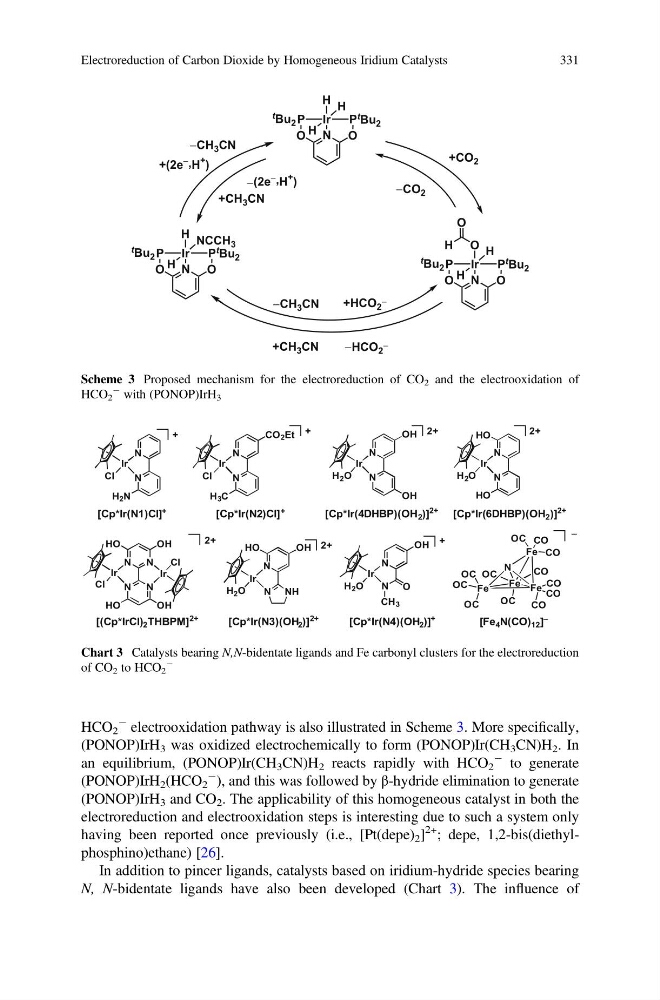
À electrooxidation pathway is also illustrated in Scheme 3. More specifically,
(PONOP)IrH 3 was oxidized electrochemically to form (PONOP)Ir(CH 3 CN)H 2 . In
an equilibrium, (PONOP)Ir(CH 3 CN)H 2 reacts rapidly with HCO 2
À to generate
(PONOP)IrH 2 (HCO 2
À ), and this was followed by β-hydride elimination to generate
(PONOP)IrH 3 and CO 2 . The applicability of this homogeneous catalyst in both the
electroreduction and electrooxidation steps is interesting due to such a system only
having been reported once previously (i.e., [Pt(depe) 2 ]
2+ ; depe, 1,2-bis(diethylphosphino)ethane) [26].
In addition to pincer ligands, catalysts based on iridium-hydride species bearing
N, N-bidentate ligands have also been developed (Chart 3). The influence of
+CO 2
+CH 3 CN
−HCO 2
−
+(2e
− , H
+
)
−CH 3 CN
Ir
N
NCCH 3
P t Bu 2
H
P
O
O
t Bu 2 H
Ir
N
H
P t Bu 2
O
P
O
O
t Bu 2 H
O
H
Ir
N
H
P t Bu 2
H
P
O
O
t Bu 2 H
−(2e
− , H
+ )
+CH 3 CN
−CH 3 CN
+HCO 2
−
−CO 2
Scheme 3 Proposed mechanism for the electroreduction of CO 2 and the electrooxidation of
HCO 2
À with (PONOP)IrH 3
[Cp*Ir(N1)Cl] +
N
N
Ir
Cl
+
H 2 N
[Cp*Ir(4DHBP)(OH 2 )]
2+
N
N
Ir
H 2 O
2+
[Cp*Ir(N2)Cl] +
N
N
Ir
Cl
+
H 3 C
CO 2 Et
OH
OH
[Cp*Ir(6DHBP)(OH 2 )]
2+
N
N
Ir
H 2 O
2+
HO
HO
[(Cp*IrCl) 2 THBPM]
2+
N
N
N
N
OH
HO
HO
OH
Ir
Ir
Cl
Cl
2+
N
Ir
H 2 O
2+
HO
OH
N NH
[Cp*Ir(N4)(OH 2 )]
+
[Cp*Ir(N3)(OH 2 )]
2+
N
Ir
H 2 O
OH
N O
CH 3
+
Fe
Fe
Fe
N
Fe
CO
OC
CO
CO
CO
CO
OC
OC
OC
OC
CO
OC
[Fe 4 N(CO) 12 ] −
−
Chart 3 Catalysts bearing N,N-bidentate ligands and Fe carbonyl clusters for the electroreduction
of CO 2 to HCO 2
À
Electroreduction of Carbon Dioxide by Homogeneous Iridium Catalysts
331
À electrooxidation pathway is also illustrated in Scheme 3. More specifically,
(PONOP)IrH 3 was oxidized electrochemically to form (PONOP)Ir(CH 3 CN)H 2 . In
an equilibrium, (PONOP)Ir(CH 3 CN)H 2 reacts rapidly with HCO 2
À to generate
(PONOP)IrH 2 (HCO 2
À ), and this was followed by β-hydride elimination to generate
(PONOP)IrH 3 and CO 2 . The applicability of this homogeneous catalyst in both the
electroreduction and electrooxidation steps is interesting due to such a system only
having been reported once previously (i.e., [Pt(depe) 2 ]
2+ ; depe, 1,2-bis(diethylphosphino)ethane) [26].
In addition to pincer ligands, catalysts based on iridium-hydride species bearing
N, N-bidentate ligands have also been developed (Chart 3). The influence of
+CO 2
+CH 3 CN
−HCO 2
−
+(2e
− , H
+
)
−CH 3 CN
Ir
N
NCCH 3
P t Bu 2
H
P
O
O
t Bu 2 H
Ir
N
H
P t Bu 2
O
P
O
O
t Bu 2 H
O
H
Ir
N
H
P t Bu 2
H
P
O
O
t Bu 2 H
−(2e
− , H
+ )
+CH 3 CN
−CH 3 CN
+HCO 2
−
−CO 2
Scheme 3 Proposed mechanism for the electroreduction of CO 2 and the electrooxidation of
HCO 2
À with (PONOP)IrH 3
[Cp*Ir(N1)Cl] +
N
N
Ir
Cl
+
H 2 N
[Cp*Ir(4DHBP)(OH 2 )]
2+
N
N
Ir
H 2 O
2+
[Cp*Ir(N2)Cl] +
N
N
Ir
Cl
+
H 3 C
CO 2 Et
OH
OH
[Cp*Ir(6DHBP)(OH 2 )]
2+
N
N
Ir
H 2 O
2+
HO
HO
[(Cp*IrCl) 2 THBPM]
2+
N
N
N
N
OH
HO
HO
OH
Ir
Ir
Cl
Cl
2+
N
Ir
H 2 O
2+
HO
OH
N NH
[Cp*Ir(N4)(OH 2 )]
+
[Cp*Ir(N3)(OH 2 )]
2+
N
Ir
H 2 O
OH
N O
CH 3
+
Fe
Fe
Fe
N
Fe
CO
OC
CO
CO
CO
CO
OC
OC
OC
OC
CO
OC
[Fe 4 N(CO) 12 ] −
−
Chart 3 Catalysts bearing N,N-bidentate ligands and Fe carbonyl clusters for the electroreduction
of CO 2 to HCO 2
À
Electroreduction of Carbon Dioxide by Homogeneous Iridium Catalysts
331