

16.6 and 19.0 kcal mol
À1 ), compared to the reaction between the in situ formed
iridium(I) monohydride species (i.e., 12.3 kcal mol
À1 ).
An iridium trihydride complex bearing a PNHP ligand with a secondary coordination sphere interactions was found to improve the catalytic activity in CH 3 CN/
12% H 2 O solution [22]. At À0.81 V, (PNHP)IrH 3 yielded HCO 2
À with an FE
(HCO 2
À ) of 97% (0.45 mA cm
À2 ). Mechanistic studies indicated that the insertion
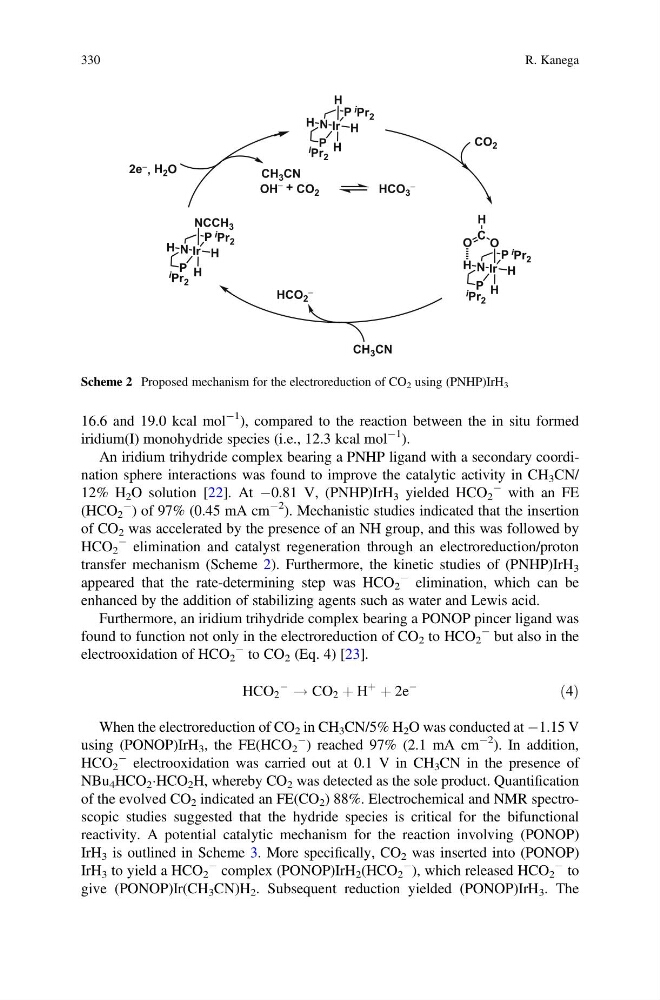
of CO 2 was accelerated by the presence of an NH group, and this was followed by
HCO 2
À elimination and catalyst regeneration through an electroreduction/proton
transfer mechanism (Scheme 2). Furthermore, the kinetic studies of (PNHP)IrH 3
appeared that the rate-determining step was HCO 2
À elimination, which can be
enhanced by the addition of stabilizing agents such as water and Lewis acid.
Furthermore, an iridium trihydride complex bearing a PONOP pincer ligand was
found to function not only in the electroreduction of CO 2 to HCO 2
À but also in the
electrooxidation of HCO 2
À to CO 2 (Eq. 4) [23].
HCO 2
À
! CO 2 þ H
þ
þ 2e
À
ð4Þ
When the electroreduction of CO 2 in CH 3 CN/5% H 2 O was conducted at À1.15 V
using (PONOP)IrH 3 , the FE(HCO 2
À ) reached 97% (2.1 mA cm
À2 ). In addition,
HCO 2
À electrooxidation was carried out at 0.1 V in CH 3 CN in the presence of
NBu 4 HCO 2 ÁHCO 2 H, whereby CO 2 was detected as the sole product. Quantification
of the evolved CO 2 indicated an FE(CO 2 ) 88%. Electrochemical and NMR spectroscopic studies suggested that the hydride species is critical for the bifunctional
reactivity. A potential catalytic mechanism for the reaction involving (PONOP)
IrH 3 is outlined in Scheme 3. More specifically, CO 2 was inserted into (PONOP)
IrH 3 to yield a HCO 2
À complex (PONOP)IrH 2 (HCO 2
À ), which released HCO 2
À to
give (PONOP)Ir(CH 3 CN)H 2 . Subsequent reduction yielded (PONOP)IrH 3 . The
CO 2
CH 3 CN
HCO 2
−
2e − , H 2 O
CH 3 CN
OH
− + CO 2
HCO 3
−
Ir
N
P
P i Pr 2
H
H
H
i Pr 2
H
Ir
N
P
P i Pr 2
H
H
H
i Pr 2
O
C
H
O
Ir
N
P
P i Pr 2
H
H
H
i Pr 2
NCCH 3
Scheme 2 Proposed mechanism for the electroreduction of CO 2 using (PNHP)IrH 3
330
R. Kanega
À1 ), compared to the reaction between the in situ formed
iridium(I) monohydride species (i.e., 12.3 kcal mol
À1 ).
An iridium trihydride complex bearing a PNHP ligand with a secondary coordination sphere interactions was found to improve the catalytic activity in CH 3 CN/
12% H 2 O solution [22]. At À0.81 V, (PNHP)IrH 3 yielded HCO 2
À with an FE
(HCO 2
À ) of 97% (0.45 mA cm
À2 ). Mechanistic studies indicated that the insertion
of CO 2 was accelerated by the presence of an NH group, and this was followed by
HCO 2
À elimination and catalyst regeneration through an electroreduction/proton
transfer mechanism (Scheme 2). Furthermore, the kinetic studies of (PNHP)IrH 3
appeared that the rate-determining step was HCO 2
À elimination, which can be
enhanced by the addition of stabilizing agents such as water and Lewis acid.
Furthermore, an iridium trihydride complex bearing a PONOP pincer ligand was
found to function not only in the electroreduction of CO 2 to HCO 2
À but also in the
electrooxidation of HCO 2
À to CO 2 (Eq. 4) [23].
HCO 2
À
! CO 2 þ H
þ
þ 2e
À
ð4Þ
When the electroreduction of CO 2 in CH 3 CN/5% H 2 O was conducted at À1.15 V
using (PONOP)IrH 3 , the FE(HCO 2
À ) reached 97% (2.1 mA cm
À2 ). In addition,
HCO 2
À electrooxidation was carried out at 0.1 V in CH 3 CN in the presence of
NBu 4 HCO 2 ÁHCO 2 H, whereby CO 2 was detected as the sole product. Quantification
of the evolved CO 2 indicated an FE(CO 2 ) 88%. Electrochemical and NMR spectroscopic studies suggested that the hydride species is critical for the bifunctional
reactivity. A potential catalytic mechanism for the reaction involving (PONOP)
IrH 3 is outlined in Scheme 3. More specifically, CO 2 was inserted into (PONOP)
IrH 3 to yield a HCO 2
À complex (PONOP)IrH 2 (HCO 2
À ), which released HCO 2
À to
give (PONOP)Ir(CH 3 CN)H 2 . Subsequent reduction yielded (PONOP)IrH 3 . The
CO 2
CH 3 CN
HCO 2
−
2e − , H 2 O
CH 3 CN
OH
− + CO 2
HCO 3
−
Ir
N
P
P i Pr 2
H
H
H
i Pr 2
H
Ir
N
P
P i Pr 2
H
H
H
i Pr 2
O
C
H
O
Ir
N
P
P i Pr 2
H
H
H
i Pr 2
NCCH 3
Scheme 2 Proposed mechanism for the electroreduction of CO 2 using (PNHP)IrH 3
330
R. Kanega