

CH 3 CN) was also active, even in aqueous solution with a small amount of organic
additive.
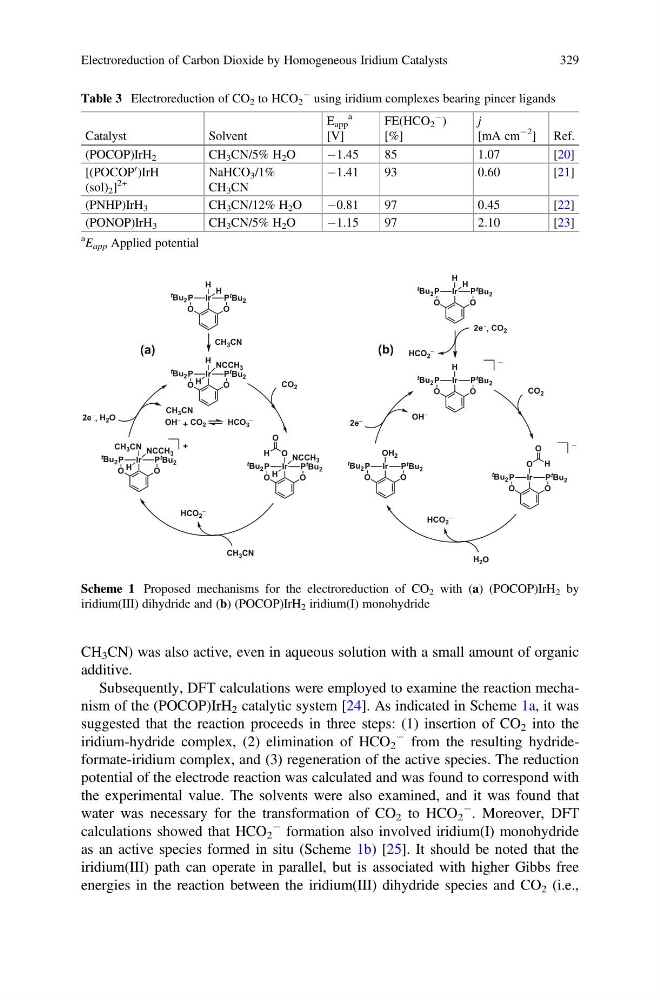
Subsequently, DFT calculations were employed to examine the reaction mechanism of the (POCOP)IrH 2 catalytic system [24]. As indicated in Scheme 1a, it was
suggested that the reaction proceeds in three steps: (1) insertion of CO 2 into the
iridium-hydride complex, (2) elimination of HCO 2
À from the resulting hydrideformate-iridium complex, and (3) regeneration of the active species. The reduction
potential of the electrode reaction was calculated and was found to correspond with
the experimental value. The solvents were also examined, and it was found that
water was necessary for the transformation of CO 2 to HCO 2
À
. Moreover, DFT
calculations showed that HCO 2
À formation also involved iridium(I) monohydride
as an active species formed in situ (Scheme 1b) [25]. It should be noted that the
iridium(III) path can operate in parallel, but is associated with higher Gibbs free
energies in the reaction between the iridium(III) dihydride species and CO 2 (i.e.,
Table 3 Electroreduction of CO 2 to HCO 2
À using iridium complexes bearing pincer ligands
Catalyst
Solvent
E app
a
[V]
FE(HCO 2
À
)
[%]
j
[mA cm
À2
] Ref.
(POCOP)IrH 2
CH 3 CN/5% H 2 O
À1.45
85
1.07
[20]
[(POCOP
0 )IrH
(sol) 2 ]
2+
NaHCO 3 /1%
CH 3 CN
À1.41
93
0.60
[21]
(PNHP)IrH 3
CH 3 CN/12% H 2 O
À0.81
97
0.45
[22]
(PONOP)IrH 3
CH 3 CN/5% H 2 O
À1.15
97
2.10
[23]
a E app Applied potential
CO 2
CH 3 CN
CH 3 CN
Ir
H
P t Bu 2
H
P
O
O
t Bu 2
Ir
NCCH 3
P t Bu 2
H
P
O
O
t Bu 2 H
Ir
NCCH 3
P t Bu 2
O
P
O
O
t Bu 2 H
O
H
Ir
NCCH 3
P t Bu 2
CH 3 CN
P
O
O
t Bu 2 H
HCO 2
−
+
2e − , H 2 O
CH 3 CN
OH − + CO 2
HCO 3
−
(a)
CO 2
H 2 O
Ir
H
P t Bu 2
H
P
O
O
t Bu 2
Ir
P t Bu 2
H
P
O
O
t Bu 2
Ir
P t Bu 2
O
P
O
O
t Bu 2
Ir
P t Bu 2
OH 2
P
O
O
t Bu 2
HCO 2
−
2e −
OH −
2e − , CO 2
HCO 2
−
−
−
H
O
(b)
Scheme 1 Proposed mechanisms for the electroreduction of CO 2 with (a) (POCOP)IrH 2 by
iridium(III) dihydride and (b) (POCOP)IrH 2 iridium(I) monohydride
Electroreduction of Carbon Dioxide by Homogeneous Iridium Catalysts
329
additive.
Subsequently, DFT calculations were employed to examine the reaction mechanism of the (POCOP)IrH 2 catalytic system [24]. As indicated in Scheme 1a, it was
suggested that the reaction proceeds in three steps: (1) insertion of CO 2 into the
iridium-hydride complex, (2) elimination of HCO 2
À from the resulting hydrideformate-iridium complex, and (3) regeneration of the active species. The reduction
potential of the electrode reaction was calculated and was found to correspond with
the experimental value. The solvents were also examined, and it was found that
water was necessary for the transformation of CO 2 to HCO 2
À
. Moreover, DFT
calculations showed that HCO 2
À formation also involved iridium(I) monohydride
as an active species formed in situ (Scheme 1b) [25]. It should be noted that the
iridium(III) path can operate in parallel, but is associated with higher Gibbs free
energies in the reaction between the iridium(III) dihydride species and CO 2 (i.e.,
Table 3 Electroreduction of CO 2 to HCO 2
À using iridium complexes bearing pincer ligands
Catalyst
Solvent
E app
a
[V]
FE(HCO 2
À
)
[%]
j
[mA cm
À2
] Ref.
(POCOP)IrH 2
CH 3 CN/5% H 2 O
À1.45
85
1.07
[20]
[(POCOP
0 )IrH
(sol) 2 ]
2+
NaHCO 3 /1%
CH 3 CN
À1.41
93
0.60
[21]
(PNHP)IrH 3
CH 3 CN/12% H 2 O
À0.81
97
0.45
[22]
(PONOP)IrH 3
CH 3 CN/5% H 2 O
À1.15
97
2.10
[23]
a E app Applied potential
CO 2
CH 3 CN
CH 3 CN
Ir
H
P t Bu 2
H
P
O
O
t Bu 2
Ir
NCCH 3
P t Bu 2
H
P
O
O
t Bu 2 H
Ir
NCCH 3
P t Bu 2
O
P
O
O
t Bu 2 H
O
H
Ir
NCCH 3
P t Bu 2
CH 3 CN
P
O
O
t Bu 2 H
HCO 2
−
+
2e − , H 2 O
CH 3 CN
OH − + CO 2
HCO 3
−
(a)
CO 2
H 2 O
Ir
H
P t Bu 2
H
P
O
O
t Bu 2
Ir
P t Bu 2
H
P
O
O
t Bu 2
Ir
P t Bu 2
O
P
O
O
t Bu 2
Ir
P t Bu 2
OH 2
P
O
O
t Bu 2
HCO 2
−
2e −
OH −
2e − , CO 2
HCO 2
−
−
−
H
O
(b)
Scheme 1 Proposed mechanisms for the electroreduction of CO 2 with (a) (POCOP)IrH 2 by
iridium(III) dihydride and (b) (POCOP)IrH 2 iridium(I) monohydride
Electroreduction of Carbon Dioxide by Homogeneous Iridium Catalysts
329