

calculations at the DFT level on the Ir-NSi
Me catalyzed CO 2 reduction to
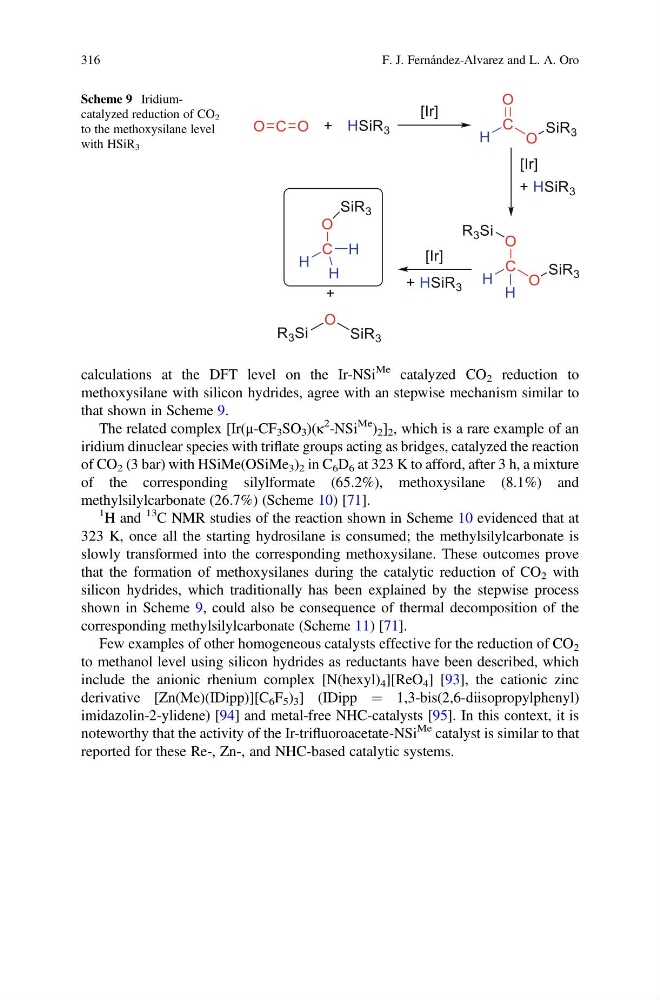
methoxysilane with silicon hydrides, agree with an stepwise mechanism similar to
that shown in Scheme 9.
The related complex [Ir(μ-CF 3 SO 3 )(κ
2 -NSi
Me
) 2 ] 2 , which is a rare example of an
iridium dinuclear species with triflate groups acting as bridges, catalyzed the reaction
of CO 2 (3 bar) with HSiMe(OSiMe 3 ) 2 in C 6 D 6 at 323 K to afford, after 3 h, a mixture
of the corresponding silylformate (65.2%), methoxysilane (8.1%) and
methylsilylcarbonate (26.7%) (Scheme 10) [71].
1 H and
13 C NMR studies of the reaction shown in Scheme 10 evidenced that at
323 K, once all the starting hydrosilane is consumed; the methylsilylcarbonate is
slowly transformed into the corresponding methoxysilane. These outcomes prove
that the formation of methoxysilanes during the catalytic reduction of CO 2 with
silicon hydrides, which traditionally has been explained by the stepwise process
shown in Scheme 9, could also be consequence of thermal decomposition of the
corresponding methylsilylcarbonate (Scheme 11) [71].
Few examples of other homogeneous catalysts effective for the reduction of CO 2
to methanol level using silicon hydrides as reductants have been described, which
include the anionic rhenium complex [N(hexyl) 4 ][ReO 4 ] [93], the cationic zinc
derivative [Zn(Me)(IDipp)][C 6 F 5 ) 3 ] (IDipp ¼ 1,3-bis(2,6-diisopropylphenyl)
imidazolin-2-ylidene) [94] and metal-free NHC-catalysts [95]. In this context, it is
noteworthy that the activity of the Ir-trifluoroacetate-NSi
Me catalyst is similar to that
reported for these Re-, Zn-, and NHC-based catalytic systems.
Scheme 9 Iridiumcatalyzed reduction of CO 2
to the methoxysilane level
with HSiR 3
316
F. J. Fernández-Alvarez and L. A. Oro
Me catalyzed CO 2 reduction to
methoxysilane with silicon hydrides, agree with an stepwise mechanism similar to
that shown in Scheme 9.
The related complex [Ir(μ-CF 3 SO 3 )(κ
2 -NSi
Me
) 2 ] 2 , which is a rare example of an
iridium dinuclear species with triflate groups acting as bridges, catalyzed the reaction
of CO 2 (3 bar) with HSiMe(OSiMe 3 ) 2 in C 6 D 6 at 323 K to afford, after 3 h, a mixture
of the corresponding silylformate (65.2%), methoxysilane (8.1%) and
methylsilylcarbonate (26.7%) (Scheme 10) [71].
1 H and
13 C NMR studies of the reaction shown in Scheme 10 evidenced that at
323 K, once all the starting hydrosilane is consumed; the methylsilylcarbonate is
slowly transformed into the corresponding methoxysilane. These outcomes prove
that the formation of methoxysilanes during the catalytic reduction of CO 2 with
silicon hydrides, which traditionally has been explained by the stepwise process
shown in Scheme 9, could also be consequence of thermal decomposition of the
corresponding methylsilylcarbonate (Scheme 11) [71].
Few examples of other homogeneous catalysts effective for the reduction of CO 2
to methanol level using silicon hydrides as reductants have been described, which
include the anionic rhenium complex [N(hexyl) 4 ][ReO 4 ] [93], the cationic zinc
derivative [Zn(Me)(IDipp)][C 6 F 5 ) 3 ] (IDipp ¼ 1,3-bis(2,6-diisopropylphenyl)
imidazolin-2-ylidene) [94] and metal-free NHC-catalysts [95]. In this context, it is
noteworthy that the activity of the Ir-trifluoroacetate-NSi
Me catalyst is similar to that
reported for these Re-, Zn-, and NHC-based catalytic systems.
Scheme 9 Iridiumcatalyzed reduction of CO 2
to the methoxysilane level
with HSiR 3
316
F. J. Fernández-Alvarez and L. A. Oro