

3.3 Iridium-Catalyzed Reduction of CO 2 to Methane
with Silicon-Hydrides
The catalytic reduction of CO 2 to methane using hydrosilanes as reducing agents
remains a challenge. Examples of transition metal catalysts based on Zr [96, 97], Hf
[97], Ir [98], Pd [99] and Pt [99] complexes as well as transition metal-free catalysts
such as the frustrated Lewis pair B(C 6 F 5 ) 3 /TMP (TMP ¼ 2,2,6,6tetramethylpyperidine) [100] and other Lewis acids and ionic pairs [101–
104]. Among them stands out the iridium(III) cationic species [Ir(H)(η
1 -HSiR 3 )
(POCOP)][B(C 6 F 5 ) 4 ] (POCOP ¼ 2,6-bis((di-tert-butylphosphanyl)oxy)benzen-1yl) reported by Brookhart et al. in 2012 [98], which has proven to be effective for
the reduction of CO 2 (1 bar, 296 K) to methane with different hydrosilanes (HSiEt 3 ,
HSiPh 3 , HSiMe 2 Et, HSiMe 2 Ph, and HSiEt 2 Me) using C 6 H 5 Cl as solvent. This
catalytic system works reasonably well with HSiMe 2 Ph at 296 K (TOF ¼ 115 h
À1 ),
moreover, increasing the temperature to 333 K produces a positive effect of the
catalytic activity (TOF ¼ 661 h
À1 ) (Scheme 12) [98].
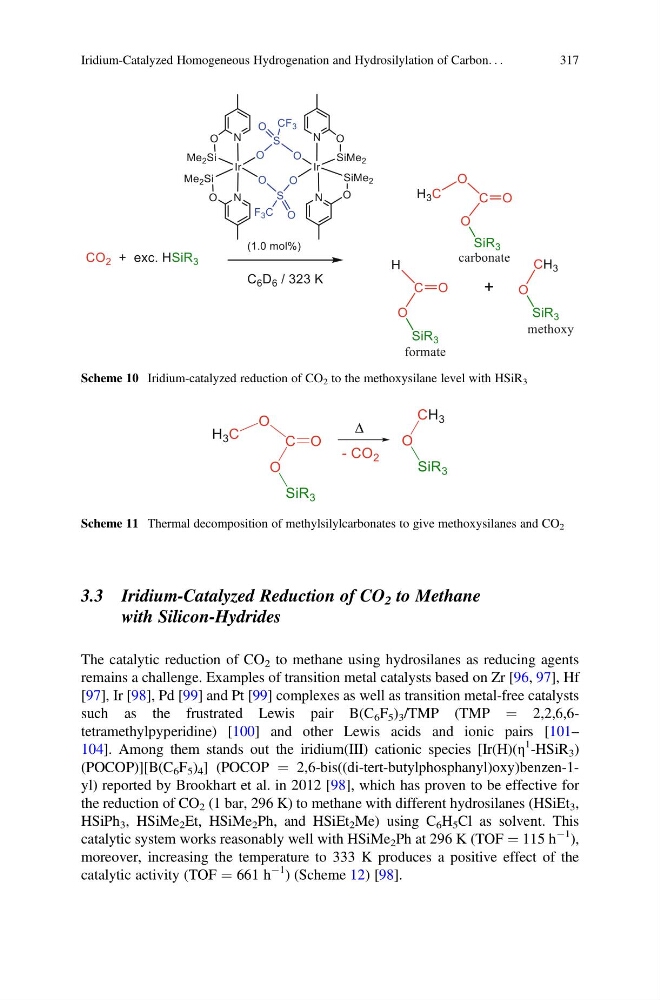
Scheme 10 Iridium-catalyzed reduction of CO 2 to the methoxysilane level with HSiR 3
Scheme 11 Thermal decomposition of methylsilylcarbonates to give methoxysilanes and CO 2
Iridium-Catalyzed Homogeneous Hydrogenation and Hydrosilylation of Carbon. . .
317
with Silicon-Hydrides
The catalytic reduction of CO 2 to methane using hydrosilanes as reducing agents
remains a challenge. Examples of transition metal catalysts based on Zr [96, 97], Hf
[97], Ir [98], Pd [99] and Pt [99] complexes as well as transition metal-free catalysts
such as the frustrated Lewis pair B(C 6 F 5 ) 3 /TMP (TMP ¼ 2,2,6,6tetramethylpyperidine) [100] and other Lewis acids and ionic pairs [101–
104]. Among them stands out the iridium(III) cationic species [Ir(H)(η
1 -HSiR 3 )
(POCOP)][B(C 6 F 5 ) 4 ] (POCOP ¼ 2,6-bis((di-tert-butylphosphanyl)oxy)benzen-1yl) reported by Brookhart et al. in 2012 [98], which has proven to be effective for
the reduction of CO 2 (1 bar, 296 K) to methane with different hydrosilanes (HSiEt 3 ,
HSiPh 3 , HSiMe 2 Et, HSiMe 2 Ph, and HSiEt 2 Me) using C 6 H 5 Cl as solvent. This
catalytic system works reasonably well with HSiMe 2 Ph at 296 K (TOF ¼ 115 h
À1 ),
moreover, increasing the temperature to 333 K produces a positive effect of the
catalytic activity (TOF ¼ 661 h
À1 ) (Scheme 12) [98].
Scheme 10 Iridium-catalyzed reduction of CO 2 to the methoxysilane level with HSiR 3
Scheme 11 Thermal decomposition of methylsilylcarbonates to give methoxysilanes and CO 2
Iridium-Catalyzed Homogeneous Hydrogenation and Hydrosilylation of Carbon. . .
317