

of hydroorganosilanes, as reductants. Therefore, from the point of view of sustainability iridium species based on Ir-NSiN and Ir-NSi
Me species could be considered
promising for future applications of the catalytic reduction of CO 2 with silicon
hydrides.
3.2 Iridium-Catalyzed Reduction of CO 2 to Methoxysilanes
with Silicon-Hydrides
Only few examples of homogeneous catalysts effective for the reduction of CO 2 to
methanol level using silicon hydrides as reducing agents have been published to
date. The first one was the abovementioned iridium complex [Ir(CN)(CO)(dppe)]
(dppe ¼ 1,2-bis(diphenylphosphino)ethane) [74]. This catalyst promotes the reduction of CO 2 with HSiMe 3 in C 6 D 6 at 313 K to the corresponding methoxysilane,
CH 3 OSiMe 3 . This reaction is slow, and 2 weeks are required to achieve the conversion of the starting hydrosilane into CH 3 OSiMe 3 .
13 C NMR studies of this process
using
13 CO 2 confirm that it entails in a stepwise progression with the initial formation of the corresponding silylformate HCO 2 SiMe 3 , which is further reduce to bis
(silyl)acetal CH 2 (OSiMe 3 ) 2 , the later finally reacts with one equivalent of HSiMe 3 to
give CH 3 OSiMe 3 and O(SiMe 3 ) 2 (Scheme 9) [74].
The iridium(III) complex [Ir(CF 3 CO 2 )(κ
2 -NSi
Me ) 2 ] (Fig. 5) has proven to be an
effective catalyst for the reduction of CO 2 with HSiMe(OSiMe 3 ) 2 to the
methoxysilane CH 3 OSiMe(OSiMe 3 ) 2 under mild reaction conditions.
1 H NMR
studies of the reaction of CO 2 (1 bar) with HSiMe(OSiMe 3 ) 2 in C 6 D 6 at 298 K
evidenced the selective formation of the corresponding methoxysilane after 16 h
(99.0%; TON ¼ 33.6; TOF ¼ 2.1 h
À1 ) [81]. Interestingly, increasing the CO 2
pressure to 4 bar the reaction stops in the corresponding silylformate, which under
4 bar is the major reaction product (93%; TON ¼ 93; TOF ¼ 2.9 h
À1 ) together with a
7% of CH 3 OSiMe(OSiMe 3 ) 2 after 3.5 h.
1 H and
13 C NMR studies and theoretical
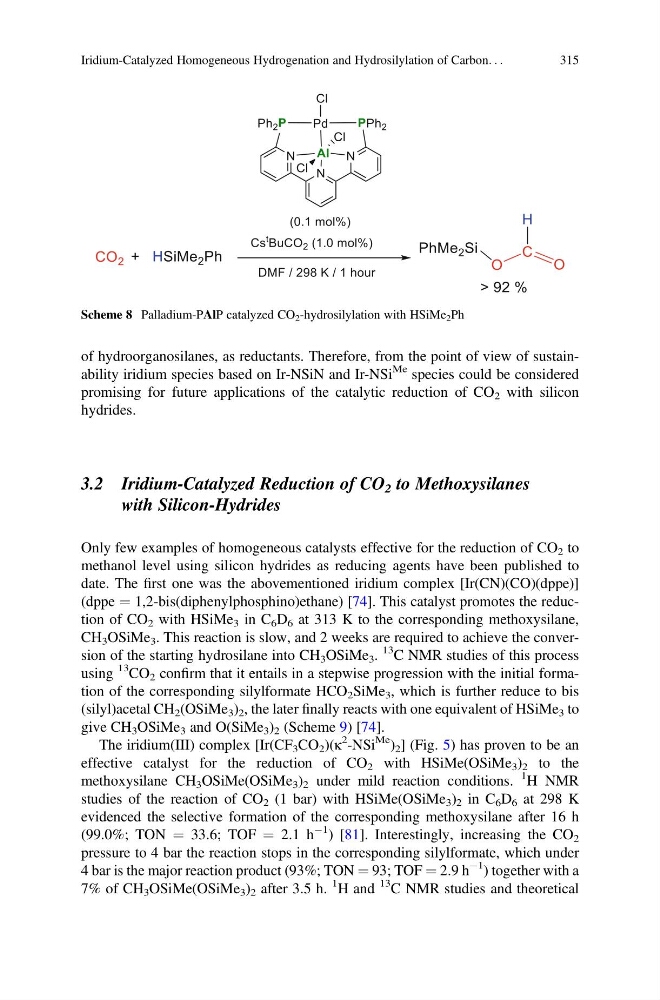
Scheme 8 Palladium-PAlP catalyzed CO 2 -hydrosilylation with HSiMe 2 Ph
Iridium-Catalyzed Homogeneous Hydrogenation and Hydrosilylation of Carbon. . .
315
Me species could be considered
promising for future applications of the catalytic reduction of CO 2 with silicon
hydrides.
3.2 Iridium-Catalyzed Reduction of CO 2 to Methoxysilanes
with Silicon-Hydrides
Only few examples of homogeneous catalysts effective for the reduction of CO 2 to
methanol level using silicon hydrides as reducing agents have been published to
date. The first one was the abovementioned iridium complex [Ir(CN)(CO)(dppe)]
(dppe ¼ 1,2-bis(diphenylphosphino)ethane) [74]. This catalyst promotes the reduction of CO 2 with HSiMe 3 in C 6 D 6 at 313 K to the corresponding methoxysilane,
CH 3 OSiMe 3 . This reaction is slow, and 2 weeks are required to achieve the conversion of the starting hydrosilane into CH 3 OSiMe 3 .
13 C NMR studies of this process
using
13 CO 2 confirm that it entails in a stepwise progression with the initial formation of the corresponding silylformate HCO 2 SiMe 3 , which is further reduce to bis
(silyl)acetal CH 2 (OSiMe 3 ) 2 , the later finally reacts with one equivalent of HSiMe 3 to
give CH 3 OSiMe 3 and O(SiMe 3 ) 2 (Scheme 9) [74].
The iridium(III) complex [Ir(CF 3 CO 2 )(κ
2 -NSi
Me ) 2 ] (Fig. 5) has proven to be an
effective catalyst for the reduction of CO 2 with HSiMe(OSiMe 3 ) 2 to the
methoxysilane CH 3 OSiMe(OSiMe 3 ) 2 under mild reaction conditions.
1 H NMR
studies of the reaction of CO 2 (1 bar) with HSiMe(OSiMe 3 ) 2 in C 6 D 6 at 298 K
evidenced the selective formation of the corresponding methoxysilane after 16 h
(99.0%; TON ¼ 33.6; TOF ¼ 2.1 h
À1 ) [81]. Interestingly, increasing the CO 2
pressure to 4 bar the reaction stops in the corresponding silylformate, which under
4 bar is the major reaction product (93%; TON ¼ 93; TOF ¼ 2.9 h
À1 ) together with a
7% of CH 3 OSiMe(OSiMe 3 ) 2 after 3.5 h.
1 H and
13 C NMR studies and theoretical
Scheme 8 Palladium-PAlP catalyzed CO 2 -hydrosilylation with HSiMe 2 Ph
Iridium-Catalyzed Homogeneous Hydrogenation and Hydrosilylation of Carbon. . .
315