

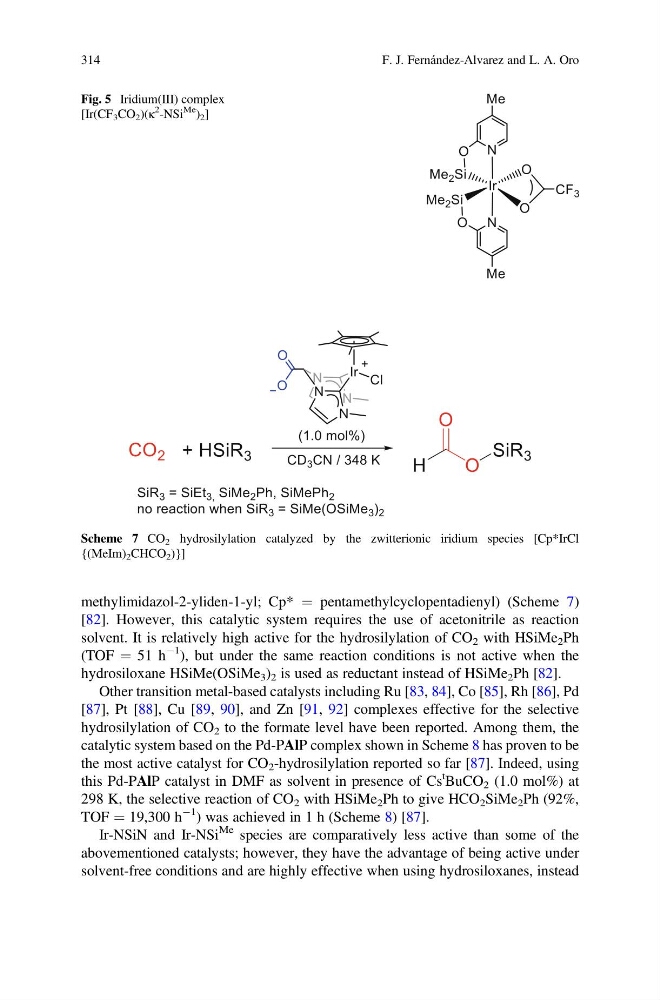
methylimidazol-2-yliden-1-yl; Cp* ¼ pentamethylcyclopentadienyl) (Scheme 7)
[82]. However, this catalytic system requires the use of acetonitrile as reaction
solvent. It is relatively high active for the hydrosilylation of CO 2 with HSiMe 2 Ph
(TOF ¼ 51 h
À1 ), but under the same reaction conditions is not active when the
hydrosiloxane HSiMe(OSiMe 3 ) 2 is used as reductant instead of HSiMe 2 Ph [82].
Other transition metal-based catalysts including Ru [83, 84], Co [85], Rh [86], Pd
[87], Pt [88], Cu [89, 90], and Zn [91, 92] complexes effective for the selective
hydrosilylation of CO 2 to the formate level have been reported. Among them, the
catalytic system based on the Pd-PAlP complex shown in Scheme 8 has proven to be
the most active catalyst for CO 2 -hydrosilylation reported so far [87]. Indeed, using
this Pd-PAlP catalyst in DMF as solvent in presence of Cs
t BuCO 2 (1.0 mol%) at
298 K, the selective reaction of CO 2 with HSiMe 2 Ph to give HCO 2 SiMe 2 Ph (92%,
TOF ¼ 19,300 h
À1 ) was achieved in 1 h (Scheme 8) [87].
Ir-NSiN and Ir-NSi
Me species are comparatively less active than some of the
abovementioned catalysts; however, they have the advantage of being active under
solvent-free conditions and are highly effective when using hydrosiloxanes, instead
Fig. 5 Iridium(III) complex
[Ir(CF 3 CO 2 )(κ
2
-NSi
Me
) 2 ]
Scheme 7 CO 2 hydrosilylation catalyzed by the zwitterionic iridium species [Cp*IrCl
{(MeIm) 2 CHCO 2 )}]
314
F. J. Fernández-Alvarez and L. A. Oro
[82]. However, this catalytic system requires the use of acetonitrile as reaction
solvent. It is relatively high active for the hydrosilylation of CO 2 with HSiMe 2 Ph
(TOF ¼ 51 h
À1 ), but under the same reaction conditions is not active when the
hydrosiloxane HSiMe(OSiMe 3 ) 2 is used as reductant instead of HSiMe 2 Ph [82].
Other transition metal-based catalysts including Ru [83, 84], Co [85], Rh [86], Pd
[87], Pt [88], Cu [89, 90], and Zn [91, 92] complexes effective for the selective
hydrosilylation of CO 2 to the formate level have been reported. Among them, the
catalytic system based on the Pd-PAlP complex shown in Scheme 8 has proven to be
the most active catalyst for CO 2 -hydrosilylation reported so far [87]. Indeed, using
this Pd-PAlP catalyst in DMF as solvent in presence of Cs
t BuCO 2 (1.0 mol%) at
298 K, the selective reaction of CO 2 with HSiMe 2 Ph to give HCO 2 SiMe 2 Ph (92%,
TOF ¼ 19,300 h
À1 ) was achieved in 1 h (Scheme 8) [87].
Ir-NSiN and Ir-NSi
Me species are comparatively less active than some of the
abovementioned catalysts; however, they have the advantage of being active under
solvent-free conditions and are highly effective when using hydrosiloxanes, instead
Fig. 5 Iridium(III) complex
[Ir(CF 3 CO 2 )(κ
2
-NSi
Me
) 2 ]
Scheme 7 CO 2 hydrosilylation catalyzed by the zwitterionic iridium species [Cp*IrCl
{(MeIm) 2 CHCO 2 )}]
314
F. J. Fernández-Alvarez and L. A. Oro