

and under 8 bar of CO 2 (100% conversion; 98.9% yield to SF by GC-MS;
TOF ¼ 99.3 h
À1 ), at temperatures above 328 K a decrease in catalytic selectivity
and activity was observed [79].
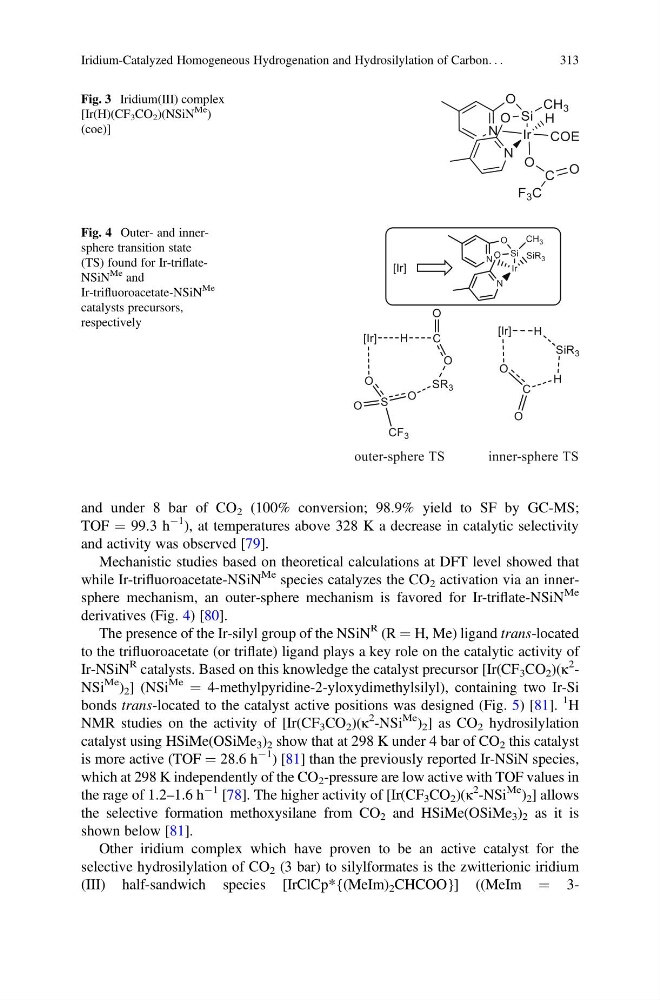
Mechanistic studies based on theoretical calculations at DFT level showed that
while Ir-trifluoroacetate-NSiN
Me species catalyzes the CO 2 activation via an innersphere mechanism, an outer-sphere mechanism is favored for Ir-triflate-NSiN
Me
derivatives (Fig. 4) [80].
The presence of the Ir-silyl group of the NSiN
R (R ¼ H, Me) ligand trans-located
to the trifluoroacetate (or triflate) ligand plays a key role on the catalytic activity of
Ir-NSiN
R catalysts. Based on this knowledge the catalyst precursor [Ir(CF 3 CO 2 )(κ
2 -
NSi
Me ) 2 ] (NSi
Me
¼ 4-methylpyridine-2-yloxydimethylsilyl), containing two Ir-Si
bonds trans-located to the catalyst active positions was designed (Fig. 5) [81].
1 H
NMR studies on the activity of [Ir(CF 3 CO 2 )(κ
2 -NSi
Me
) 2 ] as CO 2 hydrosilylation
catalyst using HSiMe(OSiMe 3 ) 2 show that at 298 K under 4 bar of CO 2 this catalyst
is more active (TOF ¼ 28.6 h
À1 ) [81] than the previously reported Ir-NSiN species,
which at 298 K independently of the CO 2 -pressure are low active with TOF values in
the rage of 1.2–1.6 h
À1 [78]. The higher activity of [Ir(CF 3 CO 2 )(κ
2 -NSi
Me ) 2 ] allows
the selective formation methoxysilane from CO 2 and HSiMe(OSiMe 3 ) 2 as it is
shown below [81].
Other iridium complex which have proven to be an active catalyst for the
selective hydrosilylation of CO 2 (3 bar) to silylformates is the zwitterionic iridium
(III) half-sandwich species [IrClCp*{(MeIm) 2 CHCOO}] ((MeIm ¼ 3Fig. 3 Iridium(III) complex
[Ir(H)(CF 3 CO 2 )(NSiN
Me
)
(coe)]
Fig. 4 Outer- and innersphere transition state
(TS) found for Ir-triflateNSiN
Me and
Ir-trifluoroacetate-NSiN
Me
catalysts precursors,
respectively
Iridium-Catalyzed Homogeneous Hydrogenation and Hydrosilylation of Carbon. . .
313
TOF ¼ 99.3 h
À1 ), at temperatures above 328 K a decrease in catalytic selectivity
and activity was observed [79].
Mechanistic studies based on theoretical calculations at DFT level showed that
while Ir-trifluoroacetate-NSiN
Me species catalyzes the CO 2 activation via an innersphere mechanism, an outer-sphere mechanism is favored for Ir-triflate-NSiN
Me
derivatives (Fig. 4) [80].
The presence of the Ir-silyl group of the NSiN
R (R ¼ H, Me) ligand trans-located
to the trifluoroacetate (or triflate) ligand plays a key role on the catalytic activity of
Ir-NSiN
R catalysts. Based on this knowledge the catalyst precursor [Ir(CF 3 CO 2 )(κ
2 -
NSi
Me ) 2 ] (NSi
Me
¼ 4-methylpyridine-2-yloxydimethylsilyl), containing two Ir-Si
bonds trans-located to the catalyst active positions was designed (Fig. 5) [81].
1 H
NMR studies on the activity of [Ir(CF 3 CO 2 )(κ
2 -NSi
Me
) 2 ] as CO 2 hydrosilylation
catalyst using HSiMe(OSiMe 3 ) 2 show that at 298 K under 4 bar of CO 2 this catalyst
is more active (TOF ¼ 28.6 h
À1 ) [81] than the previously reported Ir-NSiN species,
which at 298 K independently of the CO 2 -pressure are low active with TOF values in
the rage of 1.2–1.6 h
À1 [78]. The higher activity of [Ir(CF 3 CO 2 )(κ
2 -NSi
Me ) 2 ] allows
the selective formation methoxysilane from CO 2 and HSiMe(OSiMe 3 ) 2 as it is
shown below [81].
Other iridium complex which have proven to be an active catalyst for the
selective hydrosilylation of CO 2 (3 bar) to silylformates is the zwitterionic iridium
(III) half-sandwich species [IrClCp*{(MeIm) 2 CHCOO}] ((MeIm ¼ 3Fig. 3 Iridium(III) complex
[Ir(H)(CF 3 CO 2 )(NSiN
Me
)
(coe)]
Fig. 4 Outer- and innersphere transition state
(TS) found for Ir-triflateNSiN
Me and
Ir-trifluoroacetate-NSiN
Me
catalysts precursors,
respectively
Iridium-Catalyzed Homogeneous Hydrogenation and Hydrosilylation of Carbon. . .
313