

3.1 Iridium-Catalyzed CO 2 Hydrosilylation to Silylformate
The iridium complex [Ir(CN)(CO)(dppe)] (dppe ¼ 1,2-bis(diphenylphosphino)ethane), reported in 1989 by Eisenschmid and Eisenberg, is the first example of a
homogeneous iridium-based catalyst effective for the hydrosilylation of CO 2 . However, the catalytic activity and the selectivity of this iridium catalyst were low [74]. It
was not until 2012 that an example of iridium catalyst, complex [Ir(CF 3 SO 3 )(NSiN)
(SiR 3 )(NCMe 3 )] (NSiN ¼ fac-bis-(pyridine-2-yloxy)methylsilyl; SiR 3 ¼ SiMe
(OSiMe 3 ) 2 ), efficient for the hydrosilylation of CO 2 to selectively give the
corresponding silylformate was reported [76]. This catalytic system allows the
solvent-free and gram-scale formation of silylformates under mild reaction conditions (3 bar, 298 K, TON ¼ 97.5) but is slow (TON ¼ 0.7 h
À1
) [76]. Interestingly,
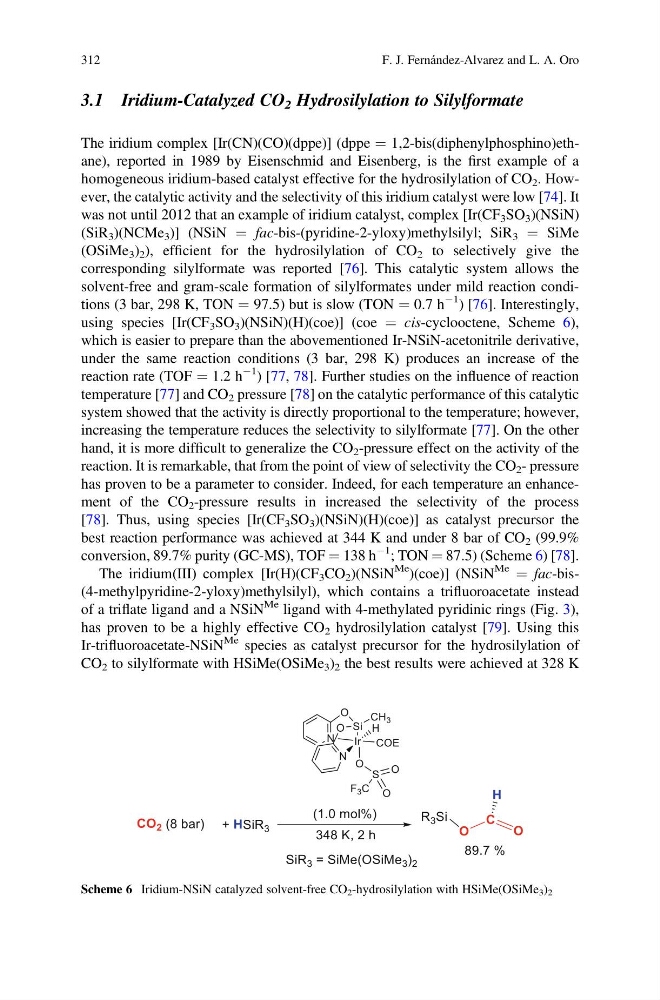
using species [Ir(CF 3 SO 3 )(NSiN)(H)(coe)] (coe ¼ cis-cyclooctene, Scheme 6),
which is easier to prepare than the abovementioned Ir-NSiN-acetonitrile derivative,
under the same reaction conditions (3 bar, 298 K) produces an increase of the
reaction rate (TOF ¼ 1.2 h
À1 ) [77, 78]. Further studies on the influence of reaction
temperature [77] and CO 2 pressure [78] on the catalytic performance of this catalytic
system showed that the activity is directly proportional to the temperature; however,
increasing the temperature reduces the selectivity to silylformate [77]. On the other
hand, it is more difficult to generalize the CO 2 -pressure effect on the activity of the
reaction. It is remarkable, that from the point of view of selectivity the CO 2 - pressure
has proven to be a parameter to consider. Indeed, for each temperature an enhancement of the CO 2 -pressure results in increased the selectivity of the process
[78]. Thus, using species [Ir(CF 3 SO 3 )(NSiN)(H)(coe)] as catalyst precursor the
best reaction performance was achieved at 344 K and under 8 bar of CO 2 (99.9%
conversion, 89.7% purity (GC-MS), TOF ¼ 138 h
À1 ; TON ¼ 87.5) (Scheme 6) [78].
The iridium(III) complex [Ir(H)(CF 3 CO 2 )(NSiN
Me )(coe)] (NSiN
Me
¼ fac-bis(4-methylpyridine-2-yloxy)methylsilyl), which contains a trifluoroacetate instead
of a triflate ligand and a NSiN
Me ligand with 4-methylated pyridinic rings (Fig. 3),
has proven to be a highly effective CO 2 hydrosilylation catalyst [79]. Using this
Ir-trifluoroacetate-NSiN
Me species as catalyst precursor for the hydrosilylation of
CO 2 to silylformate with HSiMe(OSiMe 3 ) 2 the best results were achieved at 328 K
Scheme 6 Iridium-NSiN catalyzed solvent-free CO 2 -hydrosilylation with HSiMe(OSiMe 3 ) 2
312
F. J. Fernández-Alvarez and L. A. Oro
The iridium complex [Ir(CN)(CO)(dppe)] (dppe ¼ 1,2-bis(diphenylphosphino)ethane), reported in 1989 by Eisenschmid and Eisenberg, is the first example of a
homogeneous iridium-based catalyst effective for the hydrosilylation of CO 2 . However, the catalytic activity and the selectivity of this iridium catalyst were low [74]. It
was not until 2012 that an example of iridium catalyst, complex [Ir(CF 3 SO 3 )(NSiN)
(SiR 3 )(NCMe 3 )] (NSiN ¼ fac-bis-(pyridine-2-yloxy)methylsilyl; SiR 3 ¼ SiMe
(OSiMe 3 ) 2 ), efficient for the hydrosilylation of CO 2 to selectively give the
corresponding silylformate was reported [76]. This catalytic system allows the
solvent-free and gram-scale formation of silylformates under mild reaction conditions (3 bar, 298 K, TON ¼ 97.5) but is slow (TON ¼ 0.7 h
À1
) [76]. Interestingly,
using species [Ir(CF 3 SO 3 )(NSiN)(H)(coe)] (coe ¼ cis-cyclooctene, Scheme 6),
which is easier to prepare than the abovementioned Ir-NSiN-acetonitrile derivative,
under the same reaction conditions (3 bar, 298 K) produces an increase of the
reaction rate (TOF ¼ 1.2 h
À1 ) [77, 78]. Further studies on the influence of reaction
temperature [77] and CO 2 pressure [78] on the catalytic performance of this catalytic
system showed that the activity is directly proportional to the temperature; however,
increasing the temperature reduces the selectivity to silylformate [77]. On the other
hand, it is more difficult to generalize the CO 2 -pressure effect on the activity of the
reaction. It is remarkable, that from the point of view of selectivity the CO 2 - pressure
has proven to be a parameter to consider. Indeed, for each temperature an enhancement of the CO 2 -pressure results in increased the selectivity of the process
[78]. Thus, using species [Ir(CF 3 SO 3 )(NSiN)(H)(coe)] as catalyst precursor the
best reaction performance was achieved at 344 K and under 8 bar of CO 2 (99.9%
conversion, 89.7% purity (GC-MS), TOF ¼ 138 h
À1 ; TON ¼ 87.5) (Scheme 6) [78].
The iridium(III) complex [Ir(H)(CF 3 CO 2 )(NSiN
Me )(coe)] (NSiN
Me
¼ fac-bis(4-methylpyridine-2-yloxy)methylsilyl), which contains a trifluoroacetate instead
of a triflate ligand and a NSiN
Me ligand with 4-methylated pyridinic rings (Fig. 3),
has proven to be a highly effective CO 2 hydrosilylation catalyst [79]. Using this
Ir-trifluoroacetate-NSiN
Me species as catalyst precursor for the hydrosilylation of
CO 2 to silylformate with HSiMe(OSiMe 3 ) 2 the best results were achieved at 328 K
Scheme 6 Iridium-NSiN catalyzed solvent-free CO 2 -hydrosilylation with HSiMe(OSiMe 3 ) 2
312
F. J. Fernández-Alvarez and L. A. Oro