

being a thermodynamically favored process and the fact that silanes are easier and
safer to handle and to store than molecular hydrogen [22, 23, 25, 26, 67]. However,
the utilization of silicon hydrides as reductants for large-scale reduction of CO 2 faces
some difficulties. One of them is the high price of hydrosilanes, which could be
solved by using cheap hydrosiloxanes instead of hydrosilanes, another is the stoichiometric generation of siloxanes, which is unsustainable due to the challenge of
Si-H regeneration from Si-O-Si bonds [24, 68]. Furthermore, differently to hydrogenation processes, the catalytic hydrosilylation cannot be performed in aqueous or
alcoholic solutions since homogeneous hydrosilylation catalysts usually catalyzed
the dehydrogenative hydrolysis and/or alcoholysis of silicon hydrides [69, 70].
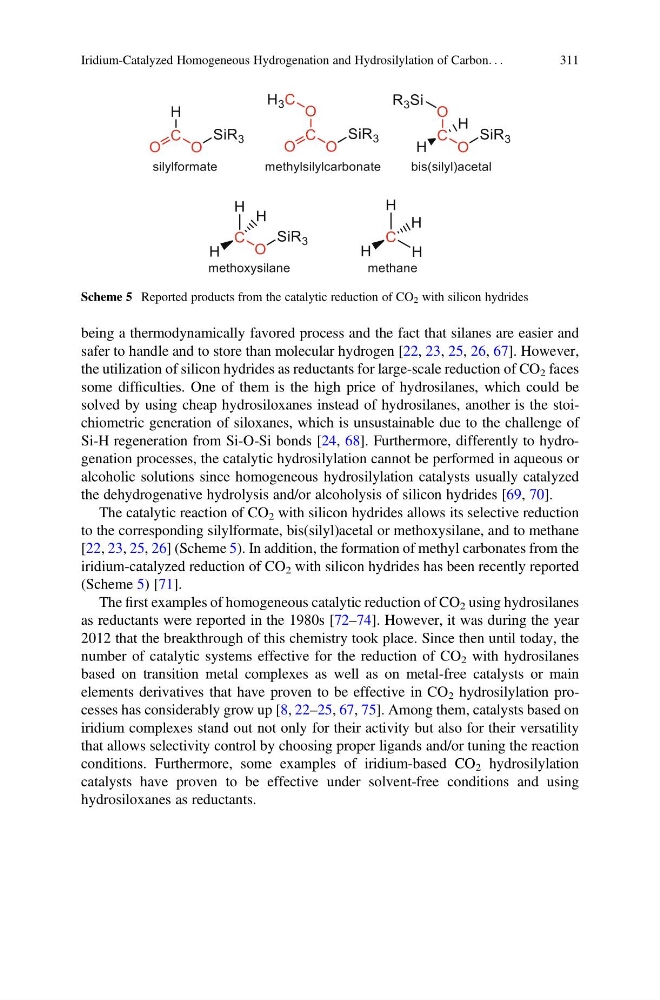
The catalytic reaction of CO 2 with silicon hydrides allows its selective reduction
to the corresponding silylformate, bis(silyl)acetal or methoxysilane, and to methane
[22, 23, 25, 26] (Scheme 5). In addition, the formation of methyl carbonates from the
iridium-catalyzed reduction of CO 2 with silicon hydrides has been recently reported
(Scheme 5) [71].
The first examples of homogeneous catalytic reduction of CO 2 using hydrosilanes
as reductants were reported in the 1980s [72–74]. However, it was during the year
2012 that the breakthrough of this chemistry took place. Since then until today, the
number of catalytic systems effective for the reduction of CO 2 with hydrosilanes
based on transition metal complexes as well as on metal-free catalysts or main
elements derivatives that have proven to be effective in CO 2 hydrosilylation processes has considerably grow up [8, 22–25, 67, 75]. Among them, catalysts based on
iridium complexes stand out not only for their activity but also for their versatility
that allows selectivity control by choosing proper ligands and/or tuning the reaction
conditions. Furthermore, some examples of iridium-based CO 2 hydrosilylation
catalysts have proven to be effective under solvent-free conditions and using
hydrosiloxanes as reductants.
Scheme 5 Reported products from the catalytic reduction of CO 2 with silicon hydrides
Iridium-Catalyzed Homogeneous Hydrogenation and Hydrosilylation of Carbon. . .
311
safer to handle and to store than molecular hydrogen [22, 23, 25, 26, 67]. However,
the utilization of silicon hydrides as reductants for large-scale reduction of CO 2 faces
some difficulties. One of them is the high price of hydrosilanes, which could be
solved by using cheap hydrosiloxanes instead of hydrosilanes, another is the stoichiometric generation of siloxanes, which is unsustainable due to the challenge of
Si-H regeneration from Si-O-Si bonds [24, 68]. Furthermore, differently to hydrogenation processes, the catalytic hydrosilylation cannot be performed in aqueous or
alcoholic solutions since homogeneous hydrosilylation catalysts usually catalyzed
the dehydrogenative hydrolysis and/or alcoholysis of silicon hydrides [69, 70].
The catalytic reaction of CO 2 with silicon hydrides allows its selective reduction
to the corresponding silylformate, bis(silyl)acetal or methoxysilane, and to methane
[22, 23, 25, 26] (Scheme 5). In addition, the formation of methyl carbonates from the
iridium-catalyzed reduction of CO 2 with silicon hydrides has been recently reported
(Scheme 5) [71].
The first examples of homogeneous catalytic reduction of CO 2 using hydrosilanes
as reductants were reported in the 1980s [72–74]. However, it was during the year
2012 that the breakthrough of this chemistry took place. Since then until today, the
number of catalytic systems effective for the reduction of CO 2 with hydrosilanes
based on transition metal complexes as well as on metal-free catalysts or main
elements derivatives that have proven to be effective in CO 2 hydrosilylation processes has considerably grow up [8, 22–25, 67, 75]. Among them, catalysts based on
iridium complexes stand out not only for their activity but also for their versatility
that allows selectivity control by choosing proper ligands and/or tuning the reaction
conditions. Furthermore, some examples of iridium-based CO 2 hydrosilylation
catalysts have proven to be effective under solvent-free conditions and using
hydrosiloxanes as reductants.
Scheme 5 Reported products from the catalytic reduction of CO 2 with silicon hydrides
Iridium-Catalyzed Homogeneous Hydrogenation and Hydrosilylation of Carbon. . .
311