

mono-substituted alkenes could selectively deuterated at the vinyl or methylidene
positions (Scheme 26, right).
In relation to vinyl HIE, formyl-selective methods of labeling benzaldehyde
derivatives has been of notable interest, due, in part, to the synthetic handle of
derivatization presented through the carbonyl functional group [140–145]. In 2010,
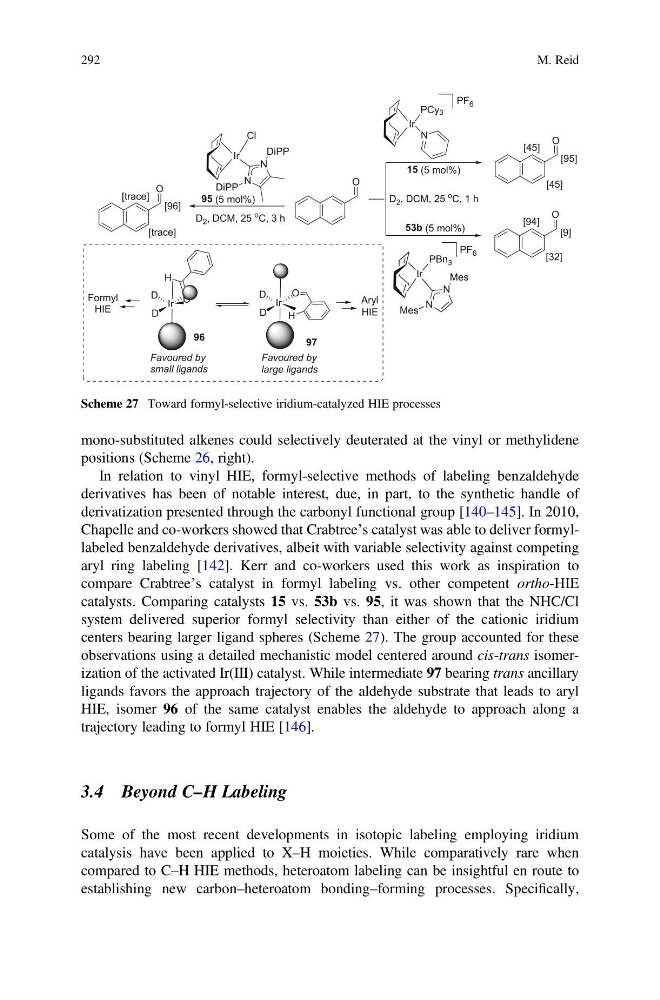
Chapelle and co-workers showed that Crabtree’s catalyst was able to deliver formyllabeled benzaldehyde derivatives, albeit with variable selectivity against competing
aryl ring labeling [142]. Kerr and co-workers used this work as inspiration to
compare Crabtree’s catalyst in formyl labeling vs. other competent ortho-HIE
catalysts. Comparing catalysts 15 vs. 53b vs. 95, it was shown that the NHC/Cl
system delivered superior formyl selectivity than either of the cationic iridium
centers bearing larger ligand spheres (Scheme 27). The group accounted for these
observations using a detailed mechanistic model centered around cis-trans isomerization of the activated Ir(III) catalyst. While intermediate 97 bearing trans ancillary
ligands favors the approach trajectory of the aldehyde substrate that leads to aryl
HIE, isomer 96 of the same catalyst enables the aldehyde to approach along a
trajectory leading to formyl HIE [146].
3.4 Beyond C–H Labeling
Some of the most recent developments in isotopic labeling employing iridium
catalysis have been applied to X–H moieties. While comparatively rare when
compared to C–H HIE methods, heteroatom labeling can be insightful en route to
establishing new carbon–heteroatom bonding–forming processes. Specifically,
D 2 , DCM, 25
o C, 1 h
Ir
Cl
N
N
DiPP
DiPP
[45]
[95]
O
15 (5 mol%)
Ir
PCy 3
N
PF 6
O
[45]
[94]
[9]
O
[32]
[trace]
[96]
O
[trace]
Ir
PF 6
PBn 3
N
N
Mes
Mes
53b (5 mol%)
D 2 , DCM, 25
o C, 3 h
95 (5 mol%)
Ir
D
D
Ir
D
D
O
H
O
H
96
97
Favoured by
large ligands
Favoured by
small ligands
Formyl
HIE
Aryl
HIE
Scheme 27 Toward formyl-selective iridium-catalyzed HIE processes
292
M. Reid
positions (Scheme 26, right).
In relation to vinyl HIE, formyl-selective methods of labeling benzaldehyde
derivatives has been of notable interest, due, in part, to the synthetic handle of
derivatization presented through the carbonyl functional group [140–145]. In 2010,
Chapelle and co-workers showed that Crabtree’s catalyst was able to deliver formyllabeled benzaldehyde derivatives, albeit with variable selectivity against competing
aryl ring labeling [142]. Kerr and co-workers used this work as inspiration to
compare Crabtree’s catalyst in formyl labeling vs. other competent ortho-HIE
catalysts. Comparing catalysts 15 vs. 53b vs. 95, it was shown that the NHC/Cl
system delivered superior formyl selectivity than either of the cationic iridium
centers bearing larger ligand spheres (Scheme 27). The group accounted for these
observations using a detailed mechanistic model centered around cis-trans isomerization of the activated Ir(III) catalyst. While intermediate 97 bearing trans ancillary
ligands favors the approach trajectory of the aldehyde substrate that leads to aryl
HIE, isomer 96 of the same catalyst enables the aldehyde to approach along a
trajectory leading to formyl HIE [146].
3.4 Beyond C–H Labeling
Some of the most recent developments in isotopic labeling employing iridium
catalysis have been applied to X–H moieties. While comparatively rare when
compared to C–H HIE methods, heteroatom labeling can be insightful en route to
establishing new carbon–heteroatom bonding–forming processes. Specifically,
D 2 , DCM, 25
o C, 1 h
Ir
Cl
N
N
DiPP
DiPP
[45]
[95]
O
15 (5 mol%)
Ir
PCy 3
N
PF 6
O
[45]
[94]
[9]
O
[32]
[trace]
[96]
O
[trace]
Ir
PF 6
PBn 3
N
N
Mes
Mes
53b (5 mol%)
D 2 , DCM, 25
o C, 3 h
95 (5 mol%)
Ir
D
D
Ir
D
D
O
H
O
H
96
97
Favoured by
large ligands
Favoured by
small ligands
Formyl
HIE
Aryl
HIE
Scheme 27 Toward formyl-selective iridium-catalyzed HIE processes
292
M. Reid