

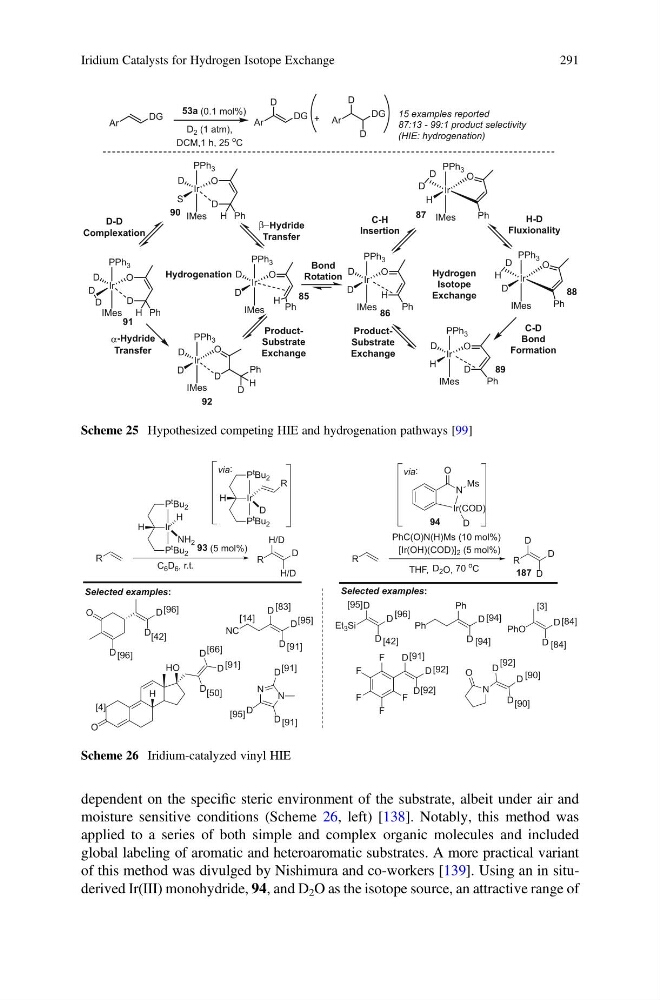
dependent on the specific steric environment of the substrate, albeit under air and
moisture sensitive conditions (Scheme 26, left) [138]. Notably, this method was
applied to a series of both simple and complex organic molecules and included
global labeling of aromatic and heteroaromatic substrates. A more practical variant
of this method was divulged by Nishimura and co-workers [139]. Using an in situderived Ir(III) monohydride, 94, and D 2 O as the isotope source, an attractive range of
C-H
Insertion
H-D
Fluxionality
C-D
Bond
Formation
Hydrogen
Isotope
Exchange
β−Hydride
Transfer
D-D
Complexation
α-Hydride
Transfer
ProductSubstrate
Exchange
ProductSubstrate
Exchange
Bond
Rotation
Ir
D
O
PPh 3
IMes
D
Ph
H
86
Ir
H
PPh 3
IMes
D
D
O
Ph
87
Ir
D
PPh 3
IMes
O
Ph
H
D
88
Ir
H
O
PPh 3
IMes
D
Ph
D
89
Ir
D
O
PPh 3
IMes
D
Ph
H
85
Ir
S
O
PPh 3
IMes
D
Ph
D
H
90
Ir
O
PPh 3
IMes
D
Ph
D
H
D
D
Ir
D
O
PPh 3
IMes
D
D
Ph
D
H
Hydrogenation
Ar
DG
53a (0.1 mol%)
Ar
DG
D
D 2 (1 atm),
DCM,1 h, 25
o
C
Ar
DG
D
D
+
15 examples reported
87:13 - 99:1 product selectivity
(HIE: hydrogenation)
91
92
Scheme 25 Hypothesized competing HIE and hydrogenation pathways [99]
93 (5 mol%)
C 6 D 6 , r.t.
NC
[14]
[83]
[91]
[95]
Selected examples:
Ir
P t Bu 2
P t Bu 2
NH 2
H
H
R
D
H/D
H/D
R
D
D
D
O
D
D
D
[96]
[42]
[96]
O
H
HO
[4]
D
D
D [66]
[91]
[50]
N
N
D
D
D [91]
[91]
[95]
THF, D 2O, 70
o C
187
Ph
[94]
[94]
Selected examples:
R
D
D
D
R
D
D
Ph
D
D
[96]
[42]
[91]
[84]
[95]
[Ir(OH)(COD)] 2 (5 mol%)
N
O
Ms
PhC(O)N(H)Ms (10 mol%)
Et 3 Si
F
F
F
F
F
N
O
D
D
D
PhO
D
D
[3]
[84]
[92]
[92]
D
D
D
[92]
[90]
[90]
Ir(COD)
D
via:
94
D
Ir
P t Bu 2
P t Bu 2
D
H
R
via:
Scheme 26 Iridium-catalyzed vinyl HIE
Iridium Catalysts for Hydrogen Isotope Exchange
291
moisture sensitive conditions (Scheme 26, left) [138]. Notably, this method was
applied to a series of both simple and complex organic molecules and included
global labeling of aromatic and heteroaromatic substrates. A more practical variant
of this method was divulged by Nishimura and co-workers [139]. Using an in situderived Ir(III) monohydride, 94, and D 2 O as the isotope source, an attractive range of
C-H
Insertion
H-D
Fluxionality
C-D
Bond
Formation
Hydrogen
Isotope
Exchange
β−Hydride
Transfer
D-D
Complexation
α-Hydride
Transfer
ProductSubstrate
Exchange
ProductSubstrate
Exchange
Bond
Rotation
Ir
D
O
PPh 3
IMes
D
Ph
H
86
Ir
H
PPh 3
IMes
D
D
O
Ph
87
Ir
D
PPh 3
IMes
O
Ph
H
D
88
Ir
H
O
PPh 3
IMes
D
Ph
D
89
Ir
D
O
PPh 3
IMes
D
Ph
H
85
Ir
S
O
PPh 3
IMes
D
Ph
D
H
90
Ir
O
PPh 3
IMes
D
Ph
D
H
D
D
Ir
D
O
PPh 3
IMes
D
D
Ph
D
H
Hydrogenation
Ar
DG
53a (0.1 mol%)
Ar
DG
D
D 2 (1 atm),
DCM,1 h, 25
o
C
Ar
DG
D
D
+
15 examples reported
87:13 - 99:1 product selectivity
(HIE: hydrogenation)
91
92
Scheme 25 Hypothesized competing HIE and hydrogenation pathways [99]
93 (5 mol%)
C 6 D 6 , r.t.
NC
[14]
[83]
[91]
[95]
Selected examples:
Ir
P t Bu 2
P t Bu 2
NH 2
H
H
R
D
H/D
H/D
R
D
D
D
O
D
D
D
[96]
[42]
[96]
O
H
HO
[4]
D
D
D [66]
[91]
[50]
N
N
D
D
D [91]
[91]
[95]
THF, D 2O, 70
o C
187
Ph
[94]
[94]
Selected examples:
R
D
D
D
R
D
D
Ph
D
D
[96]
[42]
[91]
[84]
[95]
[Ir(OH)(COD)] 2 (5 mol%)
N
O
Ms
PhC(O)N(H)Ms (10 mol%)
Et 3 Si
F
F
F
F
F
N
O
D
D
D
PhO
D
D
[3]
[84]
[92]
[92]
D
D
D
[92]
[90]
[90]
Ir(COD)
D
via:
94
D
Ir
P t Bu 2
P t Bu 2
D
H
R
via:
Scheme 26 Iridium-catalyzed vinyl HIE
Iridium Catalysts for Hydrogen Isotope Exchange
291