

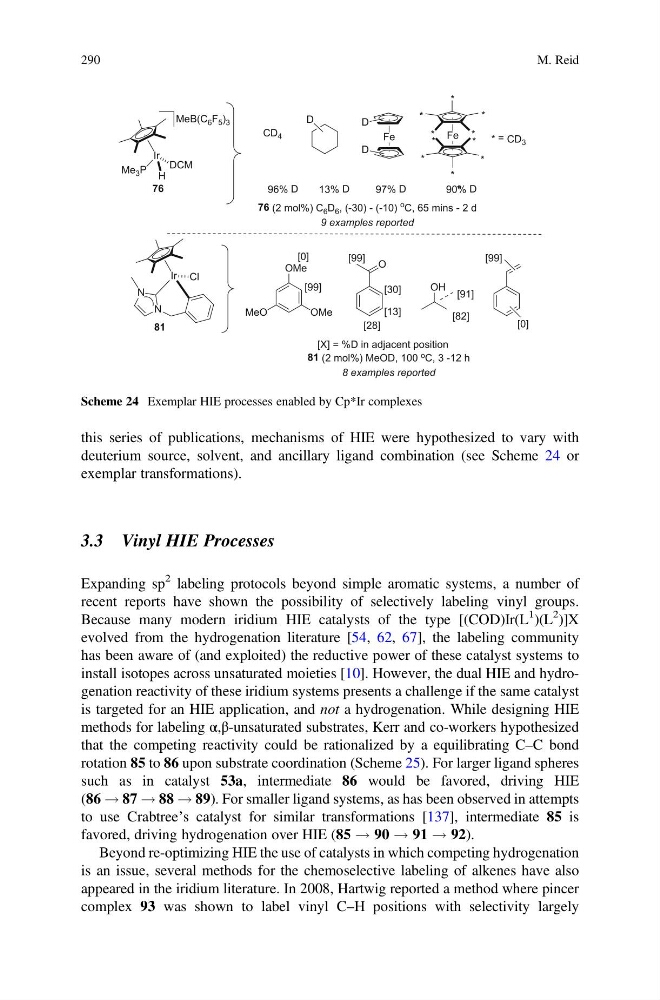
this series of publications, mechanisms of HIE were hypothesized to vary with
deuterium source, solvent, and ancillary ligand combination (see Scheme 24 or
exemplar transformations).
3.3 Vinyl HIE Processes
Expanding sp
2 labeling protocols beyond simple aromatic systems, a number of
recent reports have shown the possibility of selectively labeling vinyl groups.
Because many modern iridium HIE catalysts of the type [(COD)Ir(L
1 )(L
2 )]X
evolved from the hydrogenation literature [54, 62, 67], the labeling community
has been aware of (and exploited) the reductive power of these catalyst systems to
install isotopes across unsaturated moieties [10]. However, the dual HIE and hydrogenation reactivity of these iridium systems presents a challenge if the same catalyst
is targeted for an HIE application, and not a hydrogenation. While designing HIE
methods for labeling α,β-unsaturated substrates, Kerr and co-workers hypothesized
that the competing reactivity could be rationalized by a equilibrating C–C bond
rotation 85 to 86 upon substrate coordination (Scheme 25). For larger ligand spheres
such as in catalyst 53a, intermediate 86 would be favored, driving HIE
(86 ! 87 ! 88 ! 89). For smaller ligand systems, as has been observed in attempts
to use Crabtree’s catalyst for similar transformations [137], intermediate 85 is
favored, driving hydrogenation over HIE (85 ! 90 ! 91 ! 92).
Beyond re-optimizing HIE the use of catalysts in which competing hydrogenation
is an issue, several methods for the chemoselective labeling of alkenes have also
appeared in the iridium literature. In 2008, Hartwig reported a method where pincer
complex 93 was shown to label vinyl C–H positions with selectivity largely
76 (2 mol%) C 6 D 6 , (-30) - (-10)
o
C, 65 mins - 2 d
9 examples reported
81 (2 mol%) MeOD, 100 o C, 3 -12 h
8 examples reported
OMe
[99]
O
[99]
[30]
Ir
Me 3 P H
DCM
76
MeB(C 6 F 5 ) 3
CD 4
Fe
Fe
D
*
*
*
*
*
*
*
*
*
*
* = CD 3
D
D
96% D
13% D
97% D
90% D
*
Ir Cl
N
N
81
MeO
OMe
[0]
[X] = %D in adjacent position
[13]
[28]
OH
[82]
[91]
[99]
[0]
Scheme 24 Exemplar HIE processes enabled by Cp*Ir complexes
290
M. Reid
deuterium source, solvent, and ancillary ligand combination (see Scheme 24 or
exemplar transformations).
3.3 Vinyl HIE Processes
Expanding sp
2 labeling protocols beyond simple aromatic systems, a number of
recent reports have shown the possibility of selectively labeling vinyl groups.
Because many modern iridium HIE catalysts of the type [(COD)Ir(L
1 )(L
2 )]X
evolved from the hydrogenation literature [54, 62, 67], the labeling community
has been aware of (and exploited) the reductive power of these catalyst systems to
install isotopes across unsaturated moieties [10]. However, the dual HIE and hydrogenation reactivity of these iridium systems presents a challenge if the same catalyst
is targeted for an HIE application, and not a hydrogenation. While designing HIE
methods for labeling α,β-unsaturated substrates, Kerr and co-workers hypothesized
that the competing reactivity could be rationalized by a equilibrating C–C bond
rotation 85 to 86 upon substrate coordination (Scheme 25). For larger ligand spheres
such as in catalyst 53a, intermediate 86 would be favored, driving HIE
(86 ! 87 ! 88 ! 89). For smaller ligand systems, as has been observed in attempts
to use Crabtree’s catalyst for similar transformations [137], intermediate 85 is
favored, driving hydrogenation over HIE (85 ! 90 ! 91 ! 92).
Beyond re-optimizing HIE the use of catalysts in which competing hydrogenation
is an issue, several methods for the chemoselective labeling of alkenes have also
appeared in the iridium literature. In 2008, Hartwig reported a method where pincer
complex 93 was shown to label vinyl C–H positions with selectivity largely
76 (2 mol%) C 6 D 6 , (-30) - (-10)
o
C, 65 mins - 2 d
9 examples reported
81 (2 mol%) MeOD, 100 o C, 3 -12 h
8 examples reported
OMe
[99]
O
[99]
[30]
Ir
Me 3 P H
DCM
76
MeB(C 6 F 5 ) 3
CD 4
Fe
Fe
D
*
*
*
*
*
*
*
*
*
*
* = CD 3
D
D
96% D
13% D
97% D
90% D
*
Ir Cl
N
N
81
MeO
OMe
[0]
[X] = %D in adjacent position
[13]
[28]
OH
[82]
[91]
[99]
[0]
Scheme 24 Exemplar HIE processes enabled by Cp*Ir complexes
290
M. Reid