

blue light-emitting diode (LED) to generate a long-lived excited state triplet 67, a
strong single electron oxidant. The catalyst then generates an alpha-amino radical 70
from 69, and the reduced Ir(II) catalyst 68, which is now a strong reductant. Isotopic
scrambling between the labeled water source and added thiol delivers the on-cycle
labeled thiol 72 from 71, judiciously chosen due to the favorably weak S–H bond.
Labeled thiol 72 (polarity matched with the nucleophilic amino radical 69)
undergoes a HAT process to generate the alpha-labeled amine product 74 and
thiol radical 73. Thereafter, the photoredox and HAT catalytic cycles converge to
generate the thiolate anion 75 and regenerate the photoredox catalyst 66. Through
adjustments in the choice of photocatalyst and thiol source, this method was
applicable to both deuteration and tritiation processes.
3.2 Non-ortho-HIE on Aromatic Substrates
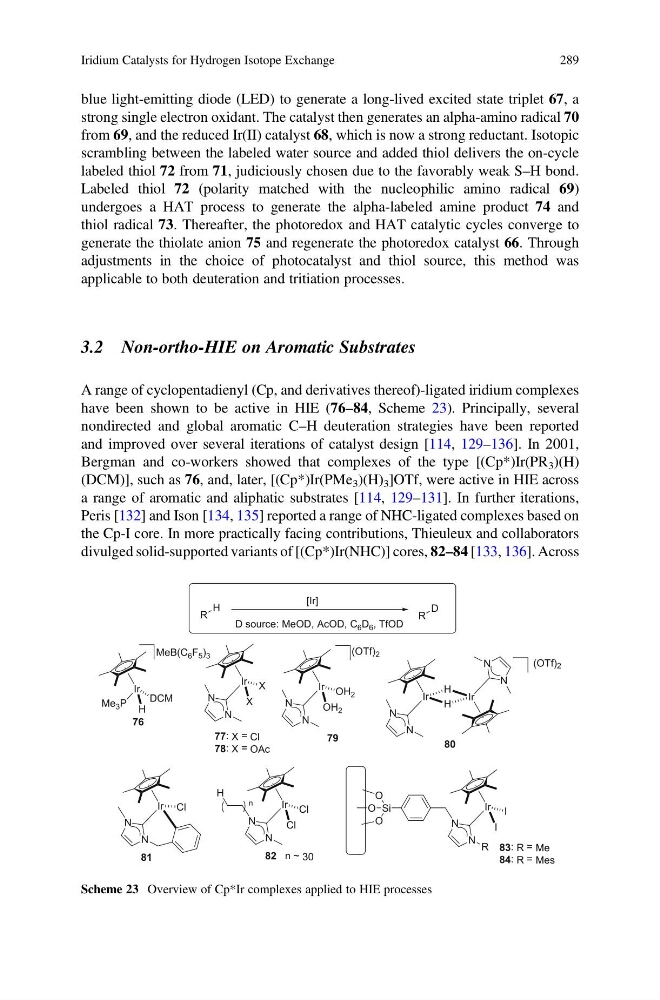
A range of cyclopentadienyl (Cp, and derivatives thereof)-ligated iridium complexes
have been shown to be active in HIE (76–84, Scheme 23). Principally, several
nondirected and global aromatic C–H deuteration strategies have been reported
and improved over several iterations of catalyst design [114, 129–136]. In 2001,
Bergman and co-workers showed that complexes of the type [(Cp*)Ir(PR 3 )(H)
(DCM)], such as 76, and, later, [(Cp*)Ir(PMe 3 )(H) 3 ]OTf, were active in HIE across
a range of aromatic and aliphatic substrates [114, 129–131]. In further iterations,
Peris [132] and Ison [134, 135] reported a range of NHC-ligated complexes based on
the Cp-I core. In more practically facing contributions, Thieuleux and collaborators
divulged solid-supported variants of [(Cp*)Ir(NHC)] cores, 82–84 [133, 136]. Across
Ir
OH 2
OH 2
N
N
(OTf) 2
R
H
R
D
[Ir]
D source: MeOD, AcOD, C 6 D 6 , TfOD
79
Ir
X
X
N
N
77: X = Cl
Ir H
H
N
N
80
Ir
N
N
Ir
Me 3 P H
DCM
76
(OTf) 2
78: X = OAc
Ir
Cl
Cl
N
N
82
H
n
Ir
I
I
N
N R
Si
O
O
O
83: R = Me
84: R = Mes
n ~ 30
MeB(C 6 F 5 ) 3
Ir Cl
N
N
81
Scheme 23 Overview of Cp*Ir complexes applied to HIE processes
Iridium Catalysts for Hydrogen Isotope Exchange
289
strong single electron oxidant. The catalyst then generates an alpha-amino radical 70
from 69, and the reduced Ir(II) catalyst 68, which is now a strong reductant. Isotopic
scrambling between the labeled water source and added thiol delivers the on-cycle
labeled thiol 72 from 71, judiciously chosen due to the favorably weak S–H bond.
Labeled thiol 72 (polarity matched with the nucleophilic amino radical 69)
undergoes a HAT process to generate the alpha-labeled amine product 74 and
thiol radical 73. Thereafter, the photoredox and HAT catalytic cycles converge to
generate the thiolate anion 75 and regenerate the photoredox catalyst 66. Through
adjustments in the choice of photocatalyst and thiol source, this method was
applicable to both deuteration and tritiation processes.
3.2 Non-ortho-HIE on Aromatic Substrates
A range of cyclopentadienyl (Cp, and derivatives thereof)-ligated iridium complexes
have been shown to be active in HIE (76–84, Scheme 23). Principally, several
nondirected and global aromatic C–H deuteration strategies have been reported
and improved over several iterations of catalyst design [114, 129–136]. In 2001,
Bergman and co-workers showed that complexes of the type [(Cp*)Ir(PR 3 )(H)
(DCM)], such as 76, and, later, [(Cp*)Ir(PMe 3 )(H) 3 ]OTf, were active in HIE across
a range of aromatic and aliphatic substrates [114, 129–131]. In further iterations,
Peris [132] and Ison [134, 135] reported a range of NHC-ligated complexes based on
the Cp-I core. In more practically facing contributions, Thieuleux and collaborators
divulged solid-supported variants of [(Cp*)Ir(NHC)] cores, 82–84 [133, 136]. Across
Ir
OH 2
OH 2
N
N
(OTf) 2
R
H
R
D
[Ir]
D source: MeOD, AcOD, C 6 D 6 , TfOD
79
Ir
X
X
N
N
77: X = Cl
Ir H
H
N
N
80
Ir
N
N
Ir
Me 3 P H
DCM
76
(OTf) 2
78: X = OAc
Ir
Cl
Cl
N
N
82
H
n
Ir
I
I
N
N R
Si
O
O
O
83: R = Me
84: R = Mes
n ~ 30
MeB(C 6 F 5 ) 3
Ir Cl
N
N
81
Scheme 23 Overview of Cp*Ir complexes applied to HIE processes
Iridium Catalysts for Hydrogen Isotope Exchange
289