

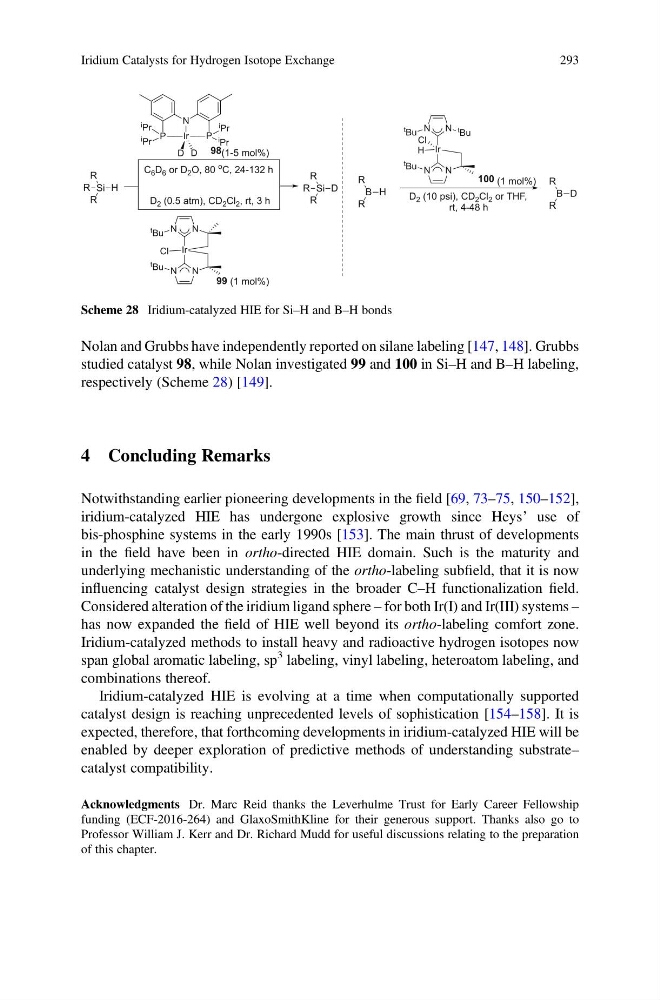
Nolan and Grubbs have independently reported on silane labeling [147, 148]. Grubbs
studied catalyst 98, while Nolan investigated 99 and 100 in Si–H and B–H labeling,
respectively (Scheme 28) [149].
4 Concluding Remarks
Notwithstanding earlier pioneering developments in the field [69, 73–75, 150–152],
iridium-catalyzed HIE has undergone explosive growth since Heys’ use of
bis-phosphine systems in the early 1990s [153]. The main thrust of developments
in the field have been in ortho-directed HIE domain. Such is the maturity and
underlying mechanistic understanding of the ortho-labeling subfield, that it is now
influencing catalyst design strategies in the broader C–H functionalization field.
Considered alteration of the iridium ligand sphere – for both Ir(I) and Ir(III) systems –
has now expanded the field of HIE well beyond its ortho-labeling comfort zone.
Iridium-catalyzed methods to install heavy and radioactive hydrogen isotopes now
span global aromatic labeling, sp
3 labeling, vinyl labeling, heteroatom labeling, and
combinations thereof.
Iridium-catalyzed HIE is evolving at a time when computationally supported
catalyst design is reaching unprecedented levels of sophistication [154–158]. It is
expected, therefore, that forthcoming developments in iridium-catalyzed HIE will be
enabled by deeper exploration of predictive methods of understanding substrate–
catalyst compatibility.
Acknowledgments Dr. Marc Reid thanks the Leverhulme Trust for Early Career Fellowship
funding (ECF-2016-264) and GlaxoSmithKline for their generous support. Thanks also go to
Professor William J. Kerr and Dr. Richard Mudd for useful discussions relating to the preparation
of this chapter.
D 2 (0.5 atm), CD 2 Cl 2 , rt, 3 h
Ir
N
N
N
N
t Bu
t Bu
t Bu
99 (1 mol%)
C 6 D 6 or D 2 O, 80
o
C, 24-132 h
Si H
R
R
R
Si D
R
R
R
98 (1-5 mol%)
N
Ir
P
P
i Pr
i Pr
i Pr
i Pr
D
D
D 2 (10 psi), CD 2 Cl 2 or THF,
rt, 4-48 h
B H
R
R
B D
R
R
H
Cl
Ir
N
N
N
N
t Bu
t Bu
Cl
100 (1 mol%)
Scheme 28 Iridium-catalyzed HIE for Si–H and B–H bonds
Iridium Catalysts for Hydrogen Isotope Exchange
293
studied catalyst 98, while Nolan investigated 99 and 100 in Si–H and B–H labeling,
respectively (Scheme 28) [149].
4 Concluding Remarks
Notwithstanding earlier pioneering developments in the field [69, 73–75, 150–152],
iridium-catalyzed HIE has undergone explosive growth since Heys’ use of
bis-phosphine systems in the early 1990s [153]. The main thrust of developments
in the field have been in ortho-directed HIE domain. Such is the maturity and
underlying mechanistic understanding of the ortho-labeling subfield, that it is now
influencing catalyst design strategies in the broader C–H functionalization field.
Considered alteration of the iridium ligand sphere – for both Ir(I) and Ir(III) systems –
has now expanded the field of HIE well beyond its ortho-labeling comfort zone.
Iridium-catalyzed methods to install heavy and radioactive hydrogen isotopes now
span global aromatic labeling, sp
3 labeling, vinyl labeling, heteroatom labeling, and
combinations thereof.
Iridium-catalyzed HIE is evolving at a time when computationally supported
catalyst design is reaching unprecedented levels of sophistication [154–158]. It is
expected, therefore, that forthcoming developments in iridium-catalyzed HIE will be
enabled by deeper exploration of predictive methods of understanding substrate–
catalyst compatibility.
Acknowledgments Dr. Marc Reid thanks the Leverhulme Trust for Early Career Fellowship
funding (ECF-2016-264) and GlaxoSmithKline for their generous support. Thanks also go to
Professor William J. Kerr and Dr. Richard Mudd for useful discussions relating to the preparation
of this chapter.
D 2 (0.5 atm), CD 2 Cl 2 , rt, 3 h
Ir
N
N
N
N
t Bu
t Bu
t Bu
99 (1 mol%)
C 6 D 6 or D 2 O, 80
o
C, 24-132 h
Si H
R
R
R
Si D
R
R
R
98 (1-5 mol%)
N
Ir
P
P
i Pr
i Pr
i Pr
i Pr
D
D
D 2 (10 psi), CD 2 Cl 2 or THF,
rt, 4-48 h
B H
R
R
B D
R
R
H
Cl
Ir
N
N
N
N
t Bu
t Bu
Cl
100 (1 mol%)
Scheme 28 Iridium-catalyzed HIE for Si–H and B–H bonds
Iridium Catalysts for Hydrogen Isotope Exchange
293