

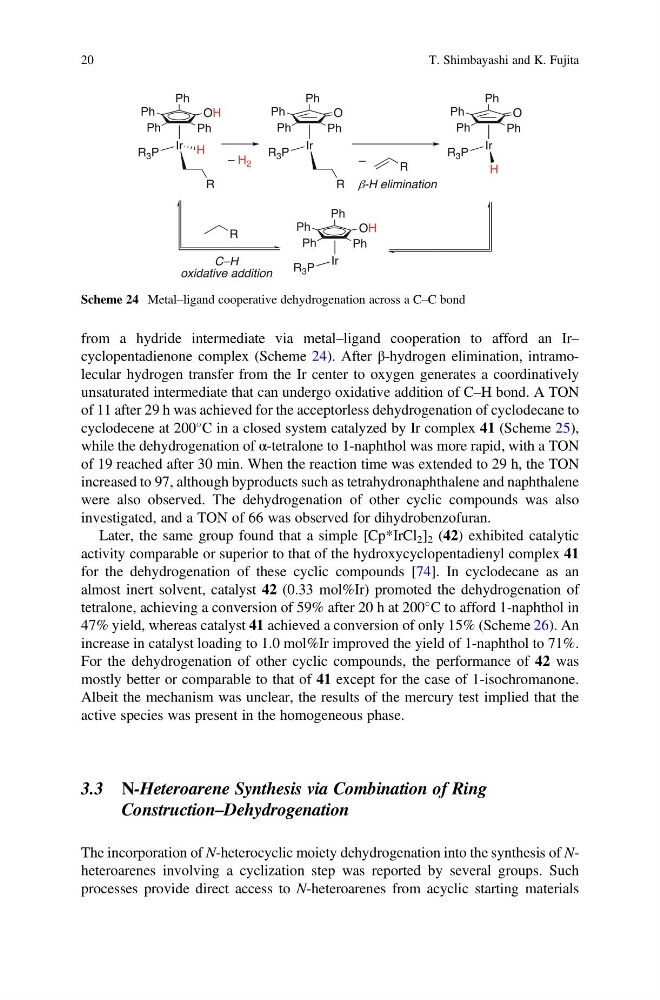
from a hydride intermediate via metal–ligand cooperation to afford an Ir–
cyclopentadienone complex (Scheme 24). After β-hydrogen elimination, intramolecular hydrogen transfer from the Ir center to oxygen generates a coordinatively
unsaturated intermediate that can undergo oxidative addition of C–H bond. A TON
of 11 after 29 h was achieved for the acceptorless dehydrogenation of cyclodecane to
cyclodecene at 200
C in a closed system catalyzed by Ir complex 41 (Scheme 25),
while the dehydrogenation of α-tetralone to 1-naphthol was more rapid, with a TON
of 19 reached after 30 min. When the reaction time was extended to 29 h, the TON
increased to 97, although byproducts such as tetrahydronaphthalene and naphthalene
were also observed. The dehydrogenation of other cyclic compounds was also
investigated, and a TON of 66 was observed for dihydrobenzofuran.
Later, the same group found that a simple [Cp*IrCl 2 ] 2 (42) exhibited catalytic
activity comparable or superior to that of the hydroxycyclopentadienyl complex 41
for the dehydrogenation of these cyclic compounds [74]. In cyclodecane as an
almost inert solvent, catalyst 42 (0.33 mol%Ir) promoted the dehydrogenation of
tetralone, achieving a conversion of 59% after 20 h at 200
C to afford 1-naphthol in
47% yield, whereas catalyst 41 achieved a conversion of only 15% (Scheme 26). An
increase in catalyst loading to 1.0 mol%Ir improved the yield of 1-naphthol to 71%.
For the dehydrogenation of other cyclic compounds, the performance of 42 was
mostly better or comparable to that of 41 except for the case of 1-isochromanone.
Albeit the mechanism was unclear, the results of the mercury test implied that the
active species was present in the homogeneous phase.
3.3 N-Heteroarene Synthesis via Combination of Ring
Construction–Dehydrogenation
The incorporation of N-heterocyclic moiety dehydrogenation into the synthesis of Nheteroarenes involving a cyclization step was reported by several groups. Such
processes provide direct access to N-heteroarenes from acyclic starting materials
Scheme 24 Metal–ligand cooperative dehydrogenation across a C–C bond
20
T. Shimbayashi and K. Fujita
cyclopentadienone complex (Scheme 24). After β-hydrogen elimination, intramolecular hydrogen transfer from the Ir center to oxygen generates a coordinatively
unsaturated intermediate that can undergo oxidative addition of C–H bond. A TON
of 11 after 29 h was achieved for the acceptorless dehydrogenation of cyclodecane to
cyclodecene at 200
C in a closed system catalyzed by Ir complex 41 (Scheme 25),
while the dehydrogenation of α-tetralone to 1-naphthol was more rapid, with a TON
of 19 reached after 30 min. When the reaction time was extended to 29 h, the TON
increased to 97, although byproducts such as tetrahydronaphthalene and naphthalene
were also observed. The dehydrogenation of other cyclic compounds was also
investigated, and a TON of 66 was observed for dihydrobenzofuran.
Later, the same group found that a simple [Cp*IrCl 2 ] 2 (42) exhibited catalytic
activity comparable or superior to that of the hydroxycyclopentadienyl complex 41
for the dehydrogenation of these cyclic compounds [74]. In cyclodecane as an
almost inert solvent, catalyst 42 (0.33 mol%Ir) promoted the dehydrogenation of
tetralone, achieving a conversion of 59% after 20 h at 200
C to afford 1-naphthol in
47% yield, whereas catalyst 41 achieved a conversion of only 15% (Scheme 26). An
increase in catalyst loading to 1.0 mol%Ir improved the yield of 1-naphthol to 71%.
For the dehydrogenation of other cyclic compounds, the performance of 42 was
mostly better or comparable to that of 41 except for the case of 1-isochromanone.
Albeit the mechanism was unclear, the results of the mercury test implied that the
active species was present in the homogeneous phase.
3.3 N-Heteroarene Synthesis via Combination of Ring
Construction–Dehydrogenation
The incorporation of N-heterocyclic moiety dehydrogenation into the synthesis of Nheteroarenes involving a cyclization step was reported by several groups. Such
processes provide direct access to N-heteroarenes from acyclic starting materials
Scheme 24 Metal–ligand cooperative dehydrogenation across a C–C bond
20
T. Shimbayashi and K. Fujita