

without the use of external oxidants and are therefore of high synthetic utility from
the viewpoint of green chemistry.
Yamamoto et al. reported the dehydrogenation of intermediate dihydropyrroles to
pyrroles in cascade Ir-catalyzed intramolecular ene-yne cyclizations/Diels-Alder
cycloadditions starting from 1,6-enynes prepared by Cu-catalyzed three-component
coupling of allylamines and glyoxylate esters with terminal alkynes (Scheme 27)
[75, 76]. In the presence of [IrCl(cod)] 2 (3 mol%) and acetic acid (12 mol%) in
refluxing toluene, 1,6-enynes underwent cycloisomerization [77] to afford 1,3-diene
intermediates that were trapped with dienophiles such as maleimide, maleic anhydride, or 1,4-naphthoquinone to afford polycyclic 3-pyrroline intermediates. Further
dehydrogenation probably proceeded via C–H activation at the C-2 position of the
pyrroline moiety by the Ir catalyst to finally afford polycyclic pyrrole-2-carboxylates. This reaction could be performed under microwave conditions, although a
slight decrease in product yield occurred in some cases. In the case of the
microwave-assisted reaction of a 5-alkyl-1,6-enyne, the pre-dehydrogenation
(pre-aromatized) intermediate (3-pyrroline) could be isolated (Scheme 28). The
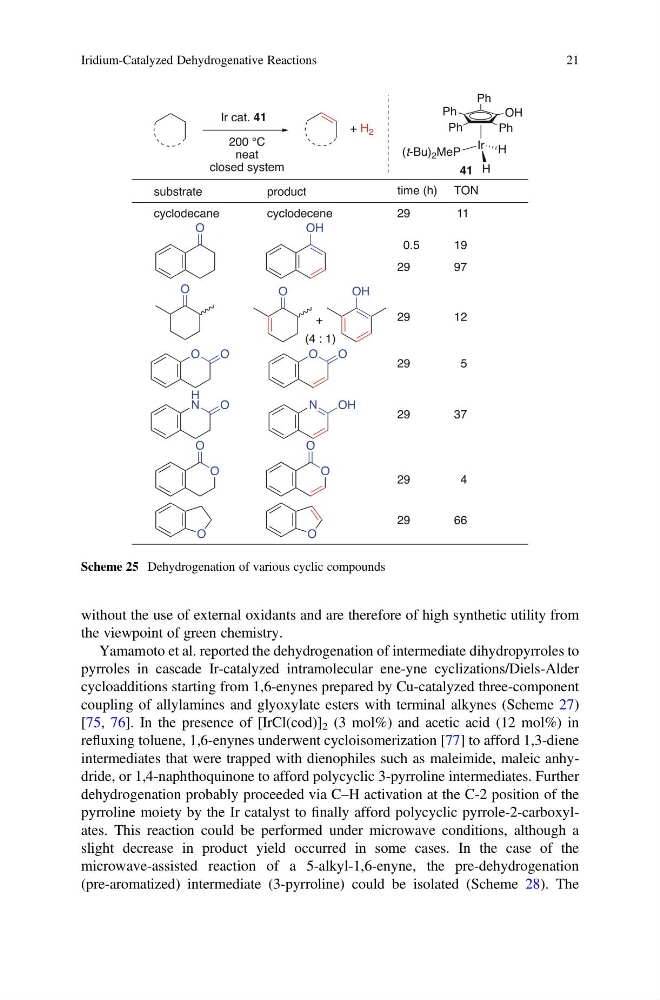
Scheme 25 Dehydrogenation of various cyclic compounds
Iridium-Catalyzed Dehydrogenative Reactions
21
the viewpoint of green chemistry.
Yamamoto et al. reported the dehydrogenation of intermediate dihydropyrroles to
pyrroles in cascade Ir-catalyzed intramolecular ene-yne cyclizations/Diels-Alder
cycloadditions starting from 1,6-enynes prepared by Cu-catalyzed three-component
coupling of allylamines and glyoxylate esters with terminal alkynes (Scheme 27)
[75, 76]. In the presence of [IrCl(cod)] 2 (3 mol%) and acetic acid (12 mol%) in
refluxing toluene, 1,6-enynes underwent cycloisomerization [77] to afford 1,3-diene
intermediates that were trapped with dienophiles such as maleimide, maleic anhydride, or 1,4-naphthoquinone to afford polycyclic 3-pyrroline intermediates. Further
dehydrogenation probably proceeded via C–H activation at the C-2 position of the
pyrroline moiety by the Ir catalyst to finally afford polycyclic pyrrole-2-carboxylates. This reaction could be performed under microwave conditions, although a
slight decrease in product yield occurred in some cases. In the case of the
microwave-assisted reaction of a 5-alkyl-1,6-enyne, the pre-dehydrogenation
(pre-aromatized) intermediate (3-pyrroline) could be isolated (Scheme 28). The
Scheme 25 Dehydrogenation of various cyclic compounds
Iridium-Catalyzed Dehydrogenative Reactions
21