

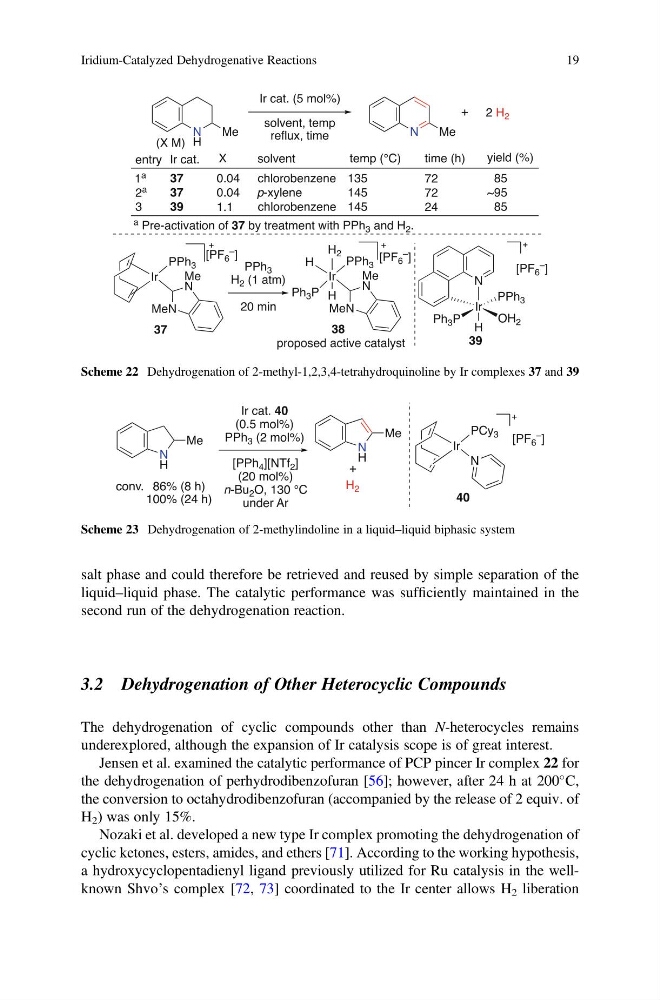
salt phase and could therefore be retrieved and reused by simple separation of the
liquid–liquid phase. The catalytic performance was sufficiently maintained in the
second run of the dehydrogenation reaction.
3.2 Dehydrogenation of Other Heterocyclic Compounds
The dehydrogenation of cyclic compounds other than N-heterocycles remains
underexplored, although the expansion of Ir catalysis scope is of great interest.
Jensen et al. examined the catalytic performance of PCP pincer Ir complex 22 for
the dehydrogenation of perhydrodibenzofuran [56]; however, after 24 h at 200
C,
the conversion to octahydrodibenzofuran (accompanied by the release of 2 equiv. of
H 2 ) was only 15%.
Nozaki et al. developed a new type Ir complex promoting the dehydrogenation of
cyclic ketones, esters, amides, and ethers [71]. According to the working hypothesis,
a hydroxycyclopentadienyl ligand previously utilized for Ru catalysis in the wellknown Shvo’s complex [72, 73] coordinated to the Ir center allows H 2 liberation
Scheme 22 Dehydrogenation of 2-methyl-1,2,3,4-tetrahydroquinoline by Ir complexes 37 and 39
Scheme 23 Dehydrogenation of 2-methylindoline in a liquid–liquid biphasic system
Iridium-Catalyzed Dehydrogenative Reactions
19
liquid–liquid phase. The catalytic performance was sufficiently maintained in the
second run of the dehydrogenation reaction.
3.2 Dehydrogenation of Other Heterocyclic Compounds
The dehydrogenation of cyclic compounds other than N-heterocycles remains
underexplored, although the expansion of Ir catalysis scope is of great interest.
Jensen et al. examined the catalytic performance of PCP pincer Ir complex 22 for
the dehydrogenation of perhydrodibenzofuran [56]; however, after 24 h at 200
C,
the conversion to octahydrodibenzofuran (accompanied by the release of 2 equiv. of
H 2 ) was only 15%.
Nozaki et al. developed a new type Ir complex promoting the dehydrogenation of
cyclic ketones, esters, amides, and ethers [71]. According to the working hypothesis,
a hydroxycyclopentadienyl ligand previously utilized for Ru catalysis in the wellknown Shvo’s complex [72, 73] coordinated to the Ir center allows H 2 liberation
Scheme 22 Dehydrogenation of 2-methyl-1,2,3,4-tetrahydroquinoline by Ir complexes 37 and 39
Scheme 23 Dehydrogenation of 2-methylindoline in a liquid–liquid biphasic system
Iridium-Catalyzed Dehydrogenative Reactions
19