

proposed active catalyst 38, which promoted the dehydrogenation of 2-methyl1,2,3,4-tetrahydroquinoline (0.04 M) under reflux conditions at 135
C in chlorobenzene or at 145
C in p-xylene, affording 2-methylquinoline in 85 or 95% yield,
respectively, after 72 h (Scheme 22). Catalyst 39 promoted the same dehydrogenation at a higher concentration (1.1 M) to afford 2-methylquinoline in 85% yield after
24 h. Both 38 and 39 also catalyzed the reverse hydrogenation.
Crabtree’s catalyst (40) was employed for the dehydrogenation of
2-methylindoline to 2-methylindole in a liquid–liquid biphasic system [70]. The
dehydrogenation proceeded at 130
C in the presence of 40 (0.5 mol%), PPh 3 (2 mol
%), and [PPh 4 ][NTf 2 ] (20 mol%) in Bu 2 O as solvent (Scheme 23). PPh 3 was
believed to stabilize the cationic Ir catalyst, which was immobilized in the molten
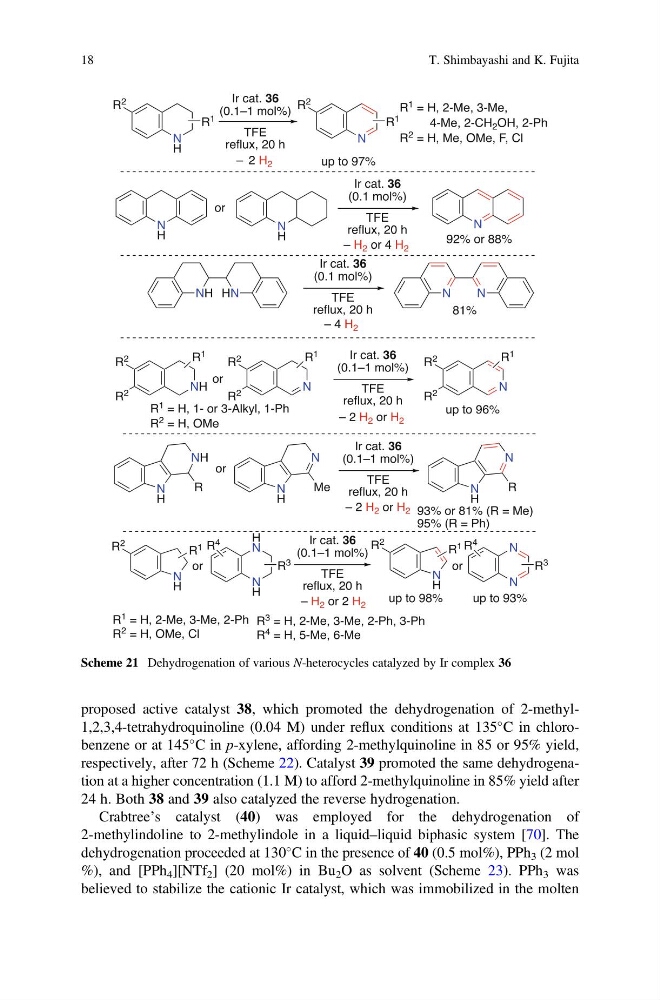
Scheme 21 Dehydrogenation of various N-heterocycles catalyzed by Ir complex 36
18
T. Shimbayashi and K. Fujita
C in chlorobenzene or at 145
C in p-xylene, affording 2-methylquinoline in 85 or 95% yield,
respectively, after 72 h (Scheme 22). Catalyst 39 promoted the same dehydrogenation at a higher concentration (1.1 M) to afford 2-methylquinoline in 85% yield after
24 h. Both 38 and 39 also catalyzed the reverse hydrogenation.
Crabtree’s catalyst (40) was employed for the dehydrogenation of
2-methylindoline to 2-methylindole in a liquid–liquid biphasic system [70]. The
dehydrogenation proceeded at 130
C in the presence of 40 (0.5 mol%), PPh 3 (2 mol
%), and [PPh 4 ][NTf 2 ] (20 mol%) in Bu 2 O as solvent (Scheme 23). PPh 3 was
believed to stabilize the cationic Ir catalyst, which was immobilized in the molten
Scheme 21 Dehydrogenation of various N-heterocycles catalyzed by Ir complex 36
18
T. Shimbayashi and K. Fujita