

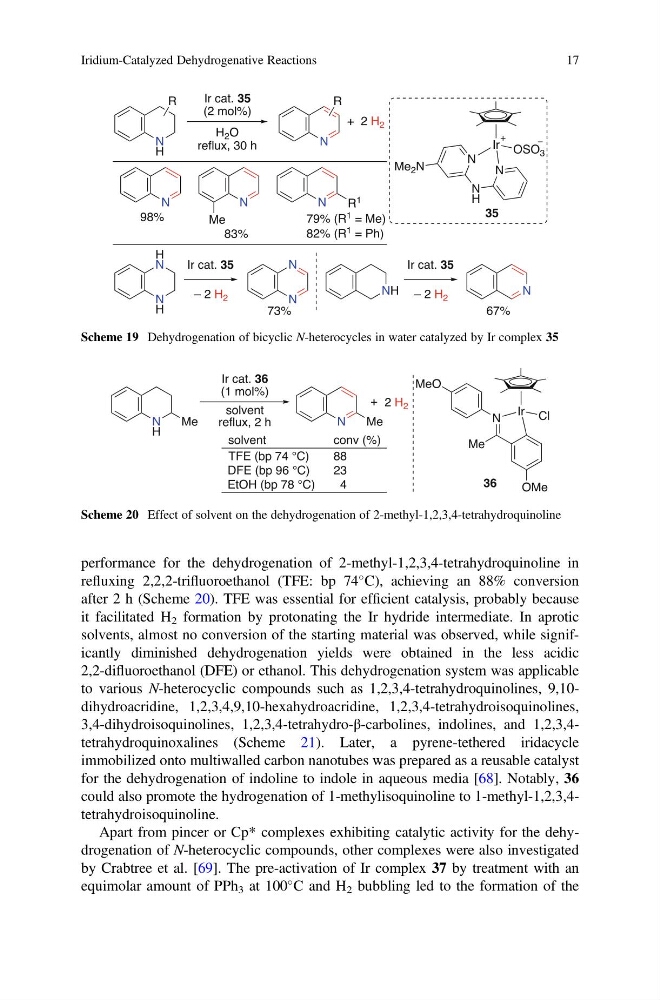
performance for the dehydrogenation of 2-methyl-1,2,3,4-tetrahydroquinoline in
refluxing 2,2,2-trifluoroethanol (TFE: bp 74
C), achieving an 88% conversion
after 2 h (Scheme 20). TFE was essential for efficient catalysis, probably because
it facilitated H 2 formation by protonating the Ir hydride intermediate. In aprotic
solvents, almost no conversion of the starting material was observed, while significantly diminished dehydrogenation yields were obtained in the less acidic
2,2-difluoroethanol (DFE) or ethanol. This dehydrogenation system was applicable
to various N-heterocyclic compounds such as 1,2,3,4-tetrahydroquinolines, 9,10dihydroacridine, 1,2,3,4,9,10-hexahydroacridine, 1,2,3,4-tetrahydroisoquinolines,
3,4-dihydroisoquinolines, 1,2,3,4-tetrahydro-β-carbolines, indolines, and 1,2,3,4tetrahydroquinoxalines (Scheme 21). Later, a pyrene-tethered iridacycle
immobilized onto multiwalled carbon nanotubes was prepared as a reusable catalyst
for the dehydrogenation of indoline to indole in aqueous media [68]. Notably, 36
could also promote the hydrogenation of 1-methylisoquinoline to 1-methyl-1,2,3,4tetrahydroisoquinoline.
Apart from pincer or Cp* complexes exhibiting catalytic activity for the dehydrogenation of N-heterocyclic compounds, other complexes were also investigated
by Crabtree et al. [69]. The pre-activation of Ir complex 37 by treatment with an
equimolar amount of PPh 3 at 100
C and H 2 bubbling led to the formation of the
Scheme 19 Dehydrogenation of bicyclic N-heterocycles in water catalyzed by Ir complex 35
Scheme 20 Effect of solvent on the dehydrogenation of 2-methyl-1,2,3,4-tetrahydroquinoline
Iridium-Catalyzed Dehydrogenative Reactions
17
refluxing 2,2,2-trifluoroethanol (TFE: bp 74
C), achieving an 88% conversion
after 2 h (Scheme 20). TFE was essential for efficient catalysis, probably because
it facilitated H 2 formation by protonating the Ir hydride intermediate. In aprotic
solvents, almost no conversion of the starting material was observed, while significantly diminished dehydrogenation yields were obtained in the less acidic
2,2-difluoroethanol (DFE) or ethanol. This dehydrogenation system was applicable
to various N-heterocyclic compounds such as 1,2,3,4-tetrahydroquinolines, 9,10dihydroacridine, 1,2,3,4,9,10-hexahydroacridine, 1,2,3,4-tetrahydroisoquinolines,
3,4-dihydroisoquinolines, 1,2,3,4-tetrahydro-β-carbolines, indolines, and 1,2,3,4tetrahydroquinoxalines (Scheme 21). Later, a pyrene-tethered iridacycle
immobilized onto multiwalled carbon nanotubes was prepared as a reusable catalyst
for the dehydrogenation of indoline to indole in aqueous media [68]. Notably, 36
could also promote the hydrogenation of 1-methylisoquinoline to 1-methyl-1,2,3,4tetrahydroisoquinoline.
Apart from pincer or Cp* complexes exhibiting catalytic activity for the dehydrogenation of N-heterocyclic compounds, other complexes were also investigated
by Crabtree et al. [69]. The pre-activation of Ir complex 37 by treatment with an
equimolar amount of PPh 3 at 100
C and H 2 bubbling led to the formation of the
Scheme 19 Dehydrogenation of bicyclic N-heterocycles in water catalyzed by Ir complex 35
Scheme 20 Effect of solvent on the dehydrogenation of 2-methyl-1,2,3,4-tetrahydroquinoline
Iridium-Catalyzed Dehydrogenative Reactions
17