

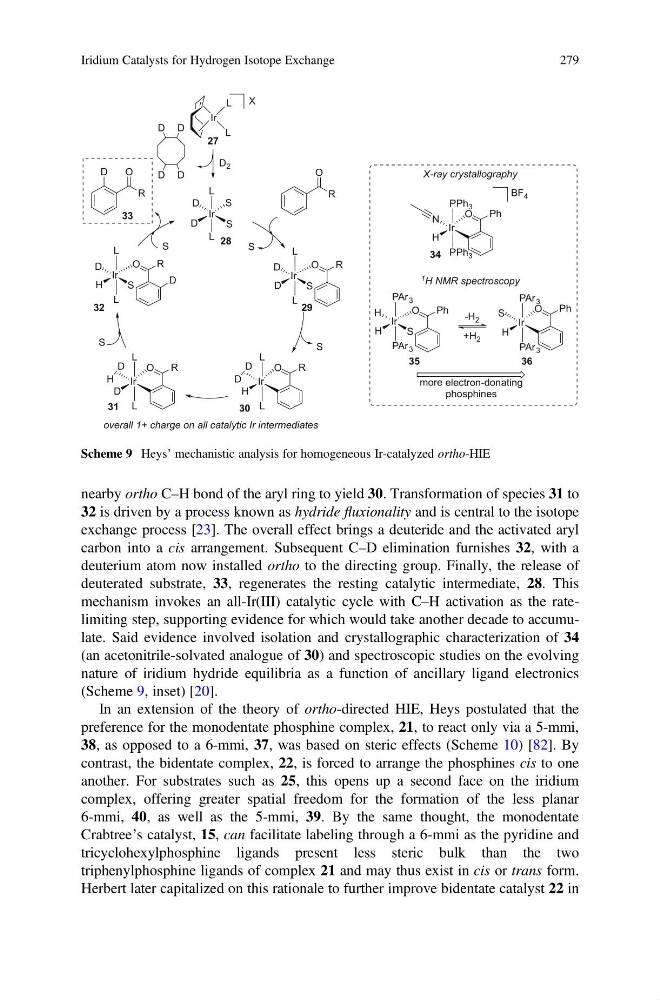
nearby ortho C–H bond of the aryl ring to yield 30. Transformation of species 31 to
32 is driven by a process known as hydride fluxionality and is central to the isotope
exchange process [23]. The overall effect brings a deuteride and the activated aryl
carbon into a cis arrangement. Subsequent C–D elimination furnishes 32, with a
deuterium atom now installed ortho to the directing group. Finally, the release of
deuterated substrate, 33, regenerates the resting catalytic intermediate, 28. This
mechanism invokes an all-Ir(III) catalytic cycle with C–H activation as the ratelimiting step, supporting evidence for which would take another decade to accumulate. Said evidence involved isolation and crystallographic characterization of 34
(an acetonitrile-solvated analogue of 30) and spectroscopic studies on the evolving
nature of iridium hydride equilibria as a function of ancillary ligand electronics
(Scheme 9, inset) [20].
In an extension of the theory of ortho-directed HIE, Heys postulated that the
preference for the monodentate phosphine complex, 21, to react only via a 5-mmi,
38, as opposed to a 6-mmi, 37, was based on steric effects (Scheme 10) [82]. By
contrast, the bidentate complex, 22, is forced to arrange the phosphines cis to one
another. For substrates such as 25, this opens up a second face on the iridium
complex, offering greater spatial freedom for the formation of the less planar
6-mmi, 40, as well as the 5-mmi, 39. By the same thought, the monodentate
Crabtree’s catalyst, 15, can facilitate labeling through a 6-mmi as the pyridine and
tricyclohexylphosphine ligands present less steric bulk than the two
triphenylphosphine ligands of complex 21 and may thus exist in cis or trans form.
Herbert later capitalized on this rationale to further improve bidentate catalyst 22 in
Ir
L
L
Ir
D
S
D
S
L
L
R
O
R
O
D
X
S
S
D 2
Ir
L
L
D
D
O
S
R
Ir
L
L
H
O
R
D
D
Ir
L
L
H
D
O
S
R
D
Ir
L
L
D
O
R
H
D
S
S
29
30
31
33
32
27
D D
D D
Ir
PPh 3
PPh 3
H
N
O
Ph
34
BF 4
Ir
PAr 3
PAr 3
H
H
O
S
Ph
35
Ir
PAr 3
PAr 3
H
O
Ph
S
36
more electron-donating
phosphines
X-ray crystallography
1 H NMR spectroscopy
28
overall 1+ charge on all catalytic Ir intermediates
-H 2
+H 2
Scheme 9 Heys’ mechanistic analysis for homogeneous Ir-catalyzed ortho-HIE
Iridium Catalysts for Hydrogen Isotope Exchange
279
32 is driven by a process known as hydride fluxionality and is central to the isotope
exchange process [23]. The overall effect brings a deuteride and the activated aryl
carbon into a cis arrangement. Subsequent C–D elimination furnishes 32, with a
deuterium atom now installed ortho to the directing group. Finally, the release of
deuterated substrate, 33, regenerates the resting catalytic intermediate, 28. This
mechanism invokes an all-Ir(III) catalytic cycle with C–H activation as the ratelimiting step, supporting evidence for which would take another decade to accumulate. Said evidence involved isolation and crystallographic characterization of 34
(an acetonitrile-solvated analogue of 30) and spectroscopic studies on the evolving
nature of iridium hydride equilibria as a function of ancillary ligand electronics
(Scheme 9, inset) [20].
In an extension of the theory of ortho-directed HIE, Heys postulated that the
preference for the monodentate phosphine complex, 21, to react only via a 5-mmi,
38, as opposed to a 6-mmi, 37, was based on steric effects (Scheme 10) [82]. By
contrast, the bidentate complex, 22, is forced to arrange the phosphines cis to one
another. For substrates such as 25, this opens up a second face on the iridium
complex, offering greater spatial freedom for the formation of the less planar
6-mmi, 40, as well as the 5-mmi, 39. By the same thought, the monodentate
Crabtree’s catalyst, 15, can facilitate labeling through a 6-mmi as the pyridine and
tricyclohexylphosphine ligands present less steric bulk than the two
triphenylphosphine ligands of complex 21 and may thus exist in cis or trans form.
Herbert later capitalized on this rationale to further improve bidentate catalyst 22 in
Ir
L
L
Ir
D
S
D
S
L
L
R
O
R
O
D
X
S
S
D 2
Ir
L
L
D
D
O
S
R
Ir
L
L
H
O
R
D
D
Ir
L
L
H
D
O
S
R
D
Ir
L
L
D
O
R
H
D
S
S
29
30
31
33
32
27
D D
D D
Ir
PPh 3
PPh 3
H
N
O
Ph
34
BF 4
Ir
PAr 3
PAr 3
H
H
O
S
Ph
35
Ir
PAr 3
PAr 3
H
O
Ph
S
36
more electron-donating
phosphines
X-ray crystallography
1 H NMR spectroscopy
28
overall 1+ charge on all catalytic Ir intermediates
-H 2
+H 2
Scheme 9 Heys’ mechanistic analysis for homogeneous Ir-catalyzed ortho-HIE
Iridium Catalysts for Hydrogen Isotope Exchange
279