

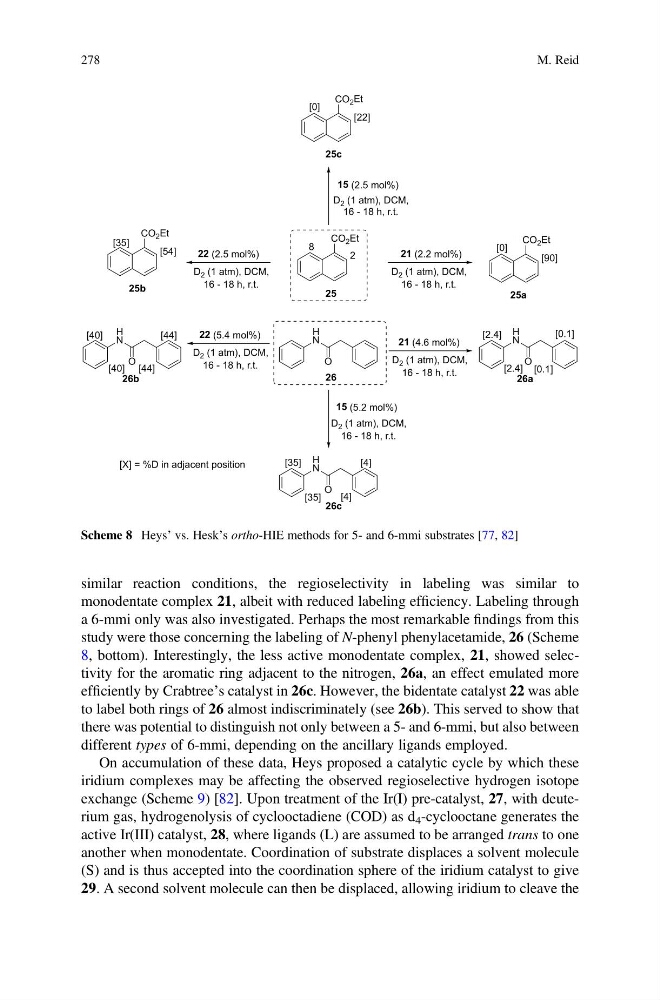
similar reaction conditions, the regioselectivity in labeling was similar to
monodentate complex 21, albeit with reduced labeling efficiency. Labeling through
a 6-mmi only was also investigated. Perhaps the most remarkable findings from this
study were those concerning the labeling of N-phenyl phenylacetamide, 26 (Scheme
8, bottom). Interestingly, the less active monodentate complex, 21, showed selectivity for the aromatic ring adjacent to the nitrogen, 26a, an effect emulated more
efficiently by Crabtree’s catalyst in 26c. However, the bidentate catalyst 22 was able
to label both rings of 26 almost indiscriminately (see 26b). This served to show that
there was potential to distinguish not only between a 5- and 6-mmi, but also between
different types of 6-mmi, depending on the ancillary ligands employed.
On accumulation of these data, Heys proposed a catalytic cycle by which these
iridium complexes may be affecting the observed regioselective hydrogen isotope
exchange (Scheme 9) [82]. Upon treatment of the Ir(I) pre-catalyst, 27, with deuterium gas, hydrogenolysis of cyclooctadiene (COD) as d 4 -cyclooctane generates the
active Ir(III) catalyst, 28, where ligands (L) are assumed to be arranged trans to one
another when monodentate. Coordination of substrate displaces a solvent molecule
(S) and is thus accepted into the coordination sphere of the iridium catalyst to give
29. A second solvent molecule can then be displaced, allowing iridium to cleave the
CO 2 Et
2
8
25
CO 2 Et
[90]
[0]
25a
21 (2.2 mol%)
D 2 (1 atm), DCM,
16 - 18 h, r.t.
22 (2.5 mol%)
D 2 (1 atm), DCM,
16 - 18 h, r.t.
CO 2 Et
[54]
[35]
25b
H
N
O
21 (4.6 mol%)
D 2 (1 atm), DCM,
16 - 18 h, r.t.
H
N
O
15 (2.5 mol%)
D 2 (1 atm), DCM,
16 - 18 h, r.t.
CO 2 Et
[22]
[0]
25c
22 (5.4 mol%)
D 2 (1 atm), DCM,
16 - 18 h, r.t.
15 (5.2 mol%)
D 2 (1 atm), DCM,
16 - 18 h, r.t.
H
N
O
26
H
N
O
[2.4]
[0.1]
[40]
[44]
[35]
[4]
26c
26a
26b
[4]
[35]
[2.4] [0.1]
[44]
[40]
[X] = %D in adjacent position
Scheme 8 Heys’ vs. Hesk’s ortho-HIE methods for 5- and 6-mmi substrates [77, 82]
278
M. Reid
monodentate complex 21, albeit with reduced labeling efficiency. Labeling through
a 6-mmi only was also investigated. Perhaps the most remarkable findings from this
study were those concerning the labeling of N-phenyl phenylacetamide, 26 (Scheme
8, bottom). Interestingly, the less active monodentate complex, 21, showed selectivity for the aromatic ring adjacent to the nitrogen, 26a, an effect emulated more
efficiently by Crabtree’s catalyst in 26c. However, the bidentate catalyst 22 was able
to label both rings of 26 almost indiscriminately (see 26b). This served to show that
there was potential to distinguish not only between a 5- and 6-mmi, but also between
different types of 6-mmi, depending on the ancillary ligands employed.
On accumulation of these data, Heys proposed a catalytic cycle by which these
iridium complexes may be affecting the observed regioselective hydrogen isotope
exchange (Scheme 9) [82]. Upon treatment of the Ir(I) pre-catalyst, 27, with deuterium gas, hydrogenolysis of cyclooctadiene (COD) as d 4 -cyclooctane generates the
active Ir(III) catalyst, 28, where ligands (L) are assumed to be arranged trans to one
another when monodentate. Coordination of substrate displaces a solvent molecule
(S) and is thus accepted into the coordination sphere of the iridium catalyst to give
29. A second solvent molecule can then be displaced, allowing iridium to cleave the
CO 2 Et
2
8
25
CO 2 Et
[90]
[0]
25a
21 (2.2 mol%)
D 2 (1 atm), DCM,
16 - 18 h, r.t.
22 (2.5 mol%)
D 2 (1 atm), DCM,
16 - 18 h, r.t.
CO 2 Et
[54]
[35]
25b
H
N
O
21 (4.6 mol%)
D 2 (1 atm), DCM,
16 - 18 h, r.t.
H
N
O
15 (2.5 mol%)
D 2 (1 atm), DCM,
16 - 18 h, r.t.
CO 2 Et
[22]
[0]
25c
22 (5.4 mol%)
D 2 (1 atm), DCM,
16 - 18 h, r.t.
15 (5.2 mol%)
D 2 (1 atm), DCM,
16 - 18 h, r.t.
H
N
O
26
H
N
O
[2.4]
[0.1]
[40]
[44]
[35]
[4]
26c
26a
26b
[4]
[35]
[2.4] [0.1]
[44]
[40]
[X] = %D in adjacent position
Scheme 8 Heys’ vs. Hesk’s ortho-HIE methods for 5- and 6-mmi substrates [77, 82]
278
M. Reid