

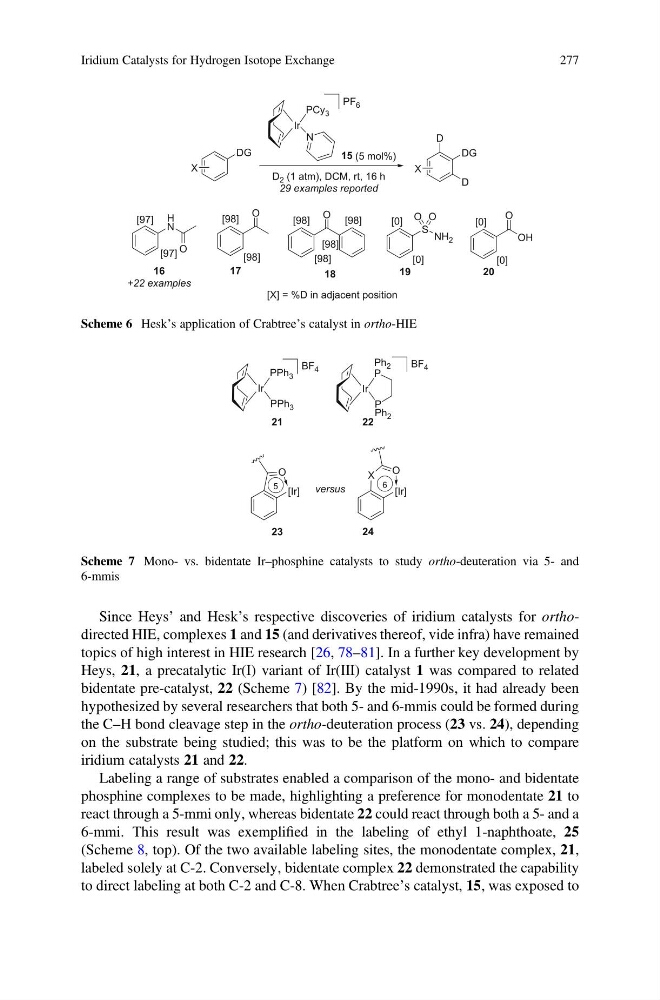
Since Heys’ and Hesk’s respective discoveries of iridium catalysts for orthodirected HIE, complexes 1 and 15 (and derivatives thereof, vide infra) have remained
topics of high interest in HIE research [26, 78–81]. In a further key development by
Heys, 21, a precatalytic Ir(I) variant of Ir(III) catalyst 1 was compared to related
bidentate pre-catalyst, 22 (Scheme 7) [82]. By the mid-1990s, it had already been
hypothesized by several researchers that both 5- and 6-mmis could be formed during
the C–H bond cleavage step in the ortho-deuteration process (23 vs. 24), depending
on the substrate being studied; this was to be the platform on which to compare
iridium catalysts 21 and 22.
Labeling a range of substrates enabled a comparison of the mono- and bidentate
phosphine complexes to be made, highlighting a preference for monodentate 21 to
react through a 5-mmi only, whereas bidentate 22 could react through both a 5- and a
6-mmi. This result was exemplified in the labeling of ethyl 1-naphthoate, 25
(Scheme 8, top). Of the two available labeling sites, the monodentate complex, 21,
labeled solely at C-2. Conversely, bidentate complex 22 demonstrated the capability
to direct labeling at both C-2 and C-8. When Crabtree’s catalyst, 15, was exposed to
DG
DG
D
D
15 (5 mol%)
D 2 (1 atm), DCM, rt, 16 h
29 examples reported
X
X
H
N
16
+22 examples
O
Ir
PCy 3
N
PF 6
17
[97]
[97]
O
[98]
[98]
S NH 2
O O
[0]
[0]
19
20
OH
O
[0]
[0]
18
O
[98]
[98]
[98]
[98]
[X] = %D in adjacent position
Scheme 6 Hesk’s application of Crabtree’s catalyst in ortho-HIE
Ir
PPh 3
PPh 3
BF 4
21
22
Ir
Ph 2
P
P
Ph 2
BF 4
O
[Ir]
X
O
[Ir]
24
23
versus
5
6
Scheme 7 Mono- vs. bidentate Ir–phosphine catalysts to study ortho-deuteration via 5- and
6-mmis
Iridium Catalysts for Hydrogen Isotope Exchange
277
topics of high interest in HIE research [26, 78–81]. In a further key development by
Heys, 21, a precatalytic Ir(I) variant of Ir(III) catalyst 1 was compared to related
bidentate pre-catalyst, 22 (Scheme 7) [82]. By the mid-1990s, it had already been
hypothesized by several researchers that both 5- and 6-mmis could be formed during
the C–H bond cleavage step in the ortho-deuteration process (23 vs. 24), depending
on the substrate being studied; this was to be the platform on which to compare
iridium catalysts 21 and 22.
Labeling a range of substrates enabled a comparison of the mono- and bidentate
phosphine complexes to be made, highlighting a preference for monodentate 21 to
react through a 5-mmi only, whereas bidentate 22 could react through both a 5- and a
6-mmi. This result was exemplified in the labeling of ethyl 1-naphthoate, 25
(Scheme 8, top). Of the two available labeling sites, the monodentate complex, 21,
labeled solely at C-2. Conversely, bidentate complex 22 demonstrated the capability
to direct labeling at both C-2 and C-8. When Crabtree’s catalyst, 15, was exposed to
DG
DG
D
D
15 (5 mol%)
D 2 (1 atm), DCM, rt, 16 h
29 examples reported
X
X
H
N
16
+22 examples
O
Ir
PCy 3
N
PF 6
17
[97]
[97]
O
[98]
[98]
S NH 2
O O
[0]
[0]
19
20
OH
O
[0]
[0]
18
O
[98]
[98]
[98]
[98]
[X] = %D in adjacent position
Scheme 6 Hesk’s application of Crabtree’s catalyst in ortho-HIE
Ir
PPh 3
PPh 3
BF 4
21
22
Ir
Ph 2
P
P
Ph 2
BF 4
O
[Ir]
X
O
[Ir]
24
23
versus
5
6
Scheme 7 Mono- vs. bidentate Ir–phosphine catalysts to study ortho-deuteration via 5- and
6-mmis
Iridium Catalysts for Hydrogen Isotope Exchange
277