

The mild labeling conditions pioneered by Heys and co-workers, coupled with
intriguing substrate-dependent regioselectivity, captured the combined interest of the
industrial and academic HIE communities, resulting in a large number of subsequent
studies aimed at understanding the catalytic properties of 1 and related Ir-based HIE
catalysts. Firstly, Heys followed up his initial study with a more in-depth assessment
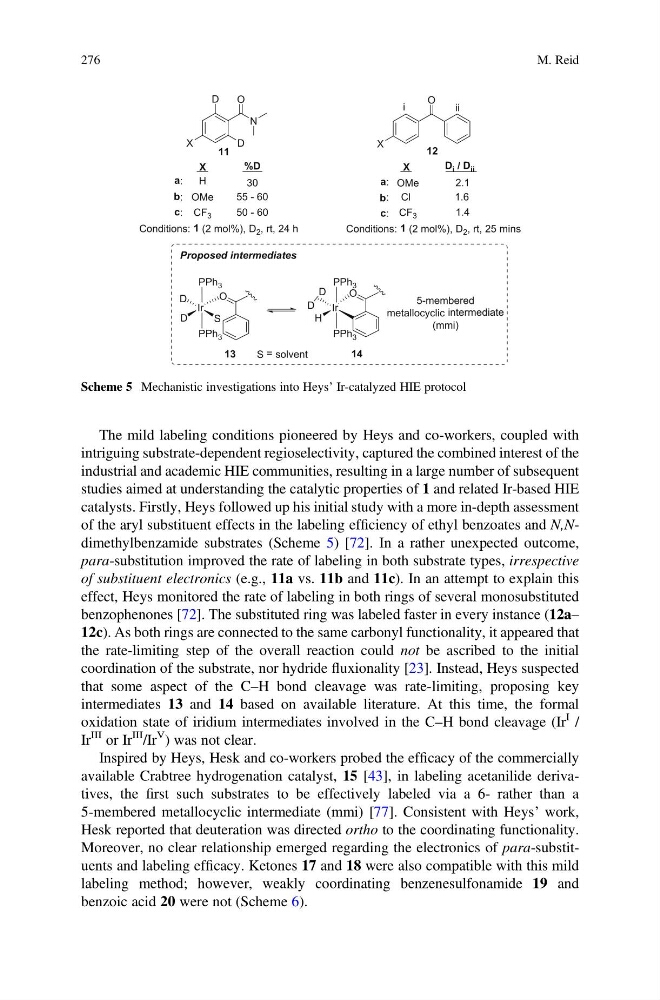
of the aryl substituent effects in the labeling efficiency of ethyl benzoates and N,Ndimethylbenzamide substrates (Scheme 5) [72]. In a rather unexpected outcome,
para-substitution improved the rate of labeling in both substrate types, irrespective
of substituent electronics (e.g., 11a vs. 11b and 11c). In an attempt to explain this
effect, Heys monitored the rate of labeling in both rings of several monosubstituted
benzophenones [72]. The substituted ring was labeled faster in every instance (12a–
12c). As both rings are connected to the same carbonyl functionality, it appeared that
the rate-limiting step of the overall reaction could not be ascribed to the initial
coordination of the substrate, nor hydride fluxionality [23]. Instead, Heys suspected
that some aspect of the C–H bond cleavage was rate-limiting, proposing key
intermediates 13 and 14 based on available literature. At this time, the formal
oxidation state of iridium intermediates involved in the C–H bond cleavage (Ir
I /
Ir
III or Ir
III
/Ir
V ) was not clear.
Inspired by Heys, Hesk and co-workers probed the efficacy of the commercially
available Crabtree hydrogenation catalyst, 15 [43], in labeling acetanilide derivatives, the first such substrates to be effectively labeled via a 6- rather than a
5-membered metallocyclic intermediate (mmi) [77]. Consistent with Heys’ work,
Hesk reported that deuteration was directed ortho to the coordinating functionality.
Moreover, no clear relationship emerged regarding the electronics of para-substituents and labeling efficacy. Ketones 17 and 18 were also compatible with this mild
labeling method; however, weakly coordinating benzenesulfonamide 19 and
benzoic acid 20 were not (Scheme 6).
O
X
i
ii
X
D i / D ii
OMe
CF 3
2.1
1.4
12
Conditions: 1 (2 mol%), D 2 , rt, 25 mins
O
X
11
N
D
D
X
%D
OMe
CF 3
55 - 60
50 - 60
H
30
Conditions: 1 (2 mol%), D 2 , rt, 24 h
Cl
1.6
Ir
PPh 3
PPh 3
D
D
O
S
Ir
PPh 3
PPh 3
H
O
D
D
Proposed intermediates
13
14
a:
b:
c:
a:
b:
c:
S = solvent
5-membered
metallocyclic intermediate
(mmi)
Scheme 5 Mechanistic investigations into Heys’ Ir-catalyzed HIE protocol
276
M. Reid
intriguing substrate-dependent regioselectivity, captured the combined interest of the
industrial and academic HIE communities, resulting in a large number of subsequent
studies aimed at understanding the catalytic properties of 1 and related Ir-based HIE
catalysts. Firstly, Heys followed up his initial study with a more in-depth assessment
of the aryl substituent effects in the labeling efficiency of ethyl benzoates and N,Ndimethylbenzamide substrates (Scheme 5) [72]. In a rather unexpected outcome,
para-substitution improved the rate of labeling in both substrate types, irrespective
of substituent electronics (e.g., 11a vs. 11b and 11c). In an attempt to explain this
effect, Heys monitored the rate of labeling in both rings of several monosubstituted
benzophenones [72]. The substituted ring was labeled faster in every instance (12a–
12c). As both rings are connected to the same carbonyl functionality, it appeared that
the rate-limiting step of the overall reaction could not be ascribed to the initial
coordination of the substrate, nor hydride fluxionality [23]. Instead, Heys suspected
that some aspect of the C–H bond cleavage was rate-limiting, proposing key
intermediates 13 and 14 based on available literature. At this time, the formal
oxidation state of iridium intermediates involved in the C–H bond cleavage (Ir
I /
Ir
III or Ir
III
/Ir
V ) was not clear.
Inspired by Heys, Hesk and co-workers probed the efficacy of the commercially
available Crabtree hydrogenation catalyst, 15 [43], in labeling acetanilide derivatives, the first such substrates to be effectively labeled via a 6- rather than a
5-membered metallocyclic intermediate (mmi) [77]. Consistent with Heys’ work,
Hesk reported that deuteration was directed ortho to the coordinating functionality.
Moreover, no clear relationship emerged regarding the electronics of para-substituents and labeling efficacy. Ketones 17 and 18 were also compatible with this mild
labeling method; however, weakly coordinating benzenesulfonamide 19 and
benzoic acid 20 were not (Scheme 6).
O
X
i
ii
X
D i / D ii
OMe
CF 3
2.1
1.4
12
Conditions: 1 (2 mol%), D 2 , rt, 25 mins
O
X
11
N
D
D
X
%D
OMe
CF 3
55 - 60
50 - 60
H
30
Conditions: 1 (2 mol%), D 2 , rt, 24 h
Cl
1.6
Ir
PPh 3
PPh 3
D
D
O
S
Ir
PPh 3
PPh 3
H
O
D
D
Proposed intermediates
13
14
a:
b:
c:
a:
b:
c:
S = solvent
5-membered
metallocyclic intermediate
(mmi)
Scheme 5 Mechanistic investigations into Heys’ Ir-catalyzed HIE protocol
276
M. Reid