

[70, 71], the focus of this chapter is on the far more expansive homogeneous iridium
catalysis developments.
2.1 Early Developments in Ortho-Directed HIE
There is a clear dominance of ortho-HIE in the homogeneous iridium catalyst
literature. In 1992, Heys demonstrated the successful ortho-directed deuteration of
several substituted aromatic compounds using the 18-electron Ir(III) bis-phosphine
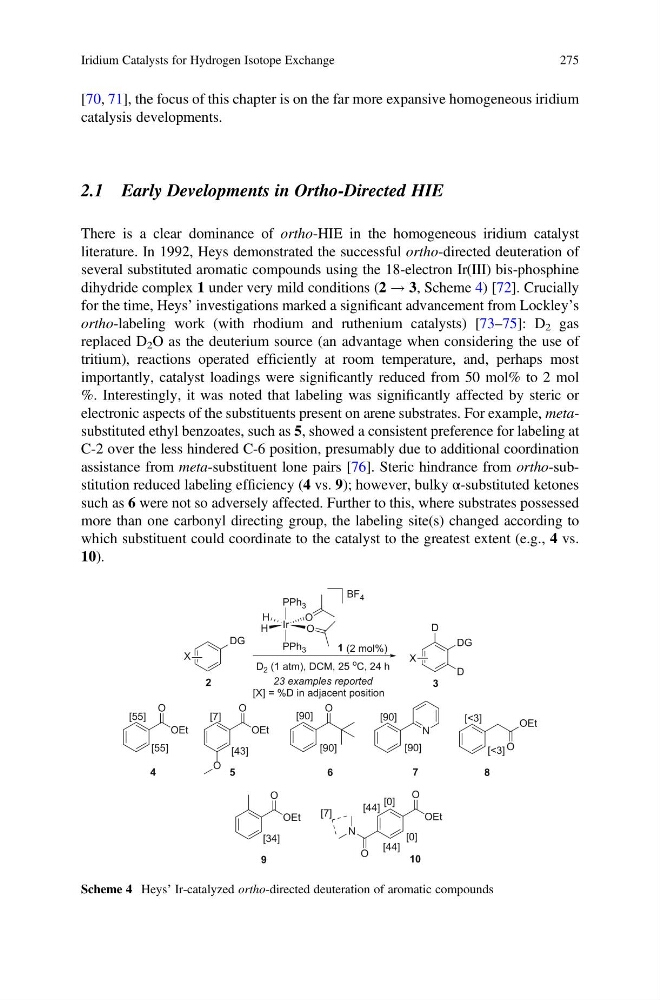
dihydride complex 1 under very mild conditions (2 ! 3, Scheme 4) [72]. Crucially
for the time, Heys’ investigations marked a significant advancement from Lockley’s
ortho-labeling work (with rhodium and ruthenium catalysts) [73–75]: D 2 gas
replaced D 2 O as the deuterium source (an advantage when considering the use of
tritium), reactions operated efficiently at room temperature, and, perhaps most
importantly, catalyst loadings were significantly reduced from 50 mol% to 2 mol
%. Interestingly, it was noted that labeling was significantly affected by steric or
electronic aspects of the substituents present on arene substrates. For example, metasubstituted ethyl benzoates, such as 5, showed a consistent preference for labeling at
C-2 over the less hindered C-6 position, presumably due to additional coordination
assistance from meta-substituent lone pairs [76]. Steric hindrance from ortho-substitution reduced labeling efficiency (4 vs. 9); however, bulky α-substituted ketones
such as 6 were not so adversely affected. Further to this, where substrates possessed
more than one carbonyl directing group, the labeling site(s) changed according to
which substituent could coordinate to the catalyst to the greatest extent (e.g., 4 vs.
10).
DG
DG
D
D
1 (2 mol%)
D 2 (1 atm), DCM, 25
o
C, 24 h
23 examples reported
2
Ir
H
O
H
O
PPh 3
PPh 3
BF 4
X
X
3
OEt
O
O
OEt
O
[43]
[7]
[55]
O
[90]
[90]
N
[90]
[90]
[<3]
[<3]
5
OEt
O
[55]
4
6
7
8
OEt
O
[34]
9
OEt
O
N
O
[44]
[7]
[0]
[44]
[0]
10
[X] = %D in adjacent position
Scheme 4 Heys’ Ir-catalyzed ortho-directed deuteration of aromatic compounds
Iridium Catalysts for Hydrogen Isotope Exchange
275
catalysis developments.
2.1 Early Developments in Ortho-Directed HIE
There is a clear dominance of ortho-HIE in the homogeneous iridium catalyst
literature. In 1992, Heys demonstrated the successful ortho-directed deuteration of
several substituted aromatic compounds using the 18-electron Ir(III) bis-phosphine
dihydride complex 1 under very mild conditions (2 ! 3, Scheme 4) [72]. Crucially
for the time, Heys’ investigations marked a significant advancement from Lockley’s
ortho-labeling work (with rhodium and ruthenium catalysts) [73–75]: D 2 gas
replaced D 2 O as the deuterium source (an advantage when considering the use of
tritium), reactions operated efficiently at room temperature, and, perhaps most
importantly, catalyst loadings were significantly reduced from 50 mol% to 2 mol
%. Interestingly, it was noted that labeling was significantly affected by steric or
electronic aspects of the substituents present on arene substrates. For example, metasubstituted ethyl benzoates, such as 5, showed a consistent preference for labeling at
C-2 over the less hindered C-6 position, presumably due to additional coordination
assistance from meta-substituent lone pairs [76]. Steric hindrance from ortho-substitution reduced labeling efficiency (4 vs. 9); however, bulky α-substituted ketones
such as 6 were not so adversely affected. Further to this, where substrates possessed
more than one carbonyl directing group, the labeling site(s) changed according to
which substituent could coordinate to the catalyst to the greatest extent (e.g., 4 vs.
10).
DG
DG
D
D
1 (2 mol%)
D 2 (1 atm), DCM, 25
o
C, 24 h
23 examples reported
2
Ir
H
O
H
O
PPh 3
PPh 3
BF 4
X
X
3
OEt
O
O
OEt
O
[43]
[7]
[55]
O
[90]
[90]
N
[90]
[90]
[<3]
[<3]
5
OEt
O
[55]
4
6
7
8
OEt
O
[34]
9
OEt
O
N
O
[44]
[7]
[0]
[44]
[0]
10
[X] = %D in adjacent position
Scheme 4 Heys’ Ir-catalyzed ortho-directed deuteration of aromatic compounds
Iridium Catalysts for Hydrogen Isotope Exchange
275