

D 2 O (heavy water), DCl, benzene-d 6 , DMSO-d 6 , and numerous deuterated alcohols.
Of these isotope sources, and of direct relevance to the focus of this chapter, D 2 gas
has been the preferred isotope source as it directly maps onto the preferred use of
tritium gas for radiolabeling protocols [5, 7, 10, 17].
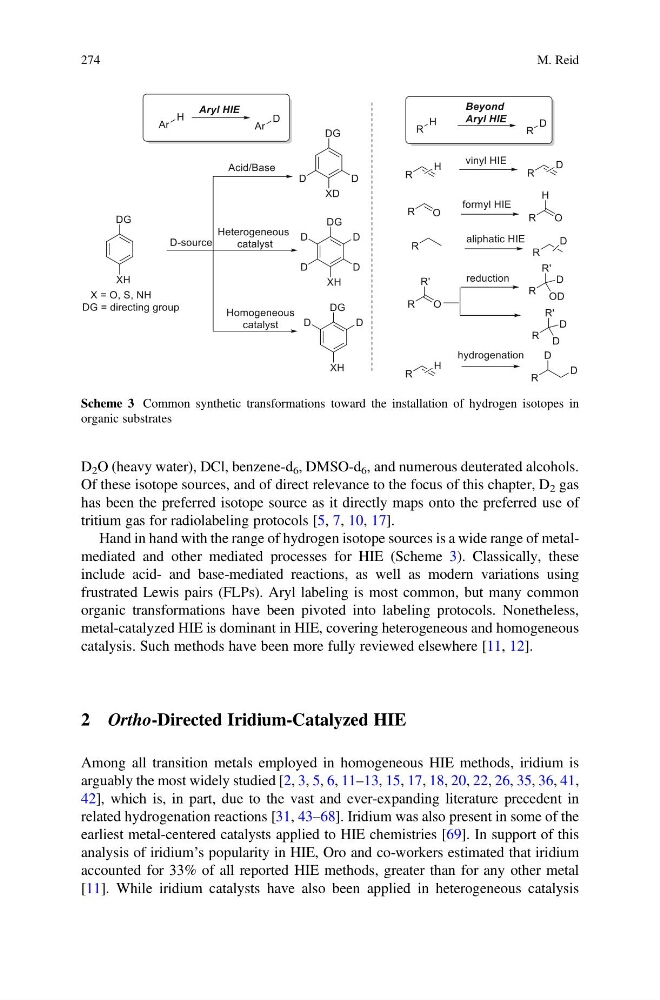
Hand in hand with the range of hydrogen isotope sources is a wide range of metalmediated and other mediated processes for HIE (Scheme 3). Classically, these
include acid- and base-mediated reactions, as well as modern variations using
frustrated Lewis pairs (FLPs). Aryl labeling is most common, but many common
organic transformations have been pivoted into labeling protocols. Nonetheless,
metal-catalyzed HIE is dominant in HIE, covering heterogeneous and homogeneous
catalysis. Such methods have been more fully reviewed elsewhere [11, 12].
2 Ortho-Directed Iridium-Catalyzed HIE
Among all transition metals employed in homogeneous HIE methods, iridium is
arguably the most widely studied [2, 3, 5, 6, 11–13, 15, 17, 18, 20, 22, 26, 35, 36, 41,
42], which is, in part, due to the vast and ever-expanding literature precedent in
related hydrogenation reactions [31, 43–68]. Iridium was also present in some of the
earliest metal-centered catalysts applied to HIE chemistries [69]. In support of this
analysis of iridium’s popularity in HIE, Oro and co-workers estimated that iridium
accounted for 33% of all reported HIE methods, greater than for any other metal
[11]. While iridium catalysts have also been applied in heterogeneous catalysis
Scheme 3 Common synthetic transformations toward the installation of hydrogen isotopes in
organic substrates
274
M. Reid
Of these isotope sources, and of direct relevance to the focus of this chapter, D 2 gas
has been the preferred isotope source as it directly maps onto the preferred use of
tritium gas for radiolabeling protocols [5, 7, 10, 17].
Hand in hand with the range of hydrogen isotope sources is a wide range of metalmediated and other mediated processes for HIE (Scheme 3). Classically, these
include acid- and base-mediated reactions, as well as modern variations using
frustrated Lewis pairs (FLPs). Aryl labeling is most common, but many common
organic transformations have been pivoted into labeling protocols. Nonetheless,
metal-catalyzed HIE is dominant in HIE, covering heterogeneous and homogeneous
catalysis. Such methods have been more fully reviewed elsewhere [11, 12].
2 Ortho-Directed Iridium-Catalyzed HIE
Among all transition metals employed in homogeneous HIE methods, iridium is
arguably the most widely studied [2, 3, 5, 6, 11–13, 15, 17, 18, 20, 22, 26, 35, 36, 41,
42], which is, in part, due to the vast and ever-expanding literature precedent in
related hydrogenation reactions [31, 43–68]. Iridium was also present in some of the
earliest metal-centered catalysts applied to HIE chemistries [69]. In support of this
analysis of iridium’s popularity in HIE, Oro and co-workers estimated that iridium
accounted for 33% of all reported HIE methods, greater than for any other metal
[11]. While iridium catalysts have also been applied in heterogeneous catalysis
Scheme 3 Common synthetic transformations toward the installation of hydrogen isotopes in
organic substrates
274
M. Reid