

Research into deuterium (
2
H or D) and tritium (
3
H or T) labeling is more substantial
than that for other isotopes and has been developed on a number of fronts over the past
60 years [2–22]. Further to this, key developments in synthetic strategies and analytical techniques over the past three decades are gradually making tritium labeling the
preferred technique in many absorption, distribution, metabolism, excretion, and
toxicology (ADMET) studies [10]. In one particularly active branch of such research,
hydrogen isotope exchange (HIE) is commonly employed to deliver deuterium or
radioactive tritium to pharmaceutical drug candidates in one synthetic step.
1.2 Applications of Hydrogen Isotope Exchange
The importance of hydrogen isotope exchange (HIE), for iridium catalysts and
beyond, is manifest in the wealth of reviews published in the area [2–36]. As well
as circumventing the requirement for isotopically enriched starting materials in
synthesizing tritiated drug candidates [3, 10], HIE can also provide analogous
deuterated compounds for use as internal standards for mass spectrometry
[29, 37], for kinetic isotope studies, [21, 38, 39], and for the alteration of reaction
pathways in total syntheses [40]. Additionally, HIE is applied within almost every
sub-discipline in life science, in nuclear science, and beyond [2]. The ability for
precise measurement of isotope ratios promotes a dynamic view on biosynthetic
pathways, protein turnover, and systems-wide metabolic networks and, thus, has
paved the way for a number of scientific breakthroughs in biomedical research. In
assessing a drug candidate’s metabolic fate, the chemist must first have a flexible
technique with which to study it. Consequently, isotopic labeling is the gold
standard method by which early stage drug discovery processes are optimized.
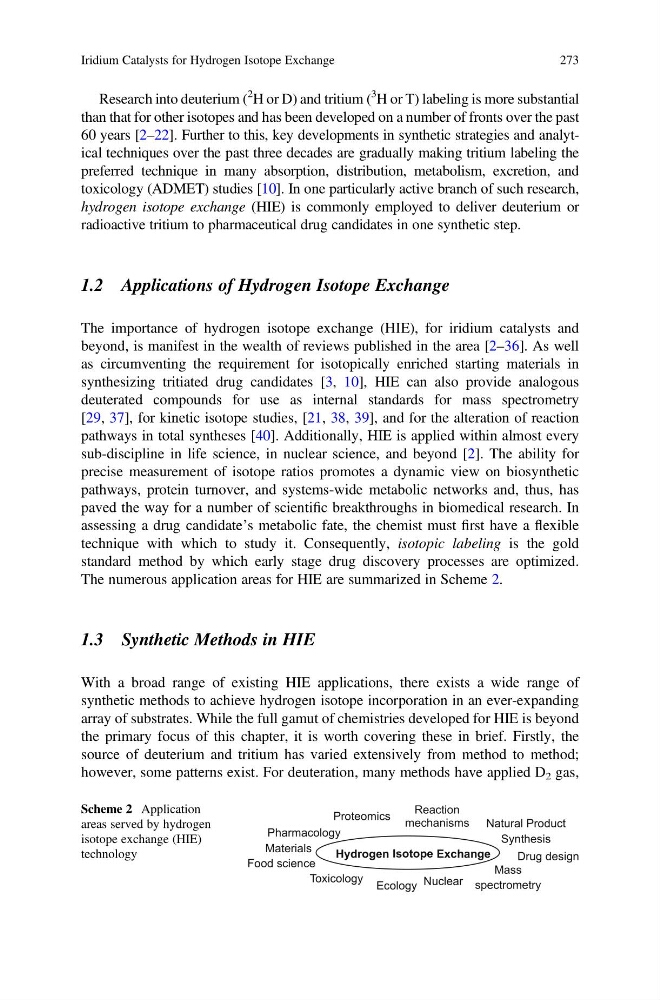
The numerous application areas for HIE are summarized in Scheme 2.
1.3 Synthetic Methods in HIE
With a broad range of existing HIE applications, there exists a wide range of
synthetic methods to achieve hydrogen isotope incorporation in an ever-expanding
array of substrates. While the full gamut of chemistries developed for HIE is beyond
the primary focus of this chapter, it is worth covering these in brief. Firstly, the
source of deuterium and tritium has varied extensively from method to method;
however, some patterns exist. For deuteration, many methods have applied D 2 gas,
Hydrogen Isotope Exchange
Food science
Toxicology Ecology
Mass
spectrometry
Drug design
Pharmacology
Proteomics
Materials
Reaction
mechanisms
Nuclear
Natural Product
Synthesis
Scheme 2 Application
areas served by hydrogen
isotope exchange (HIE)
technology
Iridium Catalysts for Hydrogen Isotope Exchange
273
2
H or D) and tritium (
3
H or T) labeling is more substantial
than that for other isotopes and has been developed on a number of fronts over the past
60 years [2–22]. Further to this, key developments in synthetic strategies and analytical techniques over the past three decades are gradually making tritium labeling the
preferred technique in many absorption, distribution, metabolism, excretion, and
toxicology (ADMET) studies [10]. In one particularly active branch of such research,
hydrogen isotope exchange (HIE) is commonly employed to deliver deuterium or
radioactive tritium to pharmaceutical drug candidates in one synthetic step.
1.2 Applications of Hydrogen Isotope Exchange
The importance of hydrogen isotope exchange (HIE), for iridium catalysts and
beyond, is manifest in the wealth of reviews published in the area [2–36]. As well
as circumventing the requirement for isotopically enriched starting materials in
synthesizing tritiated drug candidates [3, 10], HIE can also provide analogous
deuterated compounds for use as internal standards for mass spectrometry
[29, 37], for kinetic isotope studies, [21, 38, 39], and for the alteration of reaction
pathways in total syntheses [40]. Additionally, HIE is applied within almost every
sub-discipline in life science, in nuclear science, and beyond [2]. The ability for
precise measurement of isotope ratios promotes a dynamic view on biosynthetic
pathways, protein turnover, and systems-wide metabolic networks and, thus, has
paved the way for a number of scientific breakthroughs in biomedical research. In
assessing a drug candidate’s metabolic fate, the chemist must first have a flexible
technique with which to study it. Consequently, isotopic labeling is the gold
standard method by which early stage drug discovery processes are optimized.
The numerous application areas for HIE are summarized in Scheme 2.
1.3 Synthetic Methods in HIE
With a broad range of existing HIE applications, there exists a wide range of
synthetic methods to achieve hydrogen isotope incorporation in an ever-expanding
array of substrates. While the full gamut of chemistries developed for HIE is beyond
the primary focus of this chapter, it is worth covering these in brief. Firstly, the
source of deuterium and tritium has varied extensively from method to method;
however, some patterns exist. For deuteration, many methods have applied D 2 gas,
Hydrogen Isotope Exchange
Food science
Toxicology Ecology
Mass
spectrometry
Drug design
Pharmacology
Proteomics
Materials
Reaction
mechanisms
Nuclear
Natural Product
Synthesis
Scheme 2 Application
areas served by hydrogen
isotope exchange (HIE)
technology
Iridium Catalysts for Hydrogen Isotope Exchange
273