

Keywords C–H functionalization · Deuterium · Iridium · Isotope exchange ·
Tritium
1 Introduction
1.1 Isotopes and Isotopic Labeling
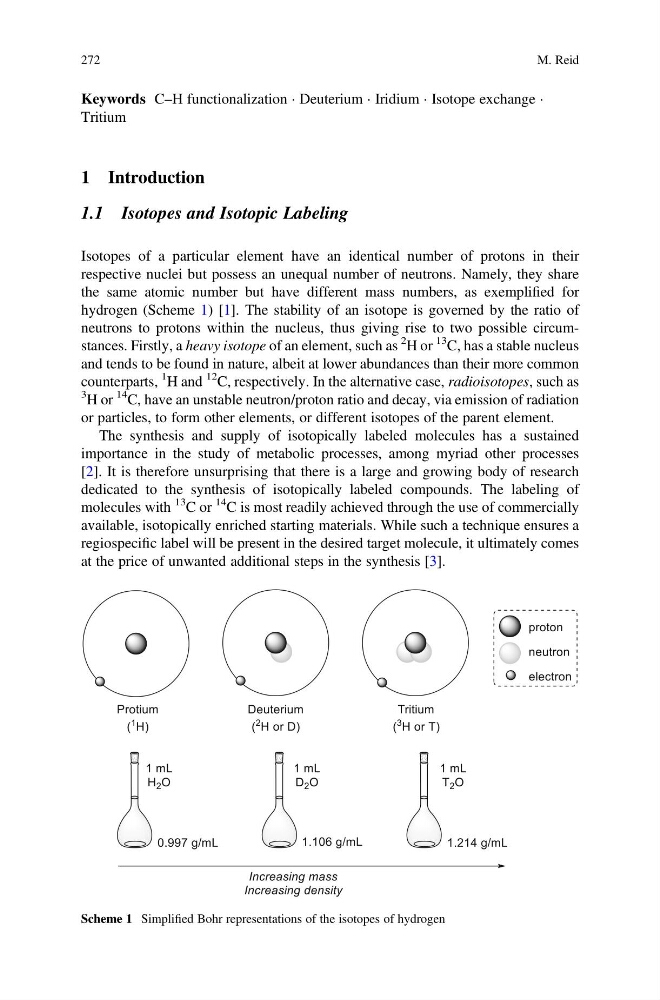
Isotopes of a particular element have an identical number of protons in their
respective nuclei but possess an unequal number of neutrons. Namely, they share
the same atomic number but have different mass numbers, as exemplified for
hydrogen (Scheme 1) [1]. The stability of an isotope is governed by the ratio of
neutrons to protons within the nucleus, thus giving rise to two possible circumstances. Firstly, a heavy isotope of an element, such as
2 H or
13 C, has a stable nucleus
and tends to be found in nature, albeit at lower abundances than their more common
counterparts,
1 H and
12 C, respectively. In the alternative case, radioisotopes, such as
3 H or
14 C, have an unstable neutron/proton ratio and decay, via emission of radiation
or particles, to form other elements, or different isotopes of the parent element.
The synthesis and supply of isotopically labeled molecules has a sustained
importance in the study of metabolic processes, among myriad other processes
[2]. It is therefore unsurprising that there is a large and growing body of research
dedicated to the synthesis of isotopically labeled compounds. The labeling of
molecules with
13
C or
14 C is most readily achieved through the use of commercially
available, isotopically enriched starting materials. While such a technique ensures a
regiospecific label will be present in the desired target molecule, it ultimately comes
at the price of unwanted additional steps in the synthesis [3].
Scheme 1 Simplified Bohr representations of the isotopes of hydrogen
272
M. Reid
Tritium
1 Introduction
1.1 Isotopes and Isotopic Labeling
Isotopes of a particular element have an identical number of protons in their
respective nuclei but possess an unequal number of neutrons. Namely, they share
the same atomic number but have different mass numbers, as exemplified for
hydrogen (Scheme 1) [1]. The stability of an isotope is governed by the ratio of
neutrons to protons within the nucleus, thus giving rise to two possible circumstances. Firstly, a heavy isotope of an element, such as
2 H or
13 C, has a stable nucleus
and tends to be found in nature, albeit at lower abundances than their more common
counterparts,
1 H and
12 C, respectively. In the alternative case, radioisotopes, such as
3 H or
14 C, have an unstable neutron/proton ratio and decay, via emission of radiation
or particles, to form other elements, or different isotopes of the parent element.
The synthesis and supply of isotopically labeled molecules has a sustained
importance in the study of metabolic processes, among myriad other processes
[2]. It is therefore unsurprising that there is a large and growing body of research
dedicated to the synthesis of isotopically labeled compounds. The labeling of
molecules with
13
C or
14 C is most readily achieved through the use of commercially
available, isotopically enriched starting materials. While such a technique ensures a
regiospecific label will be present in the desired target molecule, it ultimately comes
at the price of unwanted additional steps in the synthesis [3].
Scheme 1 Simplified Bohr representations of the isotopes of hydrogen
272
M. Reid