

the labeling of 6-mmi substrates, changing the diphenylphosphinoethane (dppe)
ligand for the sterically less encumbered arsine analogue [81].
2.2 Contemporary Methods in Ortho-Directed HIE
Further synthetic developments by Herbert [28, 78, 83] and later Salter [26] showed
that bis-phosphine catalysts like 22 may be generated in situ from the appropriate
free phosphine and commercial iridium dimer, [Ir(COD)Cl] 2 , with comparable
activity to the isolated complexes. The same authors are also separately responsible
for detailed studies into alteration of the phosphine structure [26, 78, 81]. However,
both parties have remarked that strong correlations between ligand properties (such
as sterics or electronics) and catalyst activity are difficult to detect. The number of
such ligands applied to iridium-catalyzed HIE is now extensive and includes more
elaborate catalyst system like 41 (Scheme 11).
Parallel with studies into bis-phosphine systems, Crabtree’s catalyst 15 has also
been the subject of intense study in deuteration and tritiation, since Hesk’s discovery
[76, 84–89]. In one of the largest of any such study, Herbert explored an expansive
substrate scope, including ketones, amides, anilides, and various heterocycles
[83]. Despite the impressive array of examples reported, this study employed at
least stoichiometric quantities of 15 and a dual D 2 /D 2 O isotope source, making
comparisons to related ortho-labeling methods difficult.
In a notable crossover between bis-phosphine catalysts and Crabtree’s catalyst,
Hickey and co-workers developed a polymer-supported variant of Heys’
bis-phosphine catalyst, 42, which showed comparable ortho-HIE activity to 15
and 22, but with the practical benefit of simple catalyst filtration at the end of the
reaction (43 vs. 44 vs. 45; Scheme 12) [71]. Solid-supported iridium catalysts for
HIE have now been adapted to flow systems [80].
Ir
PPh 3
PPh 3
H
Ir
PPh 2
H
Ph 2 P
OEt
O
OEt
O
D
D
Ir
Ph 3 P
PPh 3
H
D
D
OEt
O
D D
Ir
PPh 2
H
Ph 2 P
D D
OEt
O
monodentate ligands trans
5-mmi labelling favoured
bidentate ligands cis
5-mmi and 6-mmi labelling tolerated
37
38
39
40
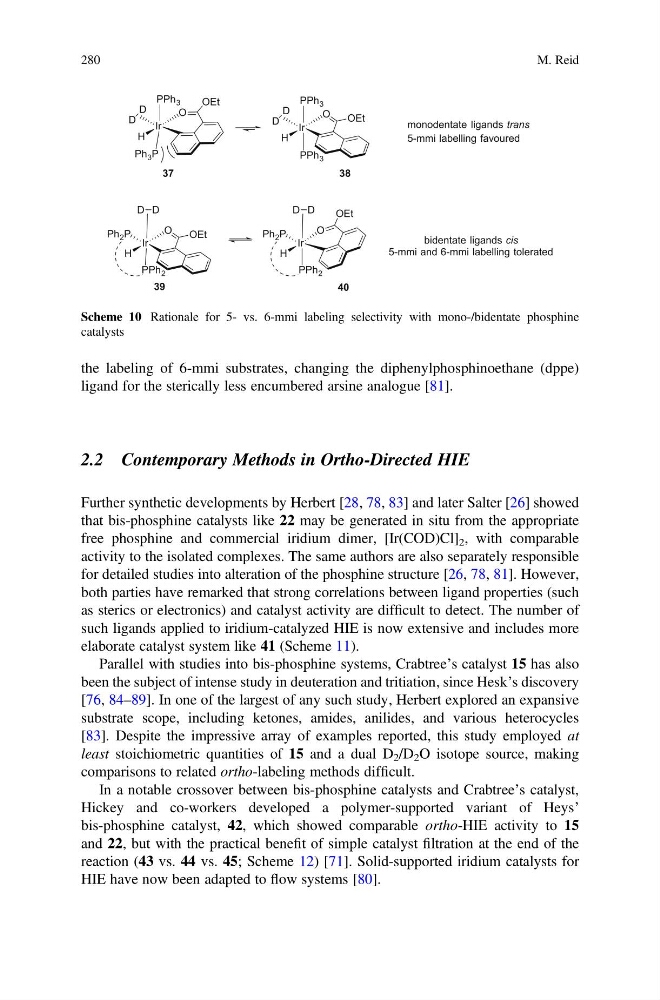
Scheme 10 Rationale for 5- vs. 6-mmi labeling selectivity with mono-/bidentate phosphine
catalysts
280
M. Reid
ligand for the sterically less encumbered arsine analogue [81].
2.2 Contemporary Methods in Ortho-Directed HIE
Further synthetic developments by Herbert [28, 78, 83] and later Salter [26] showed
that bis-phosphine catalysts like 22 may be generated in situ from the appropriate
free phosphine and commercial iridium dimer, [Ir(COD)Cl] 2 , with comparable
activity to the isolated complexes. The same authors are also separately responsible
for detailed studies into alteration of the phosphine structure [26, 78, 81]. However,
both parties have remarked that strong correlations between ligand properties (such
as sterics or electronics) and catalyst activity are difficult to detect. The number of
such ligands applied to iridium-catalyzed HIE is now extensive and includes more
elaborate catalyst system like 41 (Scheme 11).
Parallel with studies into bis-phosphine systems, Crabtree’s catalyst 15 has also
been the subject of intense study in deuteration and tritiation, since Hesk’s discovery
[76, 84–89]. In one of the largest of any such study, Herbert explored an expansive
substrate scope, including ketones, amides, anilides, and various heterocycles
[83]. Despite the impressive array of examples reported, this study employed at
least stoichiometric quantities of 15 and a dual D 2 /D 2 O isotope source, making
comparisons to related ortho-labeling methods difficult.
In a notable crossover between bis-phosphine catalysts and Crabtree’s catalyst,
Hickey and co-workers developed a polymer-supported variant of Heys’
bis-phosphine catalyst, 42, which showed comparable ortho-HIE activity to 15
and 22, but with the practical benefit of simple catalyst filtration at the end of the
reaction (43 vs. 44 vs. 45; Scheme 12) [71]. Solid-supported iridium catalysts for
HIE have now been adapted to flow systems [80].
Ir
PPh 3
PPh 3
H
Ir
PPh 2
H
Ph 2 P
OEt
O
OEt
O
D
D
Ir
Ph 3 P
PPh 3
H
D
D
OEt
O
D D
Ir
PPh 2
H
Ph 2 P
D D
OEt
O
monodentate ligands trans
5-mmi labelling favoured
bidentate ligands cis
5-mmi and 6-mmi labelling tolerated
37
38
39
40
Scheme 10 Rationale for 5- vs. 6-mmi labeling selectivity with mono-/bidentate phosphine
catalysts
280
M. Reid