

A related methodology was employed for the synthesis of L-sugars from their
parent deoxy derivatives. For example, L-glycopyranosyl donors were prepared via
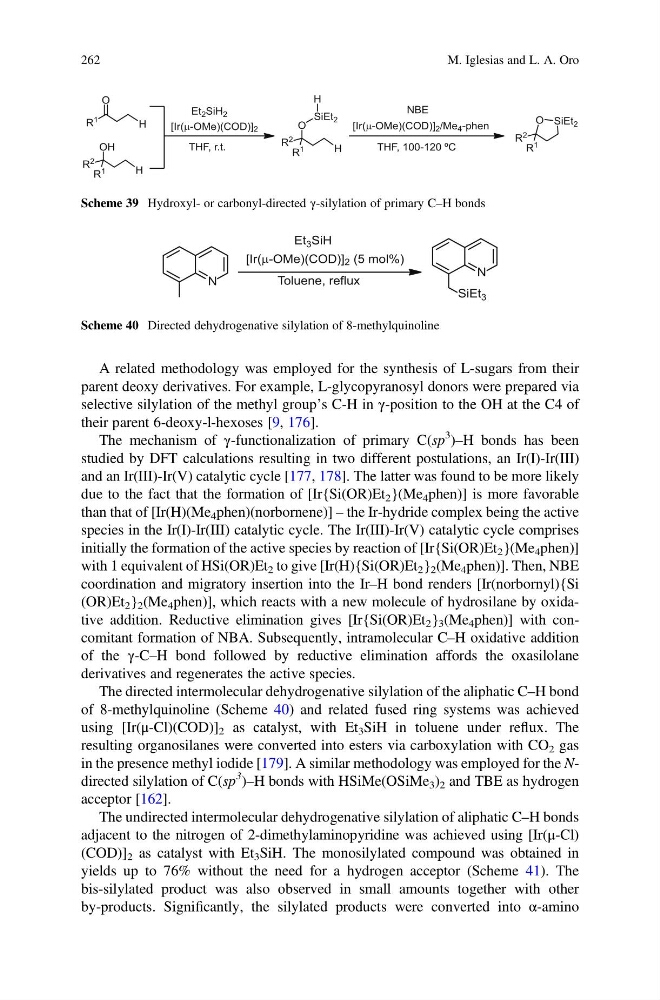
selective silylation of the methyl group’s C-H in γ-position to the OH at the C4 of
their parent 6-deoxy-l-hexoses [9, 176].
The mechanism of γ-functionalization of primary C(sp
3 )–H bonds has been
studied by DFT calculations resulting in two different postulations, an Ir(I)-Ir(III)
and an Ir(III)-Ir(V) catalytic cycle [177, 178]. The latter was found to be more likely
due to the fact that the formation of [Ir{Si(OR)Et 2 }(Me 4 phen)] is more favorable
than that of [Ir(H)(Me 4 phen)(norbornene)] – the Ir-hydride complex being the active
species in the Ir(I)-Ir(III) catalytic cycle. The Ir(III)-Ir(V) catalytic cycle comprises
initially the formation of the active species by reaction of [Ir{Si(OR)Et 2 }(Me 4 phen)]
with 1 equivalent of HSi(OR)Et 2 to give [Ir(H){Si(OR)Et 2 } 2 (Me 4 phen)]. Then, NBE
coordination and migratory insertion into the Ir–H bond renders [Ir(norbornyl){Si
(OR)Et 2 } 2 (Me 4 phen)], which reacts with a new molecule of hydrosilane by oxidative addition. Reductive elimination gives [Ir{Si(OR)Et 2 } 3 (Me 4 phen)] with concomitant formation of NBA. Subsequently, intramolecular C–H oxidative addition
of the γ-C–H bond followed by reductive elimination affords the oxasilolane
derivatives and regenerates the active species.
The directed intermolecular dehydrogenative silylation of the aliphatic C–H bond
of 8-methylquinoline (Scheme 40) and related fused ring systems was achieved
using [Ir(μ-Cl)(COD)] 2 as catalyst, with Et 3 SiH in toluene under reflux. The
resulting organosilanes were converted into esters via carboxylation with CO 2 gas
in the presence methyl iodide [179]. A similar methodology was employed for the Ndirected silylation of C(sp
3 )–H bonds with HSiMe(OSiMe 3 ) 2 and TBE as hydrogen
acceptor [162].
The undirected intermolecular dehydrogenative silylation of aliphatic C–H bonds
adjacent to the nitrogen of 2-dimethylaminopyridine was achieved using [Ir(μ-Cl)
(COD)] 2 as catalyst with Et 3 SiH. The monosilylated compound was obtained in
yields up to 76% without the need for a hydrogen acceptor (Scheme 41). The
bis-silylated product was also observed in small amounts together with other
by-products. Significantly, the silylated products were converted into α-amino
O
R
1
[Ir(µ-OMe)(COD)] 2
THF, r.t.
H
OH
R
2
H
R
1
O
R
2
R
1
SiEt 2
Et 2 SiH 2
[Ir(µ-OMe)(COD)] 2 /Me 4 -phen
NBE
THF, 100-120 ºC
O
R
2
H
R
1
SiEt 2
H
Scheme 39 Hydroxyl- or carbonyl-directed γ-silylation of primary C–H bonds
[Ir(µ-OMe)(COD)] 2 (5 mol%)
Toluene, reflux
Et 3 SiH
N
SiEt 3
N
Scheme 40 Directed dehydrogenative silylation of 8-methylquinoline
262
M. Iglesias and L. A. Oro
parent deoxy derivatives. For example, L-glycopyranosyl donors were prepared via
selective silylation of the methyl group’s C-H in γ-position to the OH at the C4 of
their parent 6-deoxy-l-hexoses [9, 176].
The mechanism of γ-functionalization of primary C(sp
3 )–H bonds has been
studied by DFT calculations resulting in two different postulations, an Ir(I)-Ir(III)
and an Ir(III)-Ir(V) catalytic cycle [177, 178]. The latter was found to be more likely
due to the fact that the formation of [Ir{Si(OR)Et 2 }(Me 4 phen)] is more favorable
than that of [Ir(H)(Me 4 phen)(norbornene)] – the Ir-hydride complex being the active
species in the Ir(I)-Ir(III) catalytic cycle. The Ir(III)-Ir(V) catalytic cycle comprises
initially the formation of the active species by reaction of [Ir{Si(OR)Et 2 }(Me 4 phen)]
with 1 equivalent of HSi(OR)Et 2 to give [Ir(H){Si(OR)Et 2 } 2 (Me 4 phen)]. Then, NBE
coordination and migratory insertion into the Ir–H bond renders [Ir(norbornyl){Si
(OR)Et 2 } 2 (Me 4 phen)], which reacts with a new molecule of hydrosilane by oxidative addition. Reductive elimination gives [Ir{Si(OR)Et 2 } 3 (Me 4 phen)] with concomitant formation of NBA. Subsequently, intramolecular C–H oxidative addition
of the γ-C–H bond followed by reductive elimination affords the oxasilolane
derivatives and regenerates the active species.
The directed intermolecular dehydrogenative silylation of the aliphatic C–H bond
of 8-methylquinoline (Scheme 40) and related fused ring systems was achieved
using [Ir(μ-Cl)(COD)] 2 as catalyst, with Et 3 SiH in toluene under reflux. The
resulting organosilanes were converted into esters via carboxylation with CO 2 gas
in the presence methyl iodide [179]. A similar methodology was employed for the Ndirected silylation of C(sp
3 )–H bonds with HSiMe(OSiMe 3 ) 2 and TBE as hydrogen
acceptor [162].
The undirected intermolecular dehydrogenative silylation of aliphatic C–H bonds
adjacent to the nitrogen of 2-dimethylaminopyridine was achieved using [Ir(μ-Cl)
(COD)] 2 as catalyst with Et 3 SiH. The monosilylated compound was obtained in
yields up to 76% without the need for a hydrogen acceptor (Scheme 41). The
bis-silylated product was also observed in small amounts together with other
by-products. Significantly, the silylated products were converted into α-amino
O
R
1
[Ir(µ-OMe)(COD)] 2
THF, r.t.
H
OH
R
2
H
R
1
O
R
2
R
1
SiEt 2
Et 2 SiH 2
[Ir(µ-OMe)(COD)] 2 /Me 4 -phen
NBE
THF, 100-120 ºC
O
R
2
H
R
1
SiEt 2
H
Scheme 39 Hydroxyl- or carbonyl-directed γ-silylation of primary C–H bonds
[Ir(µ-OMe)(COD)] 2 (5 mol%)
Toluene, reflux
Et 3 SiH
N
SiEt 3
N
Scheme 40 Directed dehydrogenative silylation of 8-methylquinoline
262
M. Iglesias and L. A. Oro