

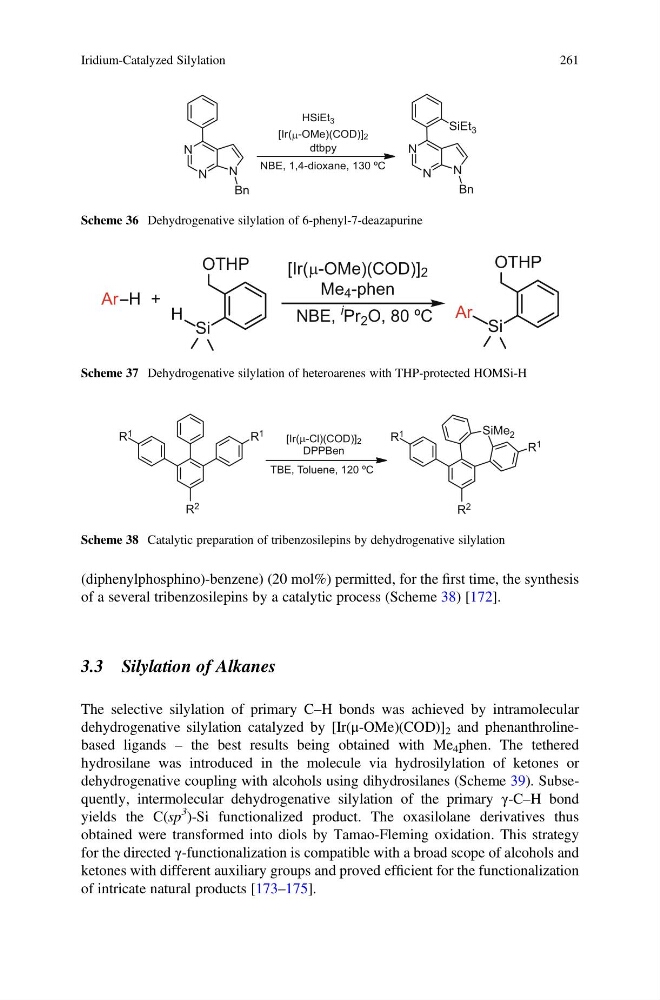
(diphenylphosphino)-benzene) (20 mol%) permitted, for the first time, the synthesis
of a several tribenzosilepins by a catalytic process (Scheme 38) [172].
3.3 Silylation of Alkanes
The selective silylation of primary C–H bonds was achieved by intramolecular
dehydrogenative silylation catalyzed by [Ir(μ-OMe)(COD)] 2 and phenanthrolinebased ligands – the best results being obtained with Me 4 phen. The tethered
hydrosilane was introduced in the molecule via hydrosilylation of ketones or
dehydrogenative coupling with alcohols using dihydrosilanes (Scheme 39). Subsequently, intermolecular dehydrogenative silylation of the primary γ-C–H bond
yields the C(sp
3 )-Si functionalized product. The oxasilolane derivatives thus
obtained were transformed into diols by Tamao-Fleming oxidation. This strategy
for the directed γ-functionalization is compatible with a broad scope of alcohols and
ketones with different auxiliary groups and proved efficient for the functionalization
of intricate natural products [173–175].
[Ir(µ-OMe)(COD)] 2
dtbpy
NBE, 1,4-dioxane, 130 ºC
N
N
N
Bn
N
N
N
Bn
HSiEt 3
SiEt 3
Scheme 36 Dehydrogenative silylation of 6-phenyl-7-deazapurine
[Ir(µ-OMe)(COD)] 2
Me 4 -phen
NBE,
i
Pr 2 O, 80 ºC
Ar H
OTHP
Si
H
+
OTHP
Si
Ar
Scheme 37 Dehydrogenative silylation of heteroarenes with THP-protected HOMSi-H
[Ir(µ-Cl)(COD)] 2
DPPBen
TBE, Toluene, 120 ºC
R 1
R 1
R 2
R 1
R 1
R 2
SiMe 2
Scheme 38 Catalytic preparation of tribenzosilepins by dehydrogenative silylation
Iridium-Catalyzed Silylation
261
of a several tribenzosilepins by a catalytic process (Scheme 38) [172].
3.3 Silylation of Alkanes
The selective silylation of primary C–H bonds was achieved by intramolecular
dehydrogenative silylation catalyzed by [Ir(μ-OMe)(COD)] 2 and phenanthrolinebased ligands – the best results being obtained with Me 4 phen. The tethered
hydrosilane was introduced in the molecule via hydrosilylation of ketones or
dehydrogenative coupling with alcohols using dihydrosilanes (Scheme 39). Subsequently, intermolecular dehydrogenative silylation of the primary γ-C–H bond
yields the C(sp
3 )-Si functionalized product. The oxasilolane derivatives thus
obtained were transformed into diols by Tamao-Fleming oxidation. This strategy
for the directed γ-functionalization is compatible with a broad scope of alcohols and
ketones with different auxiliary groups and proved efficient for the functionalization
of intricate natural products [173–175].
[Ir(µ-OMe)(COD)] 2
dtbpy
NBE, 1,4-dioxane, 130 ºC
N
N
N
Bn
N
N
N
Bn
HSiEt 3
SiEt 3
Scheme 36 Dehydrogenative silylation of 6-phenyl-7-deazapurine
[Ir(µ-OMe)(COD)] 2
Me 4 -phen
NBE,
i
Pr 2 O, 80 ºC
Ar H
OTHP
Si
H
+
OTHP
Si
Ar
Scheme 37 Dehydrogenative silylation of heteroarenes with THP-protected HOMSi-H
[Ir(µ-Cl)(COD)] 2
DPPBen
TBE, Toluene, 120 ºC
R 1
R 1
R 2
R 1
R 1
R 2
SiMe 2
Scheme 38 Catalytic preparation of tribenzosilepins by dehydrogenative silylation
Iridium-Catalyzed Silylation
261