

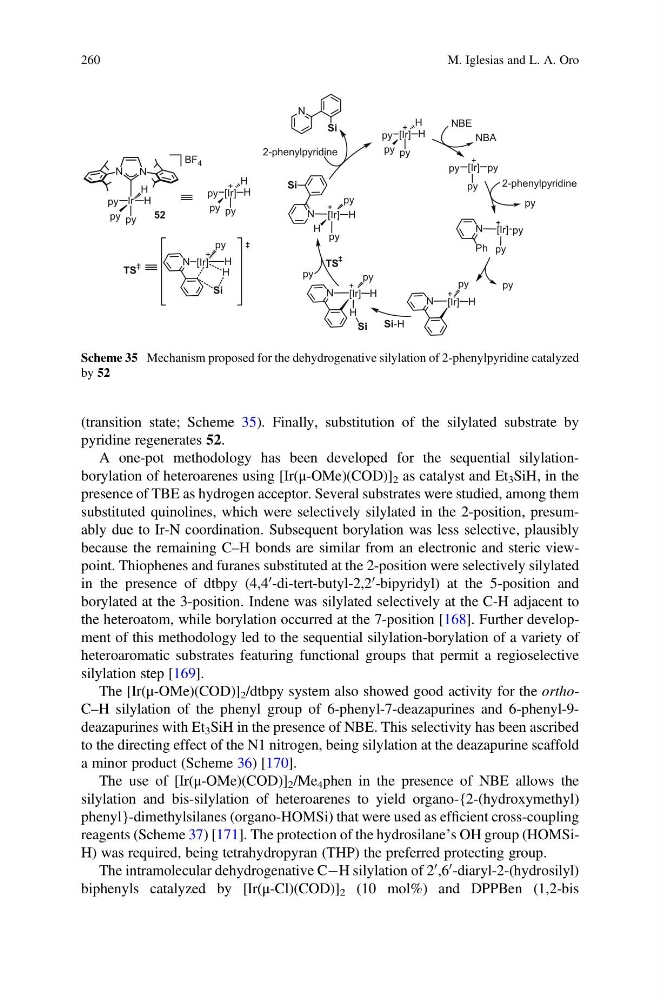
(transition state; Scheme 35). Finally, substitution of the silylated substrate by
pyridine regenerates 52.
A one-pot methodology has been developed for the sequential silylationborylation of heteroarenes using [Ir(μ-OMe)(COD)] 2 as catalyst and Et 3 SiH, in the
presence of TBE as hydrogen acceptor. Several substrates were studied, among them
substituted quinolines, which were selectively silylated in the 2-position, presumably due to Ir-N coordination. Subsequent borylation was less selective, plausibly
because the remaining C–H bonds are similar from an electronic and steric viewpoint. Thiophenes and furanes substituted at the 2-position were selectively silylated
in the presence of dtbpy (4,4
0 -di-tert-butyl-2,2
0 -bipyridyl) at the 5-position and
borylated at the 3-position. Indene was silylated selectively at the C-H adjacent to
the heteroatom, while borylation occurred at the 7-position [168]. Further development of this methodology led to the sequential silylation-borylation of a variety of
heteroaromatic substrates featuring functional groups that permit a regioselective
silylation step [169].
The [Ir(μ-OMe)(COD)] 2 /dtbpy system also showed good activity for the orthoC–H silylation of the phenyl group of 6-phenyl-7-deazapurines and 6-phenyl-9deazapurines with Et 3 SiH in the presence of NBE. This selectivity has been ascribed
to the directing effect of the N1 nitrogen, being silylation at the deazapurine scaffold
a minor product (Scheme 36) [170].
The use of [Ir(μ-OMe)(COD)] 2 /Me 4 phen in the presence of NBE allows the
silylation and bis-silylation of heteroarenes to yield organo-{2-(hydroxymethyl)
phenyl}-dimethylsilanes (organo-HOMSi) that were used as efficient cross-coupling
reagents (Scheme 37) [171]. The protection of the hydrosilane’s OH group (HOMSiH) was required, being tetrahydropyran (THP) the preferred protecting group.
The intramolecular dehydrogenative CÀH silylation of 2
0 ,6
0 -diaryl-2-(hydrosilyl)
biphenyls catalyzed by [Ir(μ-Cl)(COD)] 2 (10 mol%) and DPPBen (1,2-bis
Si-H
N
Si
NBE
NBA
TS
2-phenylpyridine
N
N
Ir
py
H
BF 4
H
py py
52
[Ir]
py
H
H
py py
[Ir]
py
H
H
py py
[Ir]
py
py
py
2-phenylpyridine
[Ir] py
py
N
py
Ph
[Ir]
py
N
H
py
TS
H
Si
[Ir]
py
N
H
py
[Ir]
py
N
H
H
Si
[Ir]
py
N
H
Si
H
py
Scheme 35 Mechanism proposed for the dehydrogenative silylation of 2-phenylpyridine catalyzed
by 52
260
M. Iglesias and L. A. Oro
pyridine regenerates 52.
A one-pot methodology has been developed for the sequential silylationborylation of heteroarenes using [Ir(μ-OMe)(COD)] 2 as catalyst and Et 3 SiH, in the
presence of TBE as hydrogen acceptor. Several substrates were studied, among them
substituted quinolines, which were selectively silylated in the 2-position, presumably due to Ir-N coordination. Subsequent borylation was less selective, plausibly
because the remaining C–H bonds are similar from an electronic and steric viewpoint. Thiophenes and furanes substituted at the 2-position were selectively silylated
in the presence of dtbpy (4,4
0 -di-tert-butyl-2,2
0 -bipyridyl) at the 5-position and
borylated at the 3-position. Indene was silylated selectively at the C-H adjacent to
the heteroatom, while borylation occurred at the 7-position [168]. Further development of this methodology led to the sequential silylation-borylation of a variety of
heteroaromatic substrates featuring functional groups that permit a regioselective
silylation step [169].
The [Ir(μ-OMe)(COD)] 2 /dtbpy system also showed good activity for the orthoC–H silylation of the phenyl group of 6-phenyl-7-deazapurines and 6-phenyl-9deazapurines with Et 3 SiH in the presence of NBE. This selectivity has been ascribed
to the directing effect of the N1 nitrogen, being silylation at the deazapurine scaffold
a minor product (Scheme 36) [170].
The use of [Ir(μ-OMe)(COD)] 2 /Me 4 phen in the presence of NBE allows the
silylation and bis-silylation of heteroarenes to yield organo-{2-(hydroxymethyl)
phenyl}-dimethylsilanes (organo-HOMSi) that were used as efficient cross-coupling
reagents (Scheme 37) [171]. The protection of the hydrosilane’s OH group (HOMSiH) was required, being tetrahydropyran (THP) the preferred protecting group.
The intramolecular dehydrogenative CÀH silylation of 2
0 ,6
0 -diaryl-2-(hydrosilyl)
biphenyls catalyzed by [Ir(μ-Cl)(COD)] 2 (10 mol%) and DPPBen (1,2-bis
Si-H
N
Si
NBE
NBA
TS
2-phenylpyridine
N
N
Ir
py
H
BF 4
H
py py
52
[Ir]
py
H
H
py py
[Ir]
py
H
H
py py
[Ir]
py
py
py
2-phenylpyridine
[Ir] py
py
N
py
Ph
[Ir]
py
N
H
py
TS
H
Si
[Ir]
py
N
H
py
[Ir]
py
N
H
H
Si
[Ir]
py
N
H
Si
H
py
Scheme 35 Mechanism proposed for the dehydrogenative silylation of 2-phenylpyridine catalyzed
by 52
260
M. Iglesias and L. A. Oro