

(COD)] 2 (2 mol%) as catalyst precursor, 20 mol% DIPEA (diisopropylethylamine)
as additive, and 2 equivalents of TBE as hydrogen acceptor. Several nitrogen-based
directing groups (imines, hydrazone, oxazoline, pyridine, N,N-dimethylamine, and
oxime ether) proved efficient to give the corresponding monosubstituted
organosilane in hexane at 80
C [162].
The use of [Ir(μ-OMe)(COD)] 2 (5 mol%) as catalyst precursor with
phenanthroline-derived ligands also proved efficient for the silylation of polycyclic
aromatic molecules (2 equivalents) with Et 3 SiH and 3,3-dimethyl-1-butene as
hydrogen acceptor at 100
C in dioxane. The regioselectivity of the process was
sterically and electronically controlled, leading to a variety of selectively mono- and
di-silylated polyaromatic compounds based on naphthalene, phenanthrene, anthracene, pyrene, and azulene scaffolds, with a divergent chemo- and regioselectivity
when compared to that expected for electrophilic functionalization [163, 164].
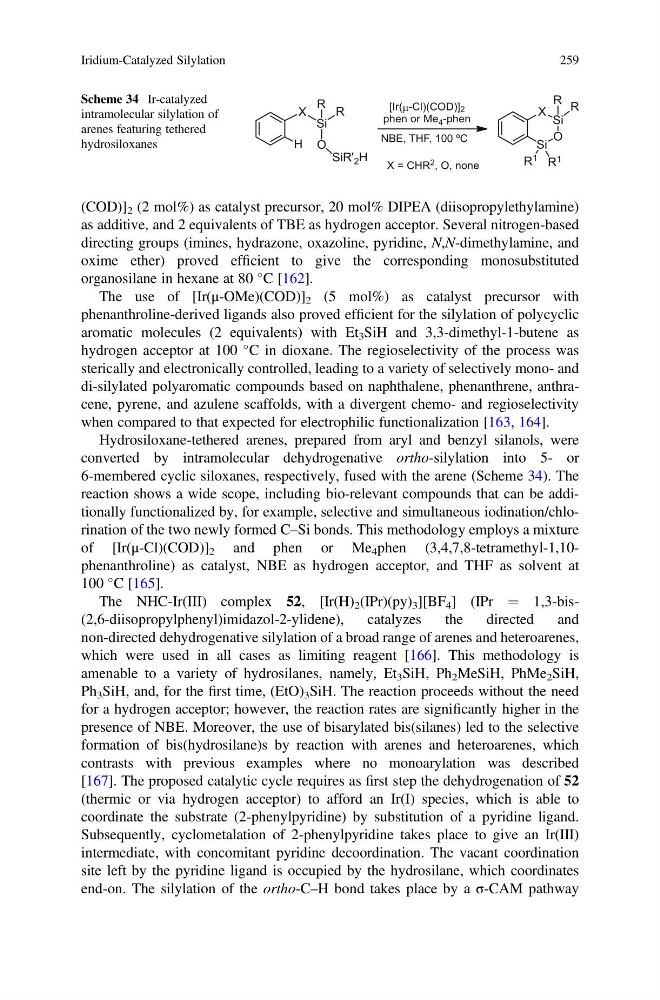
Hydrosiloxane-tethered arenes, prepared from aryl and benzyl silanols, were
converted by intramolecular dehydrogenative ortho-silylation into 5- or
6-membered cyclic siloxanes, respectively, fused with the arene (Scheme 34). The
reaction shows a wide scope, including bio-relevant compounds that can be additionally functionalized by, for example, selective and simultaneous iodination/chlorination of the two newly formed C–Si bonds. This methodology employs a mixture
of [Ir(μ-Cl)(COD)] 2 and phen or Me 4 phen (3,4,7,8-tetramethyl-1,10phenanthroline) as catalyst, NBE as hydrogen acceptor, and THF as solvent at
100
C [165].
The NHC-Ir(III) complex 52, [Ir(H) 2 (IPr)(py) 3 ][BF 4 ] (IPr ¼ 1,3-bis(2,6-diisopropylphenyl)imidazol-2-ylidene),
catalyzes
the
directed
and
non-directed dehydrogenative silylation of a broad range of arenes and heteroarenes,
which were used in all cases as limiting reagent [166]. This methodology is
amenable to a variety of hydrosilanes, namely, Et 3 SiH, Ph 2 MeSiH, PhMe 2 SiH,
Ph 3 SiH, and, for the first time, (EtO) 3 SiH. The reaction proceeds without the need
for a hydrogen acceptor; however, the reaction rates are significantly higher in the
presence of NBE. Moreover, the use of bisarylated bis(silanes) led to the selective
formation of bis(hydrosilane)s by reaction with arenes and heteroarenes, which
contrasts with previous examples where no monoarylation was described
[167]. The proposed catalytic cycle requires as first step the dehydrogenation of 52
(thermic or via hydrogen acceptor) to afford an Ir(I) species, which is able to
coordinate the substrate (2-phenylpyridine) by substitution of a pyridine ligand.
Subsequently, cyclometalation of 2-phenylpyridine takes place to give an Ir(III)
intermediate, with concomitant pyridine decoordination. The vacant coordination
site left by the pyridine ligand is occupied by the hydrosilane, which coordinates
end-on. The silylation of the ortho-C–H bond takes place by a σ-CAM pathway
[Ir(µ-Cl)(COD)] 2
phen or Me 4 -phen
NBE, THF, 100 ºC
X
Si
R
O
R
H
X = CHR 2 , O, none
SiR' 2 H
Si
O
Si
X
R
R
R 1 R 1
Scheme 34 Ir-catalyzed
intramolecular silylation of
arenes featuring tethered
hydrosiloxanes
Iridium-Catalyzed Silylation
259
as additive, and 2 equivalents of TBE as hydrogen acceptor. Several nitrogen-based
directing groups (imines, hydrazone, oxazoline, pyridine, N,N-dimethylamine, and
oxime ether) proved efficient to give the corresponding monosubstituted
organosilane in hexane at 80
C [162].
The use of [Ir(μ-OMe)(COD)] 2 (5 mol%) as catalyst precursor with
phenanthroline-derived ligands also proved efficient for the silylation of polycyclic
aromatic molecules (2 equivalents) with Et 3 SiH and 3,3-dimethyl-1-butene as
hydrogen acceptor at 100
C in dioxane. The regioselectivity of the process was
sterically and electronically controlled, leading to a variety of selectively mono- and
di-silylated polyaromatic compounds based on naphthalene, phenanthrene, anthracene, pyrene, and azulene scaffolds, with a divergent chemo- and regioselectivity
when compared to that expected for electrophilic functionalization [163, 164].
Hydrosiloxane-tethered arenes, prepared from aryl and benzyl silanols, were
converted by intramolecular dehydrogenative ortho-silylation into 5- or
6-membered cyclic siloxanes, respectively, fused with the arene (Scheme 34). The
reaction shows a wide scope, including bio-relevant compounds that can be additionally functionalized by, for example, selective and simultaneous iodination/chlorination of the two newly formed C–Si bonds. This methodology employs a mixture
of [Ir(μ-Cl)(COD)] 2 and phen or Me 4 phen (3,4,7,8-tetramethyl-1,10phenanthroline) as catalyst, NBE as hydrogen acceptor, and THF as solvent at
100
C [165].
The NHC-Ir(III) complex 52, [Ir(H) 2 (IPr)(py) 3 ][BF 4 ] (IPr ¼ 1,3-bis(2,6-diisopropylphenyl)imidazol-2-ylidene),
catalyzes
the
directed
and
non-directed dehydrogenative silylation of a broad range of arenes and heteroarenes,
which were used in all cases as limiting reagent [166]. This methodology is
amenable to a variety of hydrosilanes, namely, Et 3 SiH, Ph 2 MeSiH, PhMe 2 SiH,
Ph 3 SiH, and, for the first time, (EtO) 3 SiH. The reaction proceeds without the need
for a hydrogen acceptor; however, the reaction rates are significantly higher in the
presence of NBE. Moreover, the use of bisarylated bis(silanes) led to the selective
formation of bis(hydrosilane)s by reaction with arenes and heteroarenes, which
contrasts with previous examples where no monoarylation was described
[167]. The proposed catalytic cycle requires as first step the dehydrogenation of 52
(thermic or via hydrogen acceptor) to afford an Ir(I) species, which is able to
coordinate the substrate (2-phenylpyridine) by substitution of a pyridine ligand.
Subsequently, cyclometalation of 2-phenylpyridine takes place to give an Ir(III)
intermediate, with concomitant pyridine decoordination. The vacant coordination
site left by the pyridine ligand is occupied by the hydrosilane, which coordinates
end-on. The silylation of the ortho-C–H bond takes place by a σ-CAM pathway
[Ir(µ-Cl)(COD)] 2
phen or Me 4 -phen
NBE, THF, 100 ºC
X
Si
R
O
R
H
X = CHR 2 , O, none
SiR' 2 H
Si
O
Si
X
R
R
R 1 R 1
Scheme 34 Ir-catalyzed
intramolecular silylation of
arenes featuring tethered
hydrosiloxanes
Iridium-Catalyzed Silylation
259