

acids under CO 2 (1 atm). The silylation of 2-alkylpyridines (R ¼ Et,
i Pr) was also
accomplished, although yields below 34% were obtained [180].
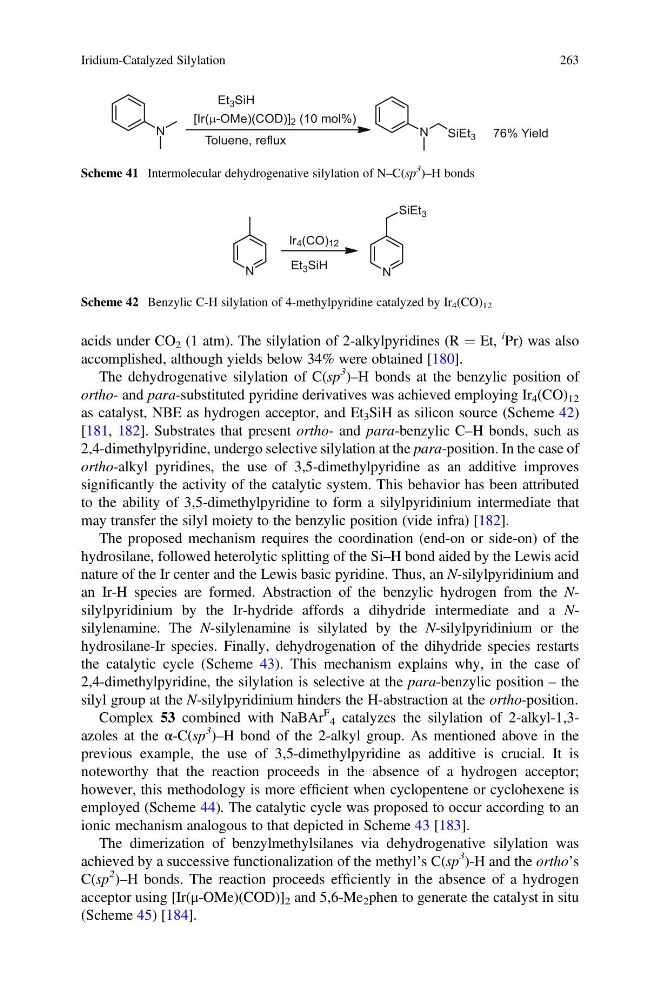
The dehydrogenative silylation of C(sp
3 )–H bonds at the benzylic position of
ortho- and para-substituted pyridine derivatives was achieved employing Ir 4 (CO) 12
as catalyst, NBE as hydrogen acceptor, and Et 3 SiH as silicon source (Scheme 42)
[181, 182]. Substrates that present ortho- and para-benzylic C–H bonds, such as
2,4-dimethylpyridine, undergo selective silylation at the para-position. In the case of
ortho-alkyl pyridines, the use of 3,5-dimethylpyridine as an additive improves
significantly the activity of the catalytic system. This behavior has been attributed
to the ability of 3,5-dimethylpyridine to form a silylpyridinium intermediate that
may transfer the silyl moiety to the benzylic position (vide infra) [182].
The proposed mechanism requires the coordination (end-on or side-on) of the
hydrosilane, followed heterolytic splitting of the Si–H bond aided by the Lewis acid
nature of the Ir center and the Lewis basic pyridine. Thus, an N-silylpyridinium and
an Ir-H species are formed. Abstraction of the benzylic hydrogen from the Nsilylpyridinium by the Ir-hydride affords a dihydride intermediate and a Nsilylenamine. The N-silylenamine is silylated by the N-silylpyridinium or the
hydrosilane-Ir species. Finally, dehydrogenation of the dihydride species restarts
the catalytic cycle (Scheme 43). This mechanism explains why, in the case of
2,4-dimethylpyridine, the silylation is selective at the para-benzylic position – the
silyl group at the N-silylpyridinium hinders the H-abstraction at the ortho-position.
Complex 53 combined with NaBAr
F
4 catalyzes the silylation of 2-alkyl-1,3azoles at the α-C(sp
3 )–H bond of the 2-alkyl group. As mentioned above in the
previous example, the use of 3,5-dimethylpyridine as additive is crucial. It is
noteworthy that the reaction proceeds in the absence of a hydrogen acceptor;
however, this methodology is more efficient when cyclopentene or cyclohexene is
employed (Scheme 44). The catalytic cycle was proposed to occur according to an
ionic mechanism analogous to that depicted in Scheme 43 [183].
The dimerization of benzylmethylsilanes via dehydrogenative silylation was
achieved by a successive functionalization of the methyl’s C(sp
3 )-H and the ortho’s
C(sp
2 )–H bonds. The reaction proceeds efficiently in the absence of a hydrogen
acceptor using [Ir(μ-OMe)(COD)] 2 and 5,6-Me 2 phen to generate the catalyst in situ
(Scheme 45) [184].
[Ir(µ-OMe)(COD)] 2 (10 mol%)
Toluene, reflux
Et 3 SiH
N
N
SiEt 3 76% Yield
Scheme 41 Intermolecular dehydrogenative silylation of N–C(sp
3
)–H bonds
Ir 4 (CO) 12
Et 3 SiH
N
N
SiEt 3
Scheme 42 Benzylic C-H silylation of 4-methylpyridine catalyzed by Ir 4 (CO) 12
Iridium-Catalyzed Silylation
263
i Pr) was also
accomplished, although yields below 34% were obtained [180].
The dehydrogenative silylation of C(sp
3 )–H bonds at the benzylic position of
ortho- and para-substituted pyridine derivatives was achieved employing Ir 4 (CO) 12
as catalyst, NBE as hydrogen acceptor, and Et 3 SiH as silicon source (Scheme 42)
[181, 182]. Substrates that present ortho- and para-benzylic C–H bonds, such as
2,4-dimethylpyridine, undergo selective silylation at the para-position. In the case of
ortho-alkyl pyridines, the use of 3,5-dimethylpyridine as an additive improves
significantly the activity of the catalytic system. This behavior has been attributed
to the ability of 3,5-dimethylpyridine to form a silylpyridinium intermediate that
may transfer the silyl moiety to the benzylic position (vide infra) [182].
The proposed mechanism requires the coordination (end-on or side-on) of the
hydrosilane, followed heterolytic splitting of the Si–H bond aided by the Lewis acid
nature of the Ir center and the Lewis basic pyridine. Thus, an N-silylpyridinium and
an Ir-H species are formed. Abstraction of the benzylic hydrogen from the Nsilylpyridinium by the Ir-hydride affords a dihydride intermediate and a Nsilylenamine. The N-silylenamine is silylated by the N-silylpyridinium or the
hydrosilane-Ir species. Finally, dehydrogenation of the dihydride species restarts
the catalytic cycle (Scheme 43). This mechanism explains why, in the case of
2,4-dimethylpyridine, the silylation is selective at the para-benzylic position – the
silyl group at the N-silylpyridinium hinders the H-abstraction at the ortho-position.
Complex 53 combined with NaBAr
F
4 catalyzes the silylation of 2-alkyl-1,3azoles at the α-C(sp
3 )–H bond of the 2-alkyl group. As mentioned above in the
previous example, the use of 3,5-dimethylpyridine as additive is crucial. It is
noteworthy that the reaction proceeds in the absence of a hydrogen acceptor;
however, this methodology is more efficient when cyclopentene or cyclohexene is
employed (Scheme 44). The catalytic cycle was proposed to occur according to an
ionic mechanism analogous to that depicted in Scheme 43 [183].
The dimerization of benzylmethylsilanes via dehydrogenative silylation was
achieved by a successive functionalization of the methyl’s C(sp
3 )-H and the ortho’s
C(sp
2 )–H bonds. The reaction proceeds efficiently in the absence of a hydrogen
acceptor using [Ir(μ-OMe)(COD)] 2 and 5,6-Me 2 phen to generate the catalyst in situ
(Scheme 45) [184].
[Ir(µ-OMe)(COD)] 2 (10 mol%)
Toluene, reflux
Et 3 SiH
N
N
SiEt 3 76% Yield
Scheme 41 Intermolecular dehydrogenative silylation of N–C(sp
3
)–H bonds
Ir 4 (CO) 12
Et 3 SiH
N
N
SiEt 3
Scheme 42 Benzylic C-H silylation of 4-methylpyridine catalyzed by Ir 4 (CO) 12
Iridium-Catalyzed Silylation
263