

presence of NBE (1.2 equivalents). This reaction can be performed in the absence of
a hydrogen acceptor using [Ir(μ-OMe)(COD)] 2 /dtbpy as catalyst; however, somewhat lower yields were obtained. It is noteworthy that, in this work, the
benzoxasilole derivatives were prepared by a one-pot procedure and functionalized
successively by Hiyama coupling and Tamao-Fleming oxidation [152].
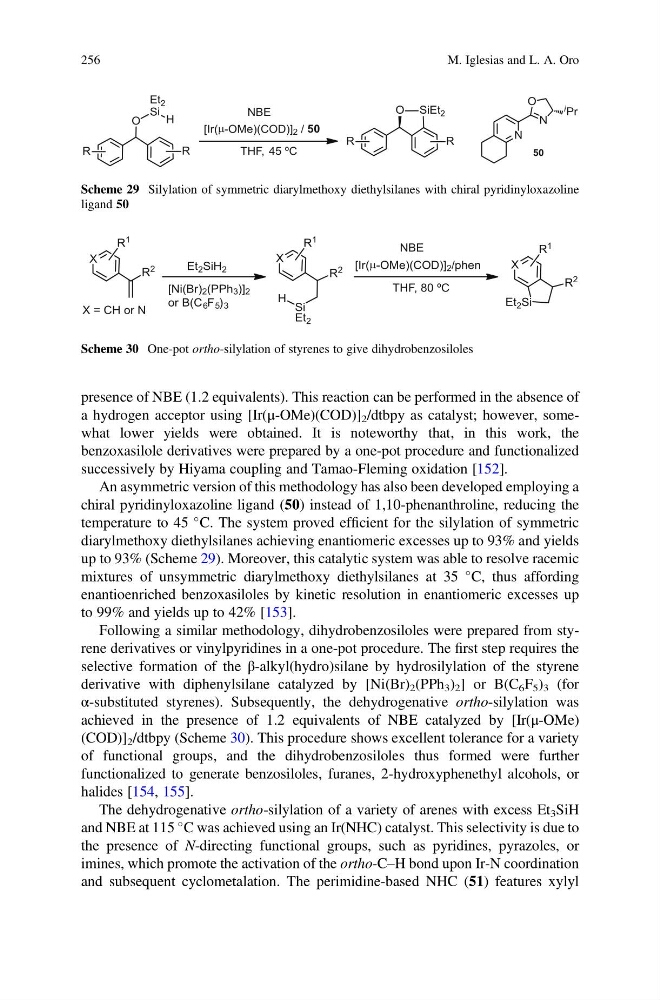
An asymmetric version of this methodology has also been developed employing a
chiral pyridinyloxazoline ligand (50) instead of 1,10-phenanthroline, reducing the
temperature to 45
C. The system proved efficient for the silylation of symmetric
diarylmethoxy diethylsilanes achieving enantiomeric excesses up to 93% and yields
up to 93% (Scheme 29). Moreover, this catalytic system was able to resolve racemic
mixtures of unsymmetric diarylmethoxy diethylsilanes at 35
C, thus affording
enantioenriched benzoxasiloles by kinetic resolution in enantiomeric excesses up
to 99% and yields up to 42% [153].
Following a similar methodology, dihydrobenzosiloles were prepared from styrene derivatives or vinylpyridines in a one-pot procedure. The first step requires the
selective formation of the β-alkyl(hydro)silane by hydrosilylation of the styrene
derivative with diphenylsilane catalyzed by [Ni(Br) 2 (PPh 3 ) 2 ] or B(C 6 F 5 ) 3 (for
α-substituted styrenes). Subsequently, the dehydrogenative ortho-silylation was
achieved in the presence of 1.2 equivalents of NBE catalyzed by [Ir(μ-OMe)
(COD)] 2 /dtbpy (Scheme 30). This procedure shows excellent tolerance for a variety
of functional groups, and the dihydrobenzosiloles thus formed were further
functionalized to generate benzosiloles, furanes, 2-hydroxyphenethyl alcohols, or
halides [154, 155].
The dehydrogenative ortho-silylation of a variety of arenes with excess Et 3 SiH
and NBE at 115
C was achieved using an Ir(NHC) catalyst. This selectivity is due to
the presence of N-directing functional groups, such as pyridines, pyrazoles, or
imines, which promote the activation of the ortho-C–H bond upon Ir-N coordination
and subsequent cyclometalation. The perimidine-based NHC (51) features xylyl
O
R
Et 2
Si H
[Ir(µ-OMe)(COD)] 2 / 50
NBE
THF, 45 ºC
50
N
N
O
i Pr
R
O
R
SiEt 2
R
Scheme 29 Silylation of symmetric diarylmethoxy diethylsilanes with chiral pyridinyloxazoline
ligand 50
R
2
[Ni(Br) 2 (PPh 3 )] 2
or B(C 6 F 5 ) 3
X
R
2
X
Si
Et 2
H
R
2
X
Et 2 Si
Et 2 SiH 2
[Ir(µ-OMe)(COD)] 2 /phen
NBE
THF, 80 ºC
X = CH or N
R
1
R
1
R
1
Scheme 30 One-pot ortho-silylation of styrenes to give dihydrobenzosiloles
256
M. Iglesias and L. A. Oro
a hydrogen acceptor using [Ir(μ-OMe)(COD)] 2 /dtbpy as catalyst; however, somewhat lower yields were obtained. It is noteworthy that, in this work, the
benzoxasilole derivatives were prepared by a one-pot procedure and functionalized
successively by Hiyama coupling and Tamao-Fleming oxidation [152].
An asymmetric version of this methodology has also been developed employing a
chiral pyridinyloxazoline ligand (50) instead of 1,10-phenanthroline, reducing the
temperature to 45
C. The system proved efficient for the silylation of symmetric
diarylmethoxy diethylsilanes achieving enantiomeric excesses up to 93% and yields
up to 93% (Scheme 29). Moreover, this catalytic system was able to resolve racemic
mixtures of unsymmetric diarylmethoxy diethylsilanes at 35
C, thus affording
enantioenriched benzoxasiloles by kinetic resolution in enantiomeric excesses up
to 99% and yields up to 42% [153].
Following a similar methodology, dihydrobenzosiloles were prepared from styrene derivatives or vinylpyridines in a one-pot procedure. The first step requires the
selective formation of the β-alkyl(hydro)silane by hydrosilylation of the styrene
derivative with diphenylsilane catalyzed by [Ni(Br) 2 (PPh 3 ) 2 ] or B(C 6 F 5 ) 3 (for
α-substituted styrenes). Subsequently, the dehydrogenative ortho-silylation was
achieved in the presence of 1.2 equivalents of NBE catalyzed by [Ir(μ-OMe)
(COD)] 2 /dtbpy (Scheme 30). This procedure shows excellent tolerance for a variety
of functional groups, and the dihydrobenzosiloles thus formed were further
functionalized to generate benzosiloles, furanes, 2-hydroxyphenethyl alcohols, or
halides [154, 155].
The dehydrogenative ortho-silylation of a variety of arenes with excess Et 3 SiH
and NBE at 115
C was achieved using an Ir(NHC) catalyst. This selectivity is due to
the presence of N-directing functional groups, such as pyridines, pyrazoles, or
imines, which promote the activation of the ortho-C–H bond upon Ir-N coordination
and subsequent cyclometalation. The perimidine-based NHC (51) features xylyl
O
R
Et 2
Si H
[Ir(µ-OMe)(COD)] 2 / 50
NBE
THF, 45 ºC
50
N
N
O
i Pr
R
O
R
SiEt 2
R
Scheme 29 Silylation of symmetric diarylmethoxy diethylsilanes with chiral pyridinyloxazoline
ligand 50
R
2
[Ni(Br) 2 (PPh 3 )] 2
or B(C 6 F 5 ) 3
X
R
2
X
Si
Et 2
H
R
2
X
Et 2 Si
Et 2 SiH 2
[Ir(µ-OMe)(COD)] 2 /phen
NBE
THF, 80 ºC
X = CH or N
R
1
R
1
R
1
Scheme 30 One-pot ortho-silylation of styrenes to give dihydrobenzosiloles
256
M. Iglesias and L. A. Oro